The history of Vision Eye Institute Chatswood
Vision Eye Institute Chatswood is a pioneering Australian refractive surgery practice. Its founding surgeons helped introduce laser vision correction to Australia in 1991 and established The Eye Institute in Chatswood in 1997. The practice has since introduced major advances in laser eye surgery and cataract care, bringing decades of experience to patients today.

Experience that informs your care
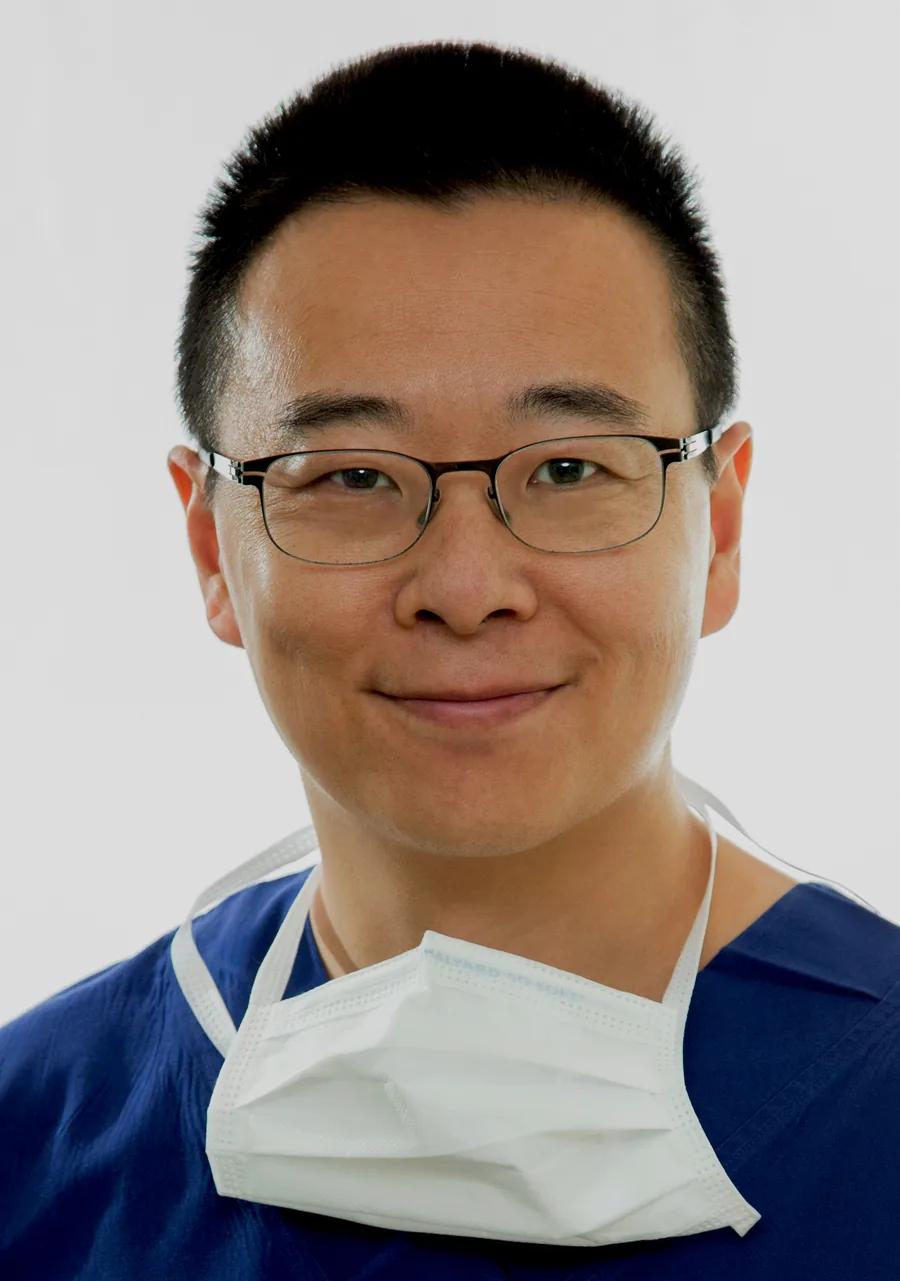
Dr Simon Chen is part of this experienced team of cataract, corneal, refractive and retinal specialists. For patients who need cataract surgery after previous laser vision correction, this brings together detailed corneal assessment, experience with complex lens calculations and expertise in the health of the whole eye.
Why does this history matter after laser eye surgery?
Laser vision correction changes the shape and focusing power of the cornea, the clear window at the front of the eye. Common treatments include laser-assisted in situ keratomileusis (LASIK), photorefractive keratectomy (PRK) and small incision lenticule extraction (SMILE). If you develop a cataract later in life, those changes need to be taken into account when choosing the power of your lens implant.
Our practice's experience spans the earliest excimer laser treatments through to modern LASIK and SMILE. Dr Michael Lawless and Dr Chris Rogers were already publishing research on cataract lens calculations after PRK in 1997. That work has continued through successive generations of measurements and calculation methods. That depth of experience helps guide the measurements, lens choices and planning for these more complex eyes.
How did the practice develop?
Introducing laser vision correction to Australia
Dr Chris Rogers, Dr Michael Lawless and Dr Peter Cohen brought Australia's first excimer laser to the Mater Hospital in North Sydney and performed the country's first PRK procedures. PRK uses a laser to reshape the surface of the cornea and reduce dependence on glasses.
Their early clinical study began in September 1991. They published the first Australian PRK series in 1992, followed by their one-year results in 1993, helping establish the evidence for this new treatment.
The first LASIK procedure in New South Wales
Dr Michael Lawless performed the first LASIK procedure in New South Wales in 1995. LASIK reshapes the cornea beneath a thin flap and became another major development in laser vision correction.
The Chatswood practice opens
Dr Chris Rogers, Dr Michael Lawless and Dr Gerard Sutton were the founding partners of The Eye Institute in Chatswood, now Vision Eye Institute Chatswood. The purpose-built practice brought corneal, cataract and refractive specialists together, with consulting rooms, laser treatment facilities and day surgery in one location.
Dr Michael Lawless is now an Associate Professor, and Dr Gerard Sutton is now a Professor. Their clinical work, research and teaching have helped shape the practice's long-standing focus on advancing eye care.
Alongside the opening of the practice, Dr Michael Lawless and Dr Chris Rogers co-authored a 1997 paper examining cataract lens calculations in eyes previously treated with PRK for high myopia. This early work addressed a challenge that remains central to cataract care after laser vision correction.
Australian firsts in femtosecond laser surgery
Dr Gerard Sutton performed Australia's first femtosecond laser LASIK procedure and its first femtosecond laser-assisted corneal transplant. Femtosecond lasers use extremely short pulses of light to make precise cuts in eye tissue, opening up new possibilities for corneal and cataract surgery.
Dedicated work on lens calculations after refractive surgery
Dr Colin Chan, Chris Hodge and Dr Michael Lawless published a paper on calculating lens implant power after corneal refractive surgery. It examined how previous laser treatment changes the measurements used to plan cataract surgery and the methods available to account for those changes.
Bringing laser cataract surgery to Australia
Dr Michael Lawless performed femtosecond laser cataract surgery in Budapest in February 2011, becoming the first Australian surgeon to perform the procedure. In April 2011, he performed Australia's first femtosecond laser cataract operation at Chatswood.
This technology allowed a laser to perform selected steps of cataract surgery, including creating the opening in the lens capsule and dividing the cataract before its removal.
A world first combining laser cataract and retinal surgery
Dr Simon Chen performed the world's first femtosecond laser-assisted cataract surgery combined with vitrectomy in July 2011. This brought laser cataract surgery and microsurgery at the back of the eye together in one operation.
Dr Chen and his colleagues published a series of these cases in Graefe's Archive for Clinical and Experimental Ophthalmology in 2012. For suitable patients with both a cataract and a retinal condition, combined surgery can address both problems during the same operation.
Sydney's first SMILE procedure
Dr Gerard Sutton performed Sydney's first SMILE laser vision correction procedure in 2014 at Chatswood. SMILE corrects vision by creating a small piece of tissue within the cornea and removing it through a small opening, without making a LASIK flap.
Sharing expertise in complex lens calculations
Dr Chris Hodge, Dr Michael Lawless, Dr Gerard Sutton and colleagues published a detailed review of lens calculations following laser refractive surgery. It brought together the challenges, calculation methods and published outcomes to help guide cataract planning in these eyes.
Introducing the Yamane technique into Dr Chen's practice
Dr Simon Chen began using the Yamane technique in his practice in 2016 for complex intraocular lens exchange surgery. This technique secures the replacement lens implant to the sclera—the strong white outer wall of the eye—when the eye's natural lens capsule cannot adequately support it.
Improving lens calculations after laser eye surgery
Dr Michael Lawless, Dr Gerard Sutton and their research colleagues published a study comparing cataract lens calculation methods in 72 eyes of 50 patients who had previously undergone laser refractive surgery.
The study examined how measurements of both the front and back surfaces of the cornea could help calculate lens implant power. This work is directly relevant to patients returning for cataract surgery years after laser vision correction.
The first SMILE pro procedure in Australia and New Zealand
Chatswood introduced the VISUMAX 800 laser in January 2022. Dr Michael Lawless subsequently performed the first SMILE pro procedure in Australia and New Zealand, continuing the practice's role in introducing new generations of laser vision correction.
How does our clinical research department support your care?
Our clinical research department is headed by Dr Chris Hodge, an orthoptist and clinical researcher with decades of experience in complex intraocular lens (IOL) calculations. An IOL is the artificial lens implanted during cataract surgery.
Dr Hodge works with the surgical team on the measurements and calculations that help guide lens selection, including eyes with previous laser surgery. His research and teaching in this field extend back more than two decades, and his publications include the 2006 paper and 2015 review described above.
Having this expertise within the practice helps bring research into day-to-day planning: checking measurements, comparing calculation methods and considering why predictions may differ in an individual eye.
How does this experience inform lens calculations today?
Careful cataract planning starts with understanding your previous treatment and measuring how your eye focuses light now. Dr Chen uses optical biometry and different methods of corneal mapping to cross-check the measurements used to select your lens implant.
The clinic's technology includes the IOLMaster 700, corneal topography and Scheimpflug tomography, which examines the front and back surfaces of the cornea. Specialised calculation methods, such as Barrett True-K, help account for the changes caused by previous laser surgery. The approach is tailored to your eye and the type of treatment you have had.
Bring your old prescription or laser treatment records if you have them. Modern calculation methods are also available when those records cannot be found. Even with careful planning, the final glasses prescription can be less predictable after previous laser surgery, and glasses or further treatment may still be needed.
Where does Dr Chen's retinal and complex lens experience fit?
Dr Chen's expertise spans cataract surgery and retinal surgery, including combined procedures, lens implant exchange and techniques for securing a lens implant when its normal support is inadequate.
This is particularly useful when cataract planning also needs to account for a retinal condition, previous retinal surgery or high myopia. Corneal, lens and retinal findings can all affect the choice of treatment and the vision you can expect afterwards.
Dr Chen has also published practical guidance on the Yamane technique, one method of securing a lens implant in an eye without adequate capsular support. His work complements the practice's corneal and refractive expertise, allowing complex problems at the front and back of the eye to be considered together.
What should I ask if I have had previous laser eye surgery?
- How does my previous laser treatment affect my cataract surgery and lens options?
- Which measurements and lens calculations are most suitable for my eye?
- Would my old prescription or treatment records help?
- What vision can I realistically expect, and when might I still need glasses?
Tell your surgeon about any previous LASIK, PRK, advanced surface laser ablation (ASLA), SMILE or radial keratotomy, even if it was many years ago. Our aim is to bring the practice's decades of experience to a clear, individual plan for your care.
Sources and further reading
- Lawless, Cohen and Rogers: first Australian PRK series, Medical Journal of Australia, 1992.
- Lawless, Rogers and Cohen: PRK, 12 months' follow-up, Medical Journal of Australia, 1993.
- mivision: The (R)evolution of Ophthalmology, founder interviews, June 2017.
- Vision Eye Institute: group twentieth anniversary, 2021.
- Hodge and colleagues: femtosecond cataract surgery and the experience from an initial installation, 2012.
- Bali, Hodge, Chen and Sutton: femtosecond laser-assisted cataract surgery in phacovitrectomy, 2012.
- Vision Eye Institute: Dr Simon Chen's professional profile.
- Lawless and colleagues: total keratometry in lens calculations after laser refractive surgery, 2020.
- Vision Eye Institute: ten years of SMILE in Sydney, September 2024.
- Vision Eye Institute: Michael Lawless's professional profile.
- CRST Europe: Pearls for the Yamane Technique, February 2020.
- Dr Simon Chen: surgical and diagnostic technology.
- Lens power calculation after corneal refractive surgery, 2022 review.
- Vision Eye Institute: Gerard Sutton's professional profile.
- Kalski, Danjoux, Fraenkel, Lawless and Rogers: lens calculations for cataract surgery after PRK for high myopia, 1997.
- Chan, Hodge and Lawless: calculation of intraocular lens power after corneal refractive surgery, 2006.
- Hodge and colleagues: intraocular lens power calculation following laser refractive surgery, 2015.
- University of Sydney: Chris Hodge’s academic curriculum vitae.
- Future Vision Foundation: Dr Chris Hodge’s clinical research role and qualifications.