Dr Simon ChenCataract & Retina Surgeon
Location
中文
For referrersRefer a patientRequest an appointment

Astigmatism and refractive errors

A refractive error means that light is not brought into clear focus on the retina. Astigmatism, short-sightedness, long-sightedness and age-related loss of near focus can occur alone or together.

What is astigmatism?

Astigmatism usually comes from the cornea, the clear window at the front of the eye, having a different curvature in one direction from another. The natural lens can also contribute. Light then fails to form one clear focus, causing blur or ghosting at near and distance.

It may cause squinting, eyestrain or difficulty with lights at night, although mild astigmatism may go unnoticed. An eye examination checks whether it explains your symptoms.

Regular and irregular astigmatism

Regular astigmatism follows a consistent pattern and can often be corrected well with glasses or toric lenses. Irregular astigmatism, for example from corneal scarring or keratoconus, needs a different assessment and may require specialised contact lenses or treatment of the cornea.

Can astigmatism be corrected during cataract surgery?

A toric implant can compensate for regular corneal astigmatism. Measurements establish its strength and orientation. The implant does not reshape the cornea, and it cannot reliably correct every irregularity.

Compare lens choices →
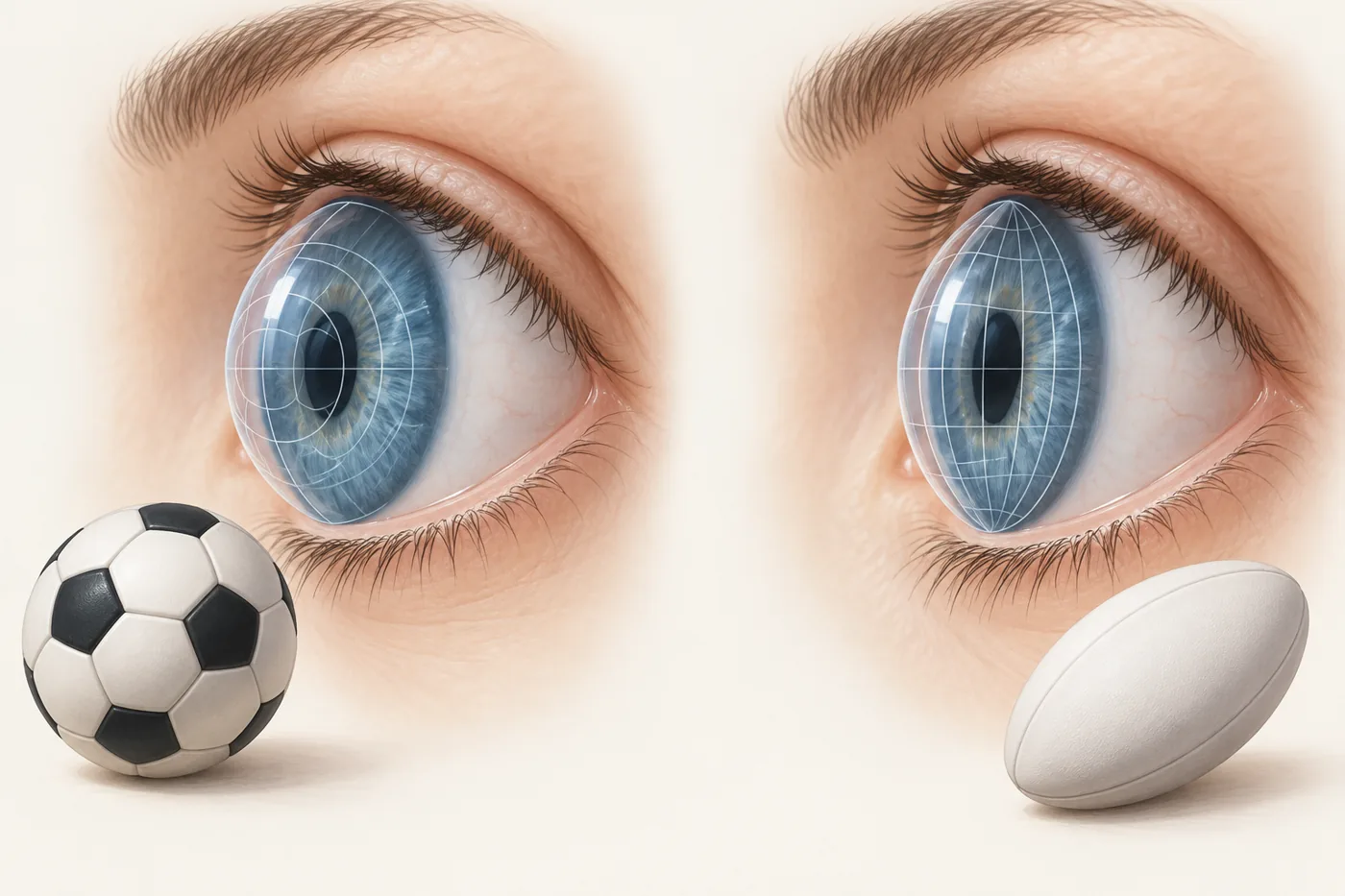
An evenly curved cornea beside a soccer ball, and a cornea slightly steeper in one direction beside a rugby ball.
Without astigmatism the cornea is evenly curved, like a soccer ball. With astigmatism it is steeper in one direction, more like a rugby ball. Illustration.

What is short-sightedness (myopia)?

With myopia, light focuses in front of the retina when the eye is relaxed. Often the eye is longer than average. Distant objects look blurred, while a nearer object may be clearer without glasses.

Strong myopia is more than a glasses prescription: a longer eye can have a higher risk of retinal problems. Correcting focus with laser or a lens implant does not remove that underlying risk. Retinal assessment is particularly important when considering lens exchange.

If you normally take off your glasses to read, tell Dr Chen. A distance target after cataract surgery can change this familiar ability, so the focusing plan deserves careful discussion.
What is long-sightedness (hyperopia)?

In a long-sighted eye, light would focus behind the retina without extra focusing effort. The eye is often shorter than average. A younger person may compensate using the natural lens, so a prescription can be present even when vision seems clear.

Reading may cause strain, and larger prescriptions can blur distance as well as near vision. As the lens loses flexibility with age, previously hidden long-sightedness can become more noticeable. Hyperopia is different from presbyopia, although both can make close work difficult.

What is presbyopia?

Presbyopia is the gradual loss of the natural lens’s ability to change focus as we age. It commonly becomes noticeable in the forties: small print needs more light, or you hold a phone farther away. It can affect people who already have myopia, hyperopia or astigmatism.

Reading glasses, multifocal spectacles or contact lenses can help. Selected surgical approaches extend the useful range or give the eyes different focusing targets. They do not recreate the flexible lens of a young eye, and each involves compromises.

Read about monovision and blended vision →

What do my glasses prescription and eye tests mean?

On a glasses prescription, “sphere” describes short- or long-sighted correction. “Cylinder” and “axis” describe the amount and direction of astigmatism correction; “add” is extra power for near tasks. A prescription describes focus, not the whole health of your eye.

Before lens surgery, measurements of eye length and corneal curvature guide implant power. Corneal mapping, assessment of the tear film and examination of the retina help distinguish a correctable focusing problem from eye disease.

How are refractive errors corrected?

Glasses and contact lenses are often sufficient. Corneal laser treatment reshapes the front surface of the eye; a phakic lens is an additional implant that leaves the natural lens in place. These are alternatives for selected eyes and require their own suitability assessment.

Cataract surgery replaces a cloudy lens. Refractive lens exchange uses a similar operation primarily to change focus before a visually significant cataract develops. The reasons to proceed, benefits and risks differ.

Dr Chen’s lens-surgery assessment considers your prescription, eye health and practical goals together. Surgery is optional when glasses or contact lenses meet your needs. A sudden change in vision should be examined rather than assumed to be a new prescription.

Common questions about refractive errors

Can I have astigmatism and another refractive error?

Yes. Astigmatism can accompany myopia or hyperopia, and presbyopia can develop on top of any of these. The treatment plan considers the combination.

Does a toric lens also correct my reading vision?

“Toric” describes correction for astigmatism. Reading range depends on the lens’s other optical features and the chosen focus. A toric lens may be monofocal, EDOF or multifocal.

Where can I read more?

Longer articles by Dr Chen go into these questions in more detail, including what the research shows.

How do I make an appointment with Dr Chen?

Appointments and enquiries through Vision Eye Institute, Chatswood.

Clinic appointments: (02) 9424 9999

Request an appointment with Dr Chen

How can we help?

Searches the English information on this website.

Dr Simon Chen practices at

Vision Eye Institute

Level 3, 270 Victoria Avenue
Chatswood NSW 2067
Call 02 9424 9999Get directions
Map showing Vision Eye Institute Chatswood at 270 Victoria AvenueOpen interactive Google Maps