Main strength
One chosen focus, with fewer optical side effects than multifocal designs.
 Dr Simon ChenCataract & Retina Surgeon
A monofocal intraocular lens gives the eye one main focusing distance. It is a well-established option for cataract surgery and refractive lens exchange, with a straightforward optical design.
Main strength
One chosen focus, with fewer optical side effects than multifocal designs.
Glasses
Usually needed outside the chosen distance; sometimes useful at that distance too.
Personal choice
The focus can favour distance or near. Astigmatism correction is considered separately.
The central optic is the clear part of the lens. The curved arms, called haptics, help support it inside the eye.
Compare lens designs and optional features. Surface details and tint are enhanced for illustration; actual lenses vary.
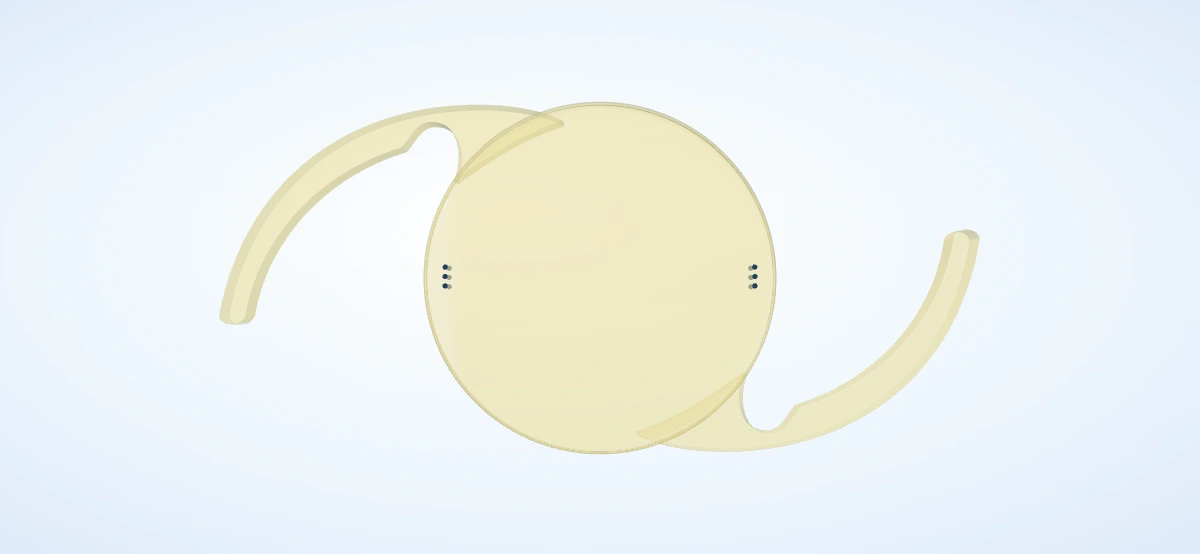
Many people choose distance focus in both eyes and use glasses for reading. This can suit someone who is comfortable wearing reading glasses and values distance vision for television, walking or driving.
Distance is not the only option. If you are short-sighted and usually remove your glasses to read, you may prefer to retain a nearer focus and wear glasses for distance. Tell Dr Chen about this habit before measurements are finalised. The intended result needs to fit how you use your eyes.
Unlike a multifocal lens, a conventional monofocal lens does not divide light between several distinct focusing distances. It generally produces fewer haloes and less loss of contrast than a multifocal design. It does not guarantee freedom from glare: the eye surface, cornea, retina and residual prescription all influence vision.
Monofocal lenses are often considered when retinal or other eye disease makes a more complex optical design less suitable. The implant cannot repair damage to the macula or optic nerve, so the expected benefit depends on the rest of the eye.
The explanation below describes this graphic. Drawing it requires JavaScript.
How sharply a monofocal lens holds focus as an object comes closer: clear at the distance it is set for, and steadily softer nearer than that. The shape is schematic and no figures are claimed for any particular lens.
A toric monofocal lens adds correction for regular corneal astigmatism. It still has one main focus. Its orientation inside the eye matters, and some residual astigmatism can remain.
Understand astigmatism →Monovision places one eye’s focus nearer than the other. A smaller difference, often called mini-monovision, may help with screens. Not everyone finds the balance comfortable.
Explore monovision and blended vision →Dr Chen uses monofocal, EDOF and multifocal lenses. The recommendation follows your eye health, measurements and priorities, rather than assuming that a wider range of focus is always better.
Bring examples of the tasks you want to improve: a computer screen, sheet music, close craft work or night driving. Ask which tasks are likely to need glasses and whether both eyes should have the same target. Lens-power calculations are estimates; the final prescription can differ from the aim.
It depends on the focusing target, screen distance and the other eye. With both eyes aimed at distance, computer glasses are often helpful. A nearer target or mini-monovision may improve that range, with different compromises.
No. A near target or monovision can provide useful unaided near vision. The choice changes what you can expect at distance, so it should be agreed before surgery.
Longer articles by Dr Chen go into these questions in more detail, including what the research shows.
Appointments and enquiries through Vision Eye Institute, Chatswood.
Clinic appointments: (02) 9424 9999