
Should cataract and retinal surgery be done together or separately?
Cataract and retinal surgery can often be performed together when an eye needs both treatments. Combining them can mean one anaesthetic, fewer separate appointments and a shorter overall period of treatment. For other patients, treating one problem first and reassessing the other is the better approach.

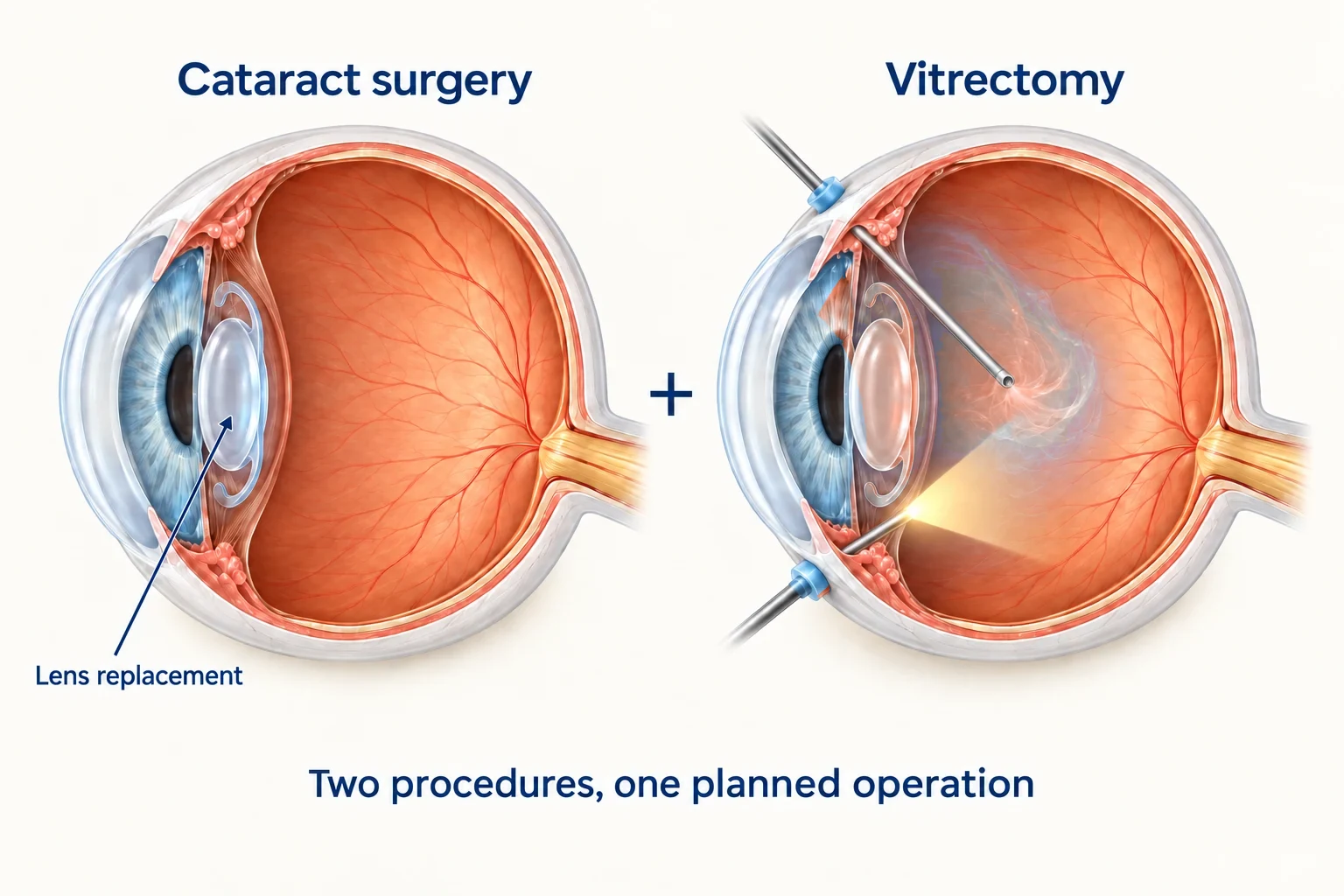
I consider combined surgery a particularly useful option for many patients who already have a cataract and also need surgery for an epiretinal membrane or troublesome floaters. The decision depends on what is affecting the vision, how the retina is likely to recover, and whether removing the natural lens is appropriate at that stage.
What is combined cataract and retinal surgery?
Combined surgery, also called phacovitrectomy, treats the lens and the back of the eye during the same operation.
The cataract part removes the cloudy natural lens and replaces it with a clear artificial lens, called an intraocular lens or IOL. The vitrectomy part removes the vitreous, the clear gel inside the back of the eye. This allows the surgeon to treat a retinal problem, such as peeling an epiretinal membrane or repairing a macular hole. For patients with troublesome floaters, the aim is to remove the opacities within the gel.
The cataract and retinal parts address different causes of poor vision. Removing a cataract can improve clarity, but it does not remove a membrane or repair damage to the retina.
Who might benefit from having both operations together?
Combined surgery is worth considering when both the cataract and the vitreous or retinal problem are contributing to symptoms, or when cataract progression is likely to interfere with recovery after vitrectomy.
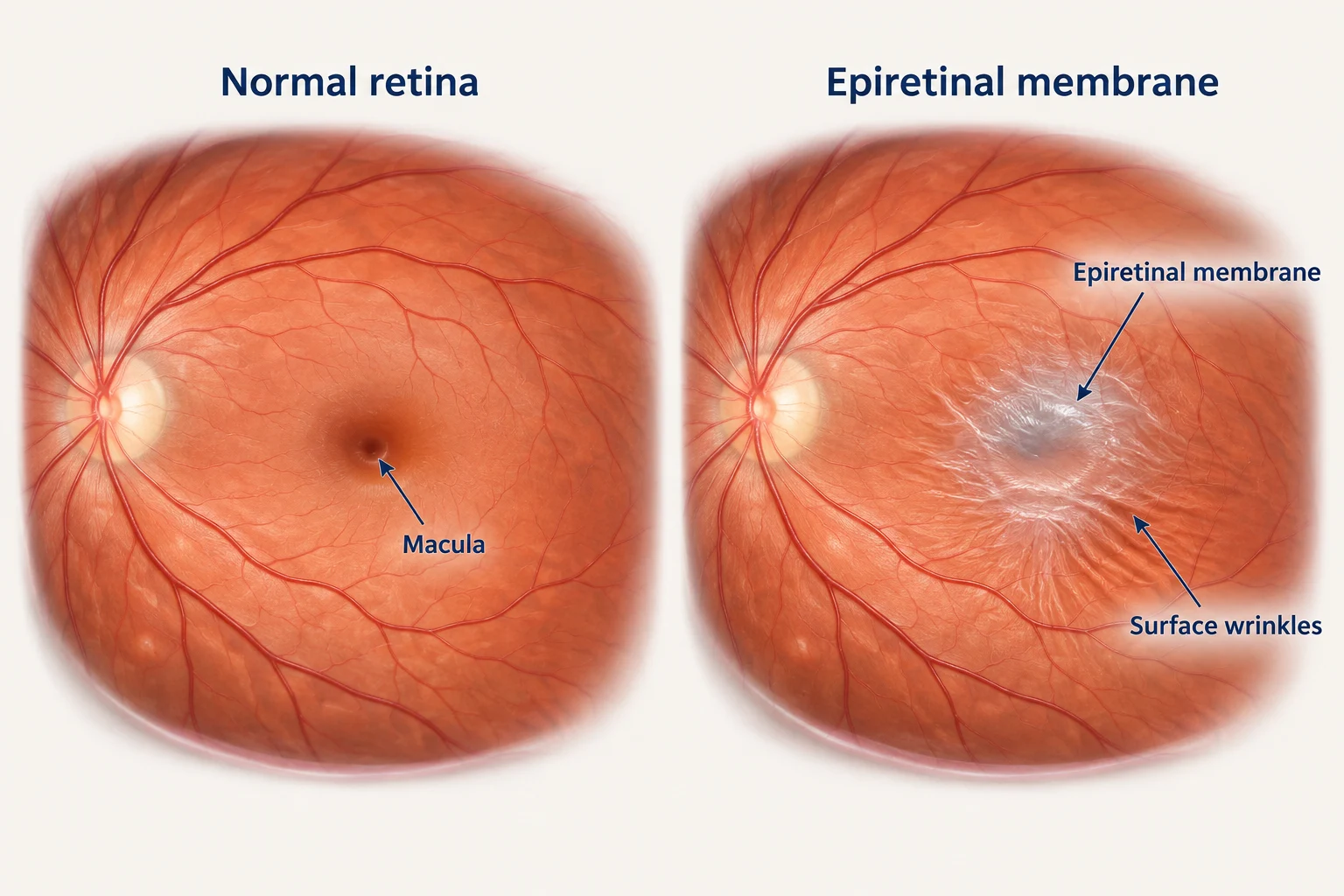
For example, an epiretinal membrane is a thin layer of tissue on the macula, the central part of the retina used for detailed vision. It can make straight lines look wavy and affect reading. If a cataract is also causing blur or glare, treating both in one operation may avoid improving one part of the vision while leaving the other problem untreated.
For persistent, troublesome floaters, combined surgery may be appropriate when the floaters substantially affect daily activities and a cataract also warrants treatment. Many floaters can be observed after examination; their presence alone does not mean surgery is needed. The decision to perform vitrectomy should stand on its own merits, including its risks.
Why does age matter, particularly after 50?
Vitrectomy commonly accelerates cataract development or progression, particularly in people over 50. A patient may recover from retinal surgery only to find that an increasingly cloudy lens limits the improvement in vision and requires another operation.
Research comparing age groups found substantially faster progression of nuclear cataract—the common hardening and clouding of the centre of the lens—in patients aged 50 and above than in younger patients after vitrectomy. Gas used during retinal surgery was also associated with faster progression.
This makes combined surgery especially relevant when some cataract is already present. However, 50 is not a cut-off at which everybody should have their lens removed. A younger patient with a clear lens, or someone whose lens still provides useful natural near focusing, may have good reasons to preserve it. The timing of cataract progression varies between individuals.
Does being short-sighted or long-sighted affect the choice?
It can make the lens-planning part of the decision particularly important. Cataract surgery replaces the natural lens with an implant whose power is selected to achieve an agreed focus. For someone with substantial myopia (short-sightedness) or hypermetropia (long-sightedness), this may reduce their dependence on strong distance glasses as well as treating the cataract.
When cataract and retinal or floater surgery are both indicated, addressing these problems together can therefore be useful. A strong spectacle prescription by itself is not a reason to have vitrectomy, and removing a clear natural lens requires a separate discussion of benefits and risks.
The desired focus also needs thought. Some short-sighted people value being able to read without glasses. The plan should take account of this, the prescription in the other eye, and the health of the macula. Glasses may still be needed afterwards, and a lens implant cannot restore vision lost through retinal damage.
How do combined and separate operations compare?
This comparison assumes that both operations will eventually be needed. If the second operation proves unnecessary, the balance changes.
Two routes to the same destination. Combined surgery treats both problems in one planned operation. Separate operations space the treatments apart, and a cataract often progresses in the interval after vitrectomy. Which route suits an eye depends on the findings, not on the diagram.
| Consideration | Combined surgery | Separate operations |
|---|---|---|
| Visits to theatre | One planned operation treats both problems. | Two planned operations if both remain necessary. |
| Anaesthesia | One anaesthetic episode for the planned treatment. | A separate anaesthetic for each operation. |
| Appointments and daily life | May reduce repeated assessments, postoperative visits, transport and time away from work or caring duties. | Two periods of preparation and recovery, with more appointments overall in many cases. |
| Visual rehabilitation | Avoids waiting for a second operation or for a post-vitrectomy cataract to be treated. | Improvement may be interrupted by cataract progression or the wait between procedures. |
| First operation | Longer than performing either component alone. | Each operation can be shorter, but total theatre time may be greater. |
| Inflammation | Treating both parts of the eye together can increase the early inflammatory burden. | The procedures are spaced apart; either operation can still cause inflammation or swelling. |
| Lens planning | Lens power and design are chosen before retinal recovery is known. | Retinal recovery can sometimes help guide later measurements, expectations and lens choice. |
| Keeping the natural lens | The lens is removed at the first operation. | It can be retained until cataract surgery becomes worthwhile, if ever. |
Comparative studies generally find similar final visual results in appropriately selected patients with an epiretinal membrane or macular hole. They do not establish that one approach is best or equally safe for every eye.
What are the main benefits of combined surgery?
The main benefit is reducing the burden of having two separate operations. One planned visit to theatre means one anaesthetic episode, rather than two. Depending on the circumstances, this may be local anaesthesia with sedation rather than a general anaesthetic.
Combining treatment can also reduce duplicated postoperative visits, transport arrangements and time off work. For someone who relies on family or carers to attend appointments, these practical differences can matter considerably.
Visual rehabilitation may be quicker across the whole course of treatment, because there is no interval waiting for the cataract operation. This does not necessarily mean that vision is clearer in the first few days. Retinal healing, inflammation and a gas bubble can still slow early recovery. A comparative study found earlier attainment of best vision with combined surgery, but the advantage depended partly on the timing of the separate procedures.
What are the disadvantages and risks?
The first operation is longer, and treating both the front and back of the eye can cause more inflammation. Some patients develop swelling at the macula, temporary clouding of the cornea or raised eye pressure. However, studies do not consistently find a higher rate of macular swelling with combined surgery; the retinal diagnosis and the individual eye matter.
The risks of cataract and vitreoretinal surgery still apply. These include problems with the lens capsule or implant, bleeding, infection, retinal tears or detachment, persistent swelling, and loss of vision. Further treatment or surgery may be needed. Combining the procedures does not guarantee that there will only ever be one operation.
Choosing the final focus can also be more challenging in an eye with retinal disease. In some circumstances, waiting until the retina has been treated allows more dependable measurements or a clearer understanding of the visual potential. This is a reason to consider staging, rather than a guarantee that separate surgery always produces a more accurate spectacle result.
For a suitable patient, the practical advantages of combined surgery may outweigh these disadvantages. That judgement should follow an assessment of the eye rather than convenience alone.
When might separate surgery be better?
Separate surgery is often sensible when the retinal problem needs treatment but the natural lens remains clear and useful. It may also be preferred when the retinal condition makes lens measurements uncertain, the eye is particularly complex, or the surgeon wants to assess the retinal recovery before choosing the implant.
There is another option: cataract surgery first, followed by reassessment. If the cataract seems to be the main cause of blur and an epiretinal membrane is mild, removing the cataract may provide enough improvement that membrane surgery can be deferred. In a small prospective study, some patients allocated to cataract-first treatment did not need vitrectomy during follow-up. This does not mean the membrane has disappeared.
Cataract surgery after vitrectomy remains a useful treatment, although it can be technically more demanding than routine cataract surgery. That possibility can be planned for; it is not, by itself, a reason to remove every clear lens during retinal surgery.
For an urgent retinal problem such as a retinal detachment, timely retinal treatment takes priority. Cataract treatment is incorporated or deferred according to the needs of that eye.
Does femtosecond laser change the decision?
Femtosecond laser can assist the cataract part of a combined operation, but it does not replace vitrectomy or perform a membrane peel. It can create the opening in the lens capsule and divide the cataract before its removal. Conventional phacovitrectomy performs these cataract steps without femtosecond laser assistance.
Both approaches can be used for combined surgery. Some comparative studies suggest that laser assistance can reduce ultrasound energy and certain measures of corneal stress. However, the direct evidence is limited by small samples or important differences between the patients being compared. It does not establish that laser-assisted combined surgery gives better final vision or is safer overall.
The first decision is whether the cataract and retinal procedures should be combined. Whether laser assistance is useful is a separate discussion about the cataract, the eye and the planned technique.
Why is combined surgery not offered everywhere?
Combined surgery requires expertise in both cataract and vitreoretinal surgery, together with suitable theatre equipment and support. Access to surgeons and facilities able to provide both procedures can be a practical limitation.
One surgeon experienced in both areas can perform the whole operation. In other settings, cataract and retinal surgeons work together. Separate operations may reflect the needs of the eye, the available surgical team, or both; they do not necessarily represent a less appropriate standard of care.
What should I expect during recovery?
Recovery is usually governed by the retinal procedure, rather than by cataract surgery alone. Membrane surgery may improve distortion and reading gradually, and the final vision depends on the condition of the macula. Combining treatment does not guarantee normal vision or freedom from glasses.
If a gas bubble is used, it can blur vision substantially while it remains in the eye. Follow the specific positioning instructions you are given. Do not fly while gas remains in the eye, and discuss any travel to altitude with the retinal team. Tell any doctor, dentist, ambulance or anaesthetic team about the bubble: nitrous oxide, including gas-and-air pain relief containing it, must not be used while intraocular gas remains.
Time away from work and driving depends on the operation, vision, gas use and the demands of your job. Although combined surgery can reduce the total disruption, an individual recovery plan is more useful than a fixed promise about the number of days off.
What should I ask before deciding?
- How much of my visual difficulty comes from the cataract, the retina or the floaters?
- Do both problems need surgery now, or could one be observed?
- What is the advantage of combining the operations in my particular eye?
- What focus and lens implant would suit my retina, daily activities and other eye?
- Would femtosecond laser offer a meaningful advantage for my cataract?
- Will I need a gas bubble, positioning, travel restrictions or further surgery?
- Who will perform each part of the operation and manage the follow-up?
Combined surgery can be an appropriate and time-efficient option when both treatments are needed. The aim is to choose the sequence that gives the eye the best opportunity to recover while avoiding unnecessary treatment and disruption.
Where can I read more?
Read more about cataract surgery, epiretinal membranes, floaters, vitrectomy, lens choices and femtosecond laser cataract surgery.
For referring optometrists and ophthalmologists
What does the evidence mean for clinicians?
For an eye with a symptomatic cataract and an ERM or macular hole requiring vitrectomy, combined phacovitrectomy is a reasonable option. The main decision is often the treatment pathway and lens strategy rather than an expectation of superior final acuity.
Daud and colleagues’ 2023 review included 855 eyes across two randomised trials and eight retrospective comparative studies. The pooled 12-month acuity analysis, drawn from four studies and 398 participants, found a mean difference of +0.02 logMAR between combined and sequential surgery (95% CI −0.04 to +0.08). Most evidence was retrospective and at high risk of bias; absence of a statistically significant difference does not demonstrate equivalence for uncommon harms. Daud et al.
Risk findings should remain indication-specific. A broader mixed-indication meta-analysis identified differences in certain inflammatory and surgical complications, whereas the large 2024 ERM cohort found no significant CMO difference. Neither supports a universal claim that combining is safer or consistently causes more macular oedema. Farahvash et al. , Fouad et al.
Assess lens opacity, metamorphopsia and functional symptoms separately. OCT helps characterise the macula; biometry, refractive target, fellow-eye status and anticipated tamponade inform the lens plan. Cataract-first reassessment remains reasonable in selected cataract-dominant ERM cases. Floater surgery requires its own symptom–finding assessment; ERM outcome data do not establish superiority of combined surgery for floaters.
Retinal-detachment evidence should not be merged uncritically with elective macular surgery. The 2026 observational RRD cohort found similar adjusted anatomical outcomes with combined surgery and PPV alone, but PPV alone was not a completed sequential cataract pathway. Gough et al.
Direct femtosecond evidence remains limited: Chao’s 26-eye study was small and imbalanced; Yang’s 379-eye cohort had substantial diagnostic imbalance; Watanabe’s selected 153-eye cohort found no laser advantage in 7 mm IOL tilt or decentration at 12 months. These studies support feasibility and further evaluation, not routine superiority. Chao et al. , Yang et al. , Watanabe et al.
A useful referral includes the patient's functional priorities, current refraction, lens status, retinal findings/OCT and any practical constraints on repeated surgery. These help frame a combined-versus-staged discussion without presuming that every patient needs both procedures.
References and further reading
- Daud F et al. Combined versus Sequential Pars Plana Vitrectomy and Phacoemulsification for Macular Hole and Epiretinal Membrane: A Systematic Review and Meta-Analysis. 2023.
- Fouad YA et al. Visual outcomes and complications of combined versus sequential pars plana vitrectomy and phacoemulsification for epiretinal membrane. 2024.
- Hamoudi H et al. Epiretinal membrane surgery: an analysis of 2-step sequential- or combined phacovitrectomy surgery on refraction and macular anatomy in a prospective trial. 2018.
- Port AD et al. Combined phaco-vitrectomy provides lower costs and greater area under the curve vision gains than sequential vitrectomy and phacoemulsification. 2021.
- Soliman MK et al. A Database Study of Visual Outcomes and Intraoperative Complications of Postvitrectomy Cataract Surgery. 2018.
- Chao HW et al. Macular pucker and cataract treated with phacoemulsification and IOL implantation combined with small-gauge pars plana vitrectomy: a comparison of outcomes with and without femtosecond laser assistance. 2025.
- ASRS patient guidance
- Thompson’s cataract-progression study
- Royal College of Ophthalmologists safety advice
These are the published sources behind this article. They are written for clinicians and do not replace advice about your own eye.
How do I make an appointment with Dr Chen?
Appointments and enquiries through Vision Eye Institute, Chatswood.
Clinic appointments: (02) 9424 9999