PureSee vs Clareon Vivity: EDOF lenses in Australia
Tecnis PureSee and Clareon Vivity are lens implants designed to give a broader range of vision after cataract surgery than a conventional single-focus lens. Both aim to make distance and arm’s-length tasks easier without glasses. Neither guarantees clear reading vision without glasses, and current evidence does not establish one as the better lens for everyone.

The choice involves more than the smallest letters on an eye chart. Computer use, fine print, driving in dim light, the health of the retina and willingness to use glasses all matter. This comparison separates what the lenses are designed to do from what clinical studies have actually shown.
What does an EDOF lens do?
An extended-depth-of-focus (EDOF) lens broadens the range over which an image remains usefully focused. It replaces the natural lens during cataract surgery, but does not restore the young eye’s ability to change focus, known as accommodation. PureSee and Vivity are non-diffractive designs: they do not use the repeated diffractive ring steps found in many multifocal lenses. That does not make them free of optical trade-offs.



A dashboard or laptop may fall within an intermediate working distance, while a phone, book or medicine label needs closer focus. “Less dependence on glasses” can therefore mean comfortable computer use but still needing readers for small print. It does not necessarily mean freedom from glasses for every activity.
The explanation below describes this graphic. Drawing it requires JavaScript.
Binocular distance-corrected vision at six months, replotted from the published figures in Bala 2021 and McCabe 2022 for the AcrySof IQ Vivity and the AcrySof IQ SN60WF monofocal, not copied from any manufacturer chart. These are trial averages; an individual eye may sit well above or below either line. PureSee is not plotted, because no comparable published binocular defocus dataset was identified.
How do PureSee and Vivity compare side by side?
| Question | Clareon Vivity | Tecnis PureSee |
|---|---|---|
| Who makes it? | Alcon | Johnson & Johnson |
| How is focus extended? | Central wavefront shaping on the front surface | A continuously varying refractive profile on the back surface |
| Where is the main intended benefit? | Distance and intermediate vision | Distance and intermediate vision |
| What do direct studies suggest? | Some intermediate-vision results favour Vivity | Some contrast-sensitivity results favour PureSee |
| Will I still need reading glasses? | Often, particularly for small print | Often, particularly for small print |
| Can halos or glare occur? | Yes | Yes |
| Is an astigmatism-correcting version listed in Australia? | Yes; exact model and supply need confirmation | Yes; exact model and supply need confirmation |
The clinical signals in this table are not a ranking. The direct studies are small, non-randomised and use different testing methods. Their findings on visual disturbances are inconsistent. Australian listings also do not prove that a particular power is currently in stock.
How are the optical designs different?
Clareon Vivity uses Alcon’s X-WAVE design. Two very small surface transitions in the central 2.2 mm of the front of the optic alter the light’s wavefront to extend and position the focus. “Clareon” identifies the lens material platform; older Vivity publications often studied the different AcrySof platform. The optical family is related, but the devices should not be treated as identical in an evidence comparison.
PureSee uses a continuously varying refractive power profile, called OptiCurve, on the back of the optic. Its front surface also compensates for spherical aberration, an optical imperfection that can affect image quality. PureSee is distinct from both Tecnis Eyhance and the diffractive Tecnis Symfony lens.
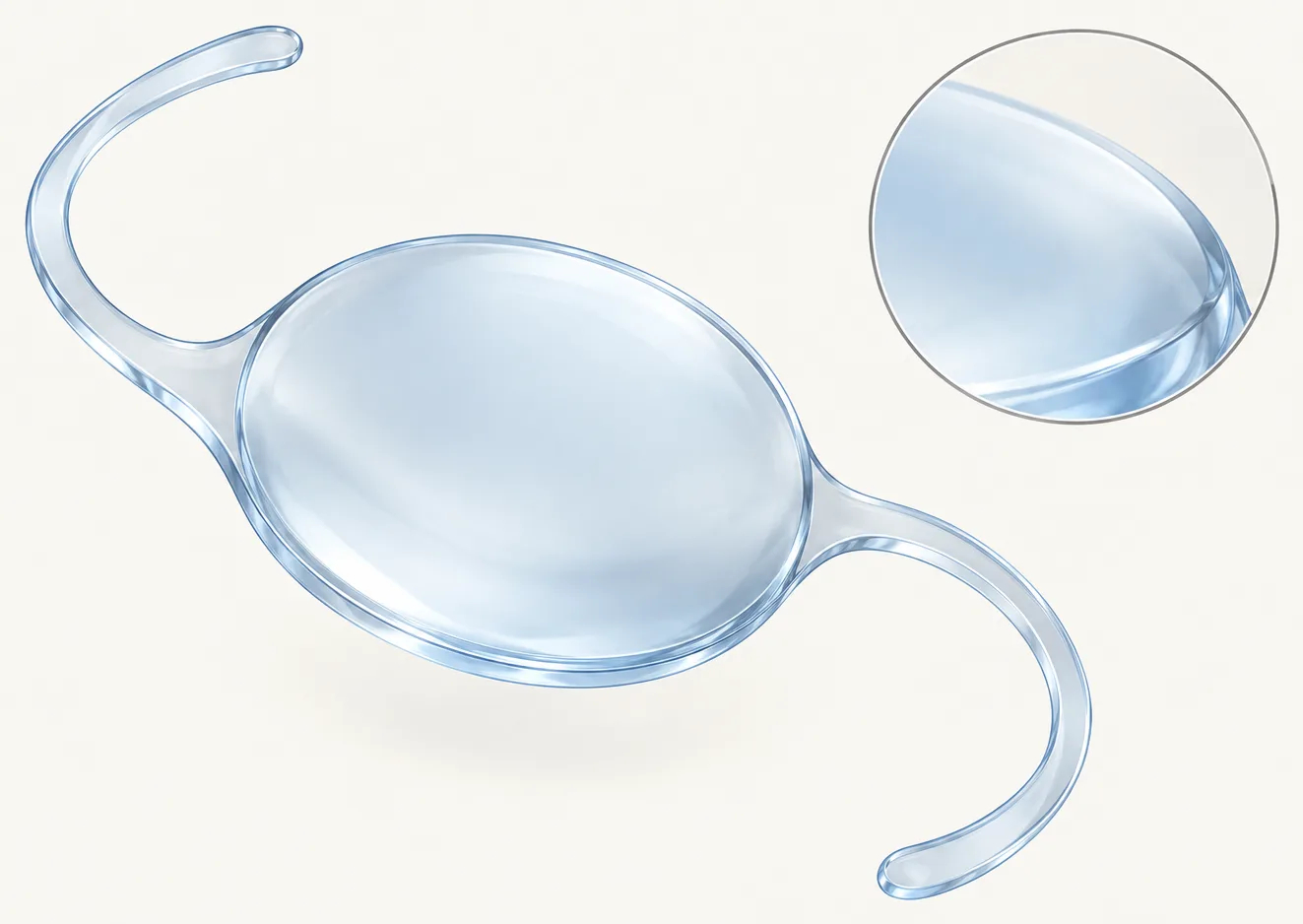
Neither lens moves to focus like the natural lens. A description such as “purely refractive” or “wavefront shaping” explains the design approach; it cannot by itself tell an individual patient how well they will read or drive at night.
The explanation below describes this graphic. Drawing it requires JavaScript.
Schematic cross-sections drawn to a 6.00 mm optic. The dashed grey line is the unmodified base surface and the amber line is the shaped surface, with its deviation exaggerated so that it can be seen; the Vivity transitions are about one micrometre high. The added-power plots show how each design distributes power across the optic and are not measured dioptre values. Exact surface profiles are proprietary and unpublished, and these features cannot be seen in a lens's overall appearance.
What have the head-to-head studies found?
The direct comparisons suggest possible differences, but they do not establish a consistent winner. In one retrospective study of 102 patients, each contributing one eye, Clareon Vivity produced slightly better uncorrected intermediate acuity at 66 cm after two months. The average difference was approximately half an eye-chart line. PureSee performed better on some contrast tests. Distance and near acuity were not significantly different. The short follow-up and non-randomised lens selection limit the conclusion.
A second Clareon study included 106 eyes of 72 patients and followed outcomes for three months. Its adjusted analysis favoured Vivity at 80 cm at one month, but the three-month result did not reach conventional statistical significance. This matters because the publication’s summary sounds more definitive than its adjusted results.
A six-month study of 85 patients found better intermediate and near acuity with AcrySof Vivity, while PureSee performed better on contrast and the study’s visual-disturbance score. This is useful background, but it is not a direct trial of Clareon Vivity. Its selection criteria and treatment groups also limit how confidently the findings apply to routine patients.
No published randomised head-to-head results were identified in this review. A registered randomised comparison, PURVI2, had no results posted in the retrieved registry record. A trial registration is a plan for research, not evidence that one lens is superior.
Which lens is better for night driving?
There is not enough consistent comparative evidence to name a night-driving winner. Contrast sensitivity describes how well an object stands out from its background—for example, a grey object against a dim road. Halos, glare and starbursts are related concerns, but are not the same measurement.
Some comparisons favour PureSee on contrast tests. However, a better laboratory or clinic contrast score does not establish safer driving. Direct studies disagree about visual disturbances, and the populations and questionnaires differ.
Alcon’s US safety information specifically warns that Vivity can reduce contrast sensitivity compared with a monofocal lens and advises caution in dim lighting and at night. PureSee’s US registration results met its contrast comparison criteria against a monofocal control; this should not be interpreted as identical performance on every test or an absence of halos. Overseas labelling is informative, but the Australian instructions for the exact model remain relevant to treatment here.
If night driving is a priority, discuss this before selecting a lens. The useful question is how much range of vision you want to gain and what compromise in visual quality you would accept.
Will either lens let me stop using reading glasses?
Reading glasses remain a realistic expectation with both lenses, especially for small print, prolonged reading or poor lighting. In the two-month Clareon comparison, many questionnaire respondents in both groups still reported using readers often or always. A reassuring distance eye-chart result does not answer the separate question of comfortable near work.
One strategy is mini-monovision: one eye is aimed at distance and the other is left slightly short-sighted. This changes the overall focusing plan, not the lens’s underlying design. It needs an individual discussion about blur, binocular vision and visual quality.
A recent randomised PureSee study compared targeting both eyes for distance with targeting the second eye at −0.75 dioptres. Among 55 patients completing three-month follow-up, the near-vision difference was not statistically significant; the mini-monovision group had poorer low-contrast acuity and more glare. The accessible abstract does not support presenting mini-monovision as an automatic improvement for every PureSee patient.
In the registration trial that supported Vivity, 57 per cent of patients reported good or very good vision without glasses for close work in bright light, falling to 38 per cent in dim light; in the monofocal comparison group the figures were 25 per cent and 8 per cent. Those are patient impressions rather than measured acuity, they come from a manufacturer-sponsored trial against one particular monofocal lens, and no equivalent published figures were identified for PureSee. The pattern is still worth knowing: close reading without glasses is the least reliable part of what either lens offers, and it is least reliable in poor light.
What if I have astigmatism or another eye condition?
A toric lens also corrects corneal astigmatism. Both lens families have toric entries in the Australian Prescribed List. Selecting the cylinder power and alignment is a separate part of planning; a study of a non-toric model does not answer every question about a toric model’s performance. The exact lens, power, Australian instructions and current supply should be confirmed.
Macular disease, glaucoma, an irregular cornea, dry eye and previous laser vision correction can change the assessment. Much of the comparative evidence comes from selected eyes without significant additional disease, so it cannot establish that either brand is preferable across these conditions. Retinal and corneal assessment helps determine whether an EDOF lens is appropriate at all.
There are alternatives: a conventional monofocal lens with glasses, an enhanced monofocal lens, or a multifocal/trifocal design for selected patients. These choices offer different balances of focus range and visual quality. The wider lens implant guide and EDOF guide explain the categories.
What should I ask at my consultation?
Bring examples of the tasks that matter: the distance to your computer screen, how much fine reading you do, and whether driving at night is essential. Useful questions include:
- What is the exact lens model and why does it suit my eyes?
- Which tasks am I still likely to need glasses for?
- Does my retina, cornea or optic nerve change the recommendation?
- Are you aiming both eyes for distance, or considering mini-monovision?
- What alternatives would better suit my priorities?
The lens choice does not remove the risks of cataract surgery. Infection, inflammation, retinal complications, an unexpected focusing result and further treatment remain possible; the cataract surgery guide explains these separately.
A good decision starts with the condition of the eyes and the tasks the patient wants to perform. The brand comparison then helps refine that decision.
For referring optometrists and ophthalmologists
What should clinicians take from this comparison?
The most useful interpretation is a possible intermediate-range versus contrast trade-off, with low confidence in a stable between-brand ranking. Do not pool the three cohorts as if they were equivalent: they differ in platform, patient selection, outcome distances and follow-up. Jeong’s adjusted three-month 80 cm result was p = 0.0711, despite stronger wording elsewhere in the paper. The smaller acuity differences should be weighed against their likely clinical relevance.
Both platforms use one-piece hydrophobic acrylic lenses with a 6 mm optic and 13 mm overall diameter. Reported refractive indices differ: approximately 1.55 for Clareon Vivity and 1.47 for PureSee. These material properties do not establish comparative clinical performance. Independent optical-bench testing can clarify pupil, tilt and decentration effects, but cannot rank night-driving safety or patient satisfaction.
For a detailed model/power table, funding and conflict disclosures, individual study appraisal, monovision evidence and unresolved Australian IFU questions, see the accompanying research dossier. For referral planning, the practical priorities remain ocular health, refractive accuracy, astigmatism, working distance and explicit counselling about readers and visual symptoms.
References and further reading
- Kohnen et al. Vivity optical design, 2023 .
- Tecnis PureSee US instructions for use, March 2026 .
- Kang et al. Clareon Vivity versus PureSee, 2026 .
- Koh et al. AcrySof Vivity versus PureSee, 2026 .
- Jeong et al. Clareon Vivity versus PureSee, 2026 .
- Australian Prescribed List instrument, 22 June 2026 .
- PURVI2 randomised trial registration .
- Alcon Clareon Vivity safety information .
- PureSee FDA safety and effectiveness report, 2026 .
- Zeilinger et al. PureSee mini-monovision trial, September 2026—abstract .
- Niknahad et al. Clareon Vivity and PureSee optical-bench comparison, 2025 .
These are the published sources behind this article. They are written for clinicians and do not replace advice about your own eye.
How do I make an appointment with Dr Chen?
Appointments and enquiries through Vision Eye Institute, Chatswood.
Clinic appointments: (02) 9424 9999