The Tecnis PureSee EDOF Intraocular Lens
Tecnis PureSee is an artificial lens used to replace the eye’s natural lens during cataract surgery. It is designed to provide clear distance vision and a wider range of useful vision at arm’s length than a standard monofocal lens. Its main compromise is close reading: you should still expect to need reading glasses for some tasks, particularly small print or reading in dim light.

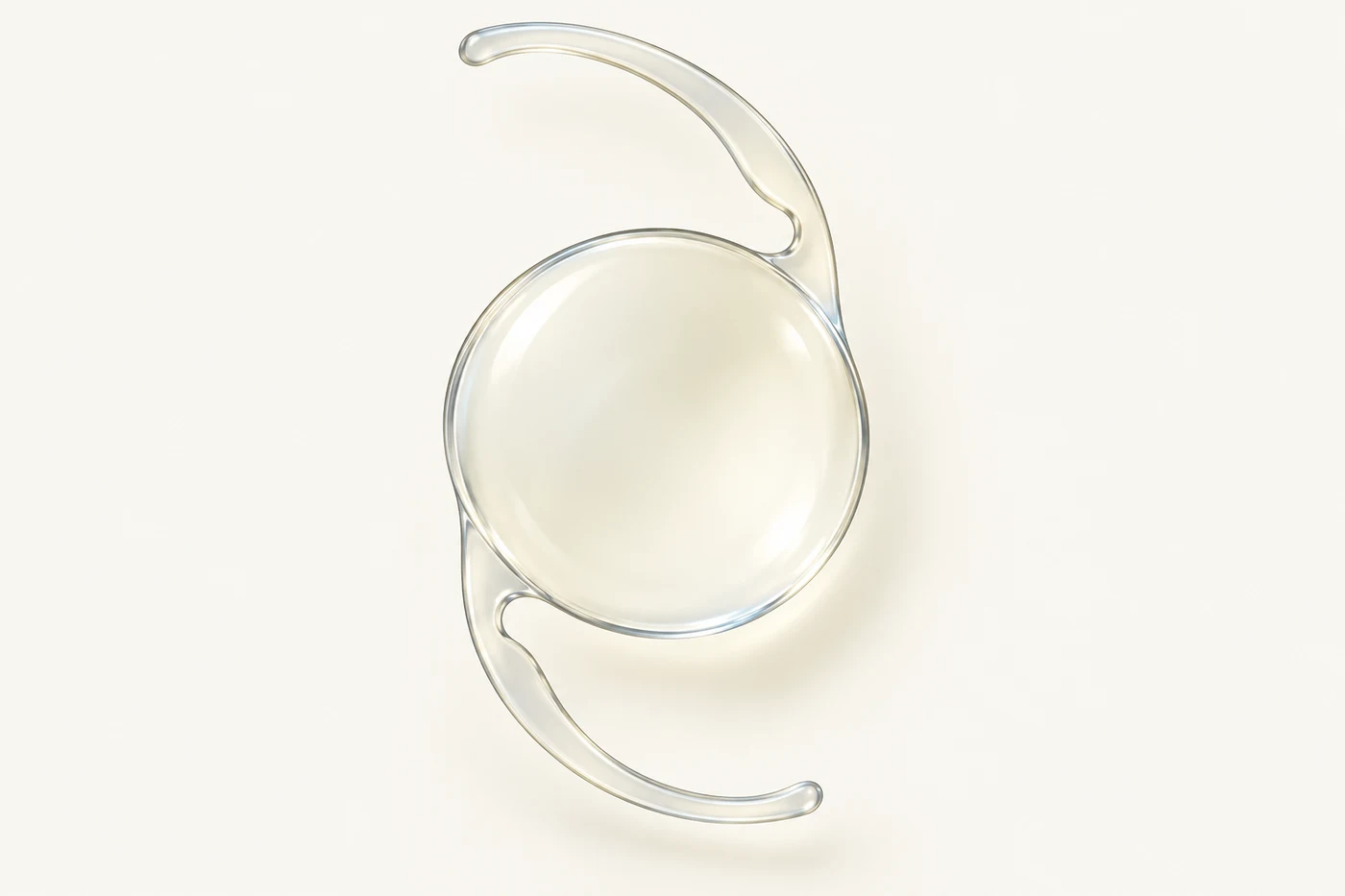
PureSee is an extended depth of focus, or EDOF, lens made by Johnson & Johnson. It uses a smooth, refractive optical design rather than the concentric diffractive steps used in some other lenses. Clinical studies have found useful intermediate vision and generally low levels of troublesome haloes and glare. That does not mean everyone will be free of these symptoms, or that the lens is the best choice for every eye.
What sort of vision is PureSee designed to provide?
The intended balance is good distance vision, useful intermediate vision and some near vision, while keeping unwanted optical effects relatively low.

- Distance: recognising faces across a room, watching television and looking into the distance.
- Intermediate: a computer screen, a car dashboard or tasks around the kitchen. Studies commonly test this at about 66 cm.
- Near: a phone, a book or fine print held closer to the eyes. Studies often test near vision at 40 cm, but reading comfort also depends on print size, lighting and how long you read.
These categories overlap. A person who can read a large phone message without glasses may still want glasses for a paperback, sewing or medicine labels. “Functional near vision” means useful vision for some near tasks; it does not mean consistently sharp vision for every close task.
The surgical target matters as well as the lens. A lens chosen to focus mainly in the distance will behave differently from the same lens deliberately targeted to leave an eye a little short-sighted.
How does its optical design work?
PureSee bends light using carefully shaped optical surfaces. Its front surface is aspheric: its curvature is designed to reduce a type of blur called spherical aberration. The back surface incorporates the manufacturer’s OptiCurve refractive design, which varies optical power across the lens to extend the useful range of focus.
A conventional monofocal lens has a relatively narrow range around its main focus. PureSee broadens that range towards intermediate distances. This is different from using a diffractive pattern to create distinct distance and near focal points.
The surface changes are subtle. The lens should not be imagined as having visible multifocal rings, a mechanical zoom or a moving part. It does not restore the youthful natural lens’s ability to change shape and focus, known as accommodation.
“Non-diffractive” describes how the optics work. It does not mean there can be no haloes, glare, starbursts or reduction in visual quality. An eye’s tear film, cornea, pupil, retina and final prescription all influence the result.
What is the lens made of?
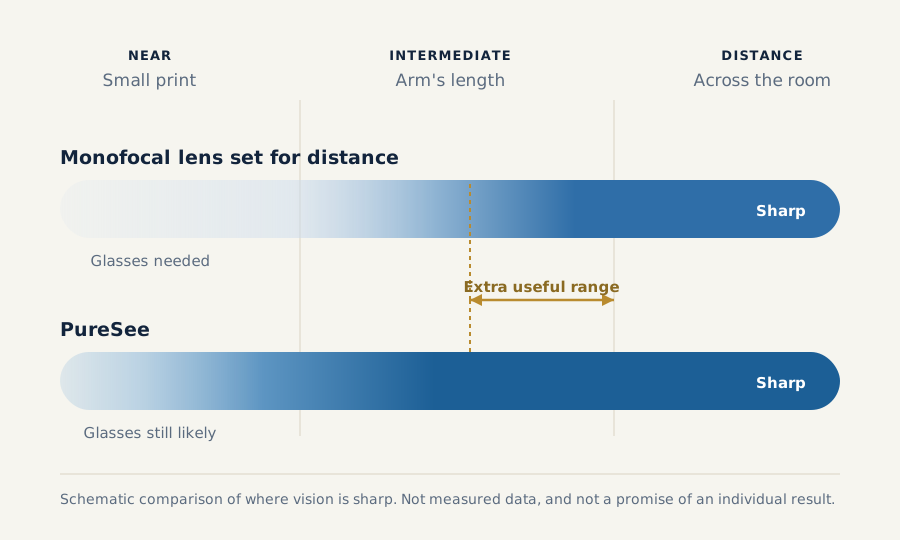
PureSee is a single-piece, foldable hydrophobic acrylic lens. Acrylic is a clear plastic suitable for a permanent implant. “Hydrophobic” describes how the material interacts with water; it does not mean the implanted lens dries out.
The material includes an ultraviolet absorber and a violet-light-filtering component, marketed as OptiBlue. The subtle colour in the illustration represents this filter. Violet filtering is a material feature, not evidence that this lens prevents macular degeneration or protects the retina from future disease.
Acrylic allows the lens to be folded for delivery through a small surgical incision. Once inside the eye it unfolds, and its curved haptics support it in the capsular bag—the thin envelope that originally held the natural lens.
What are its technical specifications?
These details describe the documented PureSee platform and Australian listings. The exact model and power ordered for an individual operation must be checked against current Australian labelling.
- Non-toric model: DEN00V with the Tecnis Simplicity preloaded delivery system. ZEN00V is the model designation used in the earlier clinical study.
- Toric family: PureSee Toric II, DET models, for correcting suitable corneal astigmatism.
- Optic diameter: 6.0 mm.
- Overall diameter: 13.0 mm, including the supporting arms.
- Spherical power: +5.0 to +34.0 dioptres, in 0.5-dioptre steps.
- Australian-listed toric cylinder range: 1.0 to 6.0 dioptres at the lens plane. This is not the same as the cylinder in a glasses prescription.
- Material refractive index: 1.47 at 35°C; reported Abbe number 55, a measure relating to colour dispersion.
- Optical surfaces: aspheric anterior surface and refractive EDOF posterior surface; the toric version also incorporates astigmatism correction.
- Supporting structure: two integral modified-C haptics, with the manufacturer’s TRI-FIX configuration.
- Posterior edge: a continuous square-edge design, marketed as PROTEC360.
- Delivery: a single-use preloaded Simplicity injector; the injector is removed after the lens is delivered.
The square edge is intended to help limit cells growing behind the implant. It does not eliminate posterior capsule opacification—the later clouding of the capsule that may need YAG laser treatment.
The power range is a catalogue specification, not a claim that every power is immediately stocked at every Australian hospital. Measurements of eye length and corneal curvature, together with the intended focus, guide the chosen power.
An original drawing of the lens, labelled with the manufacturer's published dimensions and design features. It is not a photograph and not a copy of any manufacturer illustration; the edge view is drawn far thicker than life so the shape can be read. The axis marks shown apply only to the toric version.
Is there a toric version for astigmatism?
Yes. PureSee Toric II combines the EDOF design with correction for regular corneal astigmatism. Astigmatism occurs when the front of the eye has different focusing powers in different directions.
The toric lens has orientation marks so the surgeon can align it to the planned axis. The documented design has two groups of four marks. Accurate alignment matters: rotation away from the intended position can reduce the astigmatism correction, and occasionally a further procedure is needed to reposition the lens.
A toric lens does not treat every cause of blurred or distorted vision. Irregular corneal shape, scarring or retinal disease may limit what it can achieve. The non-toric and toric versions share the same general distance-to-intermediate aim; “toric” does not mean a stronger reading focus.
When was PureSee introduced into Australia?
PureSee became commercially available in Australia in July 2024.
Availability from an individual surgical facility is a separate matter from national availability, and a lens being available does not establish a patient's insurance benefits or out-of-pocket cost.
What are the main advantages?
A useful extension beyond distance vision. Compared with a standard monofocal lens, PureSee can make arm’s-length tasks easier without glasses. This may suit someone who spends considerable time at a computer or values seeing a dashboard clearly.
A relatively low visual-disturbance profile in the studied patients. Trials found that many patients had little bother from haloes, glare and starbursts. This is relevant for people who are cautious about the optical trade-offs of presbyopia-correcting lenses.
An option for suitable eyes with astigmatism. The toric family allows the surgeon to address regular corneal astigmatism while retaining the same general EDOF approach.
A foldable implant on an established type of acrylic platform. The lens uses a familiar single-piece capsular-bag design. Experience with the broader platform is useful, although it does not replace long-term evidence for PureSee’s particular optics.
What are the main disadvantages and uncertainties?
Reading glasses are still part of the likely outcome. Someone whose highest priority is small-print reading without glasses may find the compromise disappointing. It is better to plan for occasional or regular readers than to assume complete independence.
Visual disturbances remain possible. A low average rate of troublesome symptoms is not a promise about an individual eye. Night driving can be affected by glare or haloes, residual prescription, dry eye or other eye disease.
Accurate measurements and a healthy visual system matter. Uncorrected astigmatism, an unexpected refractive result or an irregular cornea may reduce the useful range. Macular disease and optic nerve damage can limit contrast or sharpness even when surgery and lens positioning go well.
It cannot remove the risks of surgery. Cataract surgery carries risks including infection, inflammation, macular swelling, retinal detachment and, rarely, permanent loss of vision. Later capsule clouding and lens-position problems can also occur. A premium optical design does not remove these risks.
The lens-specific evidence is still developing. The studies below mainly describe outcomes over three to six months in selected patients. They cannot establish decades of performance or reliably measure very rare complications. Comparisons across separate studies are particularly easy to overinterpret.
What have clinical studies found?
A randomised Australia–New Zealand study
Corbett and colleagues’ 2024 study enrolled 120 patients at six centres, comparing PureSee with Tecnis Eyhance, an enhanced monofocal lens. Outcomes were assessed at six months.
Mean distance-corrected intermediate acuity at 66 cm was 0.13 logMAR with PureSee versus 0.18 with Eyhance—about half a chart line better. Lower logMAR numbers mean sharper vision. Distance vision was similar, and near vision showed a modest benefit.
Among 60 PureSee patients completing the relevant symptom assessment, 55 reported no or slight bother from haloes, and 57 reported no or slight bother from glare and starbursts. “No or slight bother” includes people who noticed symptoms.
This was manufacturer-funded research with relevant author industry relationships. Its extra comparison with an older standard monofocal lens used historical data, not another concurrently randomised group.
The US regulatory trial
The FDA’s 2026 review describes 228 patients receiving lenses in both eyes: 115 received PureSee and 113 a standard Tecnis monofocal lens, ZCB00. At six months, mean distance-corrected intermediate acuity was 0.15 versus 0.30 logMAR—about 1.5 chart lines better with PureSee. Distance vision met the trial’s non-inferiority criterion.
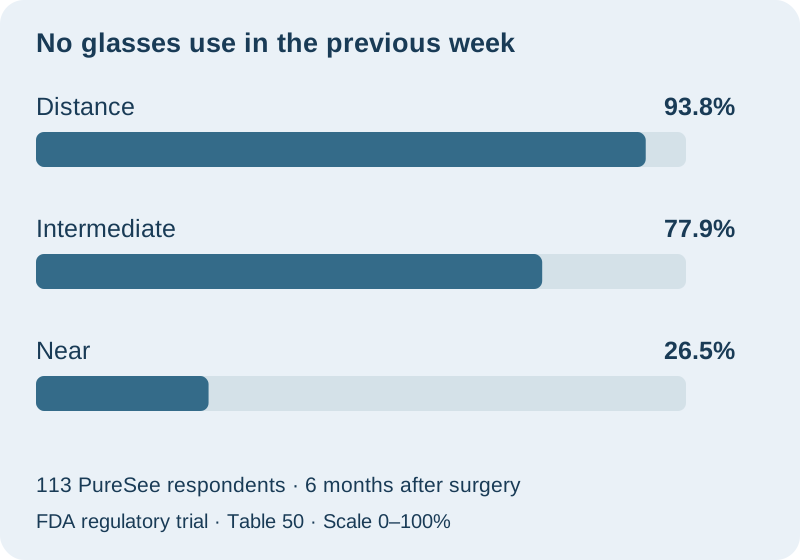
Among 113 PureSee respondents, the proportions reporting no glasses use in the preceding week were 93.8% for distance, 77.9% for intermediate and 26.5% for near. Complete independence across the overall-vision question was 54.0%. This is different from combining “none” with “a little” glasses use.
A 103-patient clinical series
McNeely and colleagues reported three-month results from 103 patients receiving PureSee in both eyes. Patients reported glasses independence of 100% for distance, 94.2% for intermediate and 66% for near.
However, this retrospective study included both cataract surgery and refractive lens exchange, had no control group and used mildly short-sighted targets, with extra short-sightedness in some second eyes. It therefore does not contradict the lower near-independence result in the regulatory trial: the treatment strategy, population and questionnaire differed. Author disclosures included industry speaking fees.
How should these results be interpreted?
The studies support PureSee as a distance-and-intermediate option with some useful near vision. They do not establish that it is superior to every other EDOF lens or that everybody will achieve the study averages.
The larger intermediate advantage against a standard monofocal lens should not be confused with the smaller advantage against Eyhance. The choice of comparator changes the answer. Laboratory optical studies are also informative, but a bench measurement is not a patient’s experience of reading or driving at night.
Can mini-monovision improve reading?
Mini-monovision means aiming one eye slightly more for near, usually by leaving it mildly short-sighted. It can be considered with an EDOF lens, but it changes the binocular balance and may involve trade-offs in distance clarity or visual comfort.
A small randomised study by Zeilinger and colleagues, published online in September 2026, compared a −0.75-dioptre target in the non-dominant eye with distance targets in both eyes. Of 60 enrolled patients, 55 completed three-month follow-up. The abstract reports no statistically significant improvement in near acuity, with worse low-contrast acuity and more reported glare in the mini-monovision group. The full paper was not available for this review.
The higher near-independence results in a study using myopic targets should not be used to promise the same result when both eyes are targeted for distance. The target for each eye needs to reflect the person’s visual priorities and tolerance of a difference between the eyes.
Who might find PureSee a good fit?
PureSee may be worth discussing if you want less reliance on glasses for distance and computer-range tasks, are comfortable using reading glasses when needed, and place considerable value on keeping visual disturbances low.
Assessment should consider the ocular surface, corneal shape, astigmatism, retina and optic nerve, as well as previous eye surgery. Someone with macular degeneration, glaucoma, a significant corneal irregularity or previous laser vision correction needs an individual assessment; a brand name alone cannot resolve those issues.
It may be a less suitable match if your expectation is never to wear glasses, if very close unaided reading is the dominant priority, or if another eye condition significantly limits visual quality. The decision is about the eye and the person’s priorities together.
What are the alternatives?
A standard monofocal lens usually prioritises one main distance, with glasses for the rest. An enhanced monofocal lens offers a modest extension towards intermediate vision. Other EDOF lenses use different optical designs, and multifocal or trifocal lenses aim to provide more near vision with their own optical trade-offs.
For the broader choices, see lens implants, EDOF lenses and multifocal lenses. The cataract surgery guide explains the operation and recovery.
Useful questions for your surgeon include which reading tasks are likely to need glasses, what focus is planned for each eye, whether a toric version is appropriate, and whether any other eye condition changes the expected benefit.
Sources and further reading
- Johnson & Johnson Vision: Australian PureSee product information — manufacturer description and Australian product context.
- Australian Prescribed List, June 2026 instrument — QQ152 and QQ318 entries and listed power ranges.
- FDA: PureSee Summary of Safety and Effectiveness Data — device description and US trial results; approved 11 March 2026.
- FDA: PureSee professional labelling — material, design and safety details. US labelling is not a substitute for the Australian instructions for use.
- Corbett and colleagues, Eye, 2024 — randomised comparison with Eyhance. Associated correction .
- McNeely and colleagues, Clinical Ophthalmology, 2026 — 103-patient clinical series with mildly myopic targets.
- Zeilinger and colleagues, American Journal of Ophthalmology, September 2026 — randomised mini-monovision comparison; abstract reviewed.
- Niknahad and colleagues, Scientific Reports, 2025 — laboratory optical comparison, including material and design information; not a clinical superiority trial.