How do I choose a cataract surgeon in Sydney?
Choosing a cataract surgeon in Sydney: questions about experience, retinal checks, lens calculations, anaesthesia, complications and aftercare.
Read the article Dr Simon ChenCataract & Retina Surgeon

Dr Simon Chen explains cataract surgery, lens implants and retinal conditions, and the evidence behind them. Written for patients and the clinicians who refer them.
Further articles about cataract, lens and retinal surgery are added regularly, so please check back from time to time. Meanwhile, the condition and treatment pages cover each topic in brief.
Choosing a cataract surgeon in Sydney: questions about experience, retinal checks, lens calculations, anaesthesia, complications and aftercare.
Read the articleDr Simon Chen explains eye doctors’ personal lens choices and the trade-offs of monofocal, mini-monovision and EDOF lenses.
Read the articleFloater surgery varies more between surgeons than many people expect. What each choice aims to do, and what the evidence shows.
Read the articleTwo extended depth of focus implants used in Australia, compared on range of vision, night driving and the head-to-head evidence.
Read the articleA detailed guide to PureSee's refractive EDOF design, the vision to expect, its specifications and the evidence behind its benefits and limits.
Read the articleWhat the first days and weeks are really like after floater surgery, from drops and showering to exercise, driving and travel.
Read the articleHow the Light Adjustable Lens works, Australian registration and access, LAL versus LAL+, adjustment visits, UV glasses, benefits, risks and evidence.
Read the articleWhat a dropped nucleus means, why it happens, how vitrectomy and a fragmentome help, and what patients and optometrists can expect.
Read the articleFind out when to stop soft, rigid and scleral contact lenses before lens measurements, including advice for keratoconus, previous RK and corneal grafts.
Read the articleWhat a capsular tension ring does during cataract surgery, why it may help with weak zonules or pseudoexfoliation, and its limitations.
Read the articleWhat pseudoexfoliation means for cataract surgery: weak zonules, dropped nucleus, capsular tension rings, glaucoma, genetics and retinal surgical support.
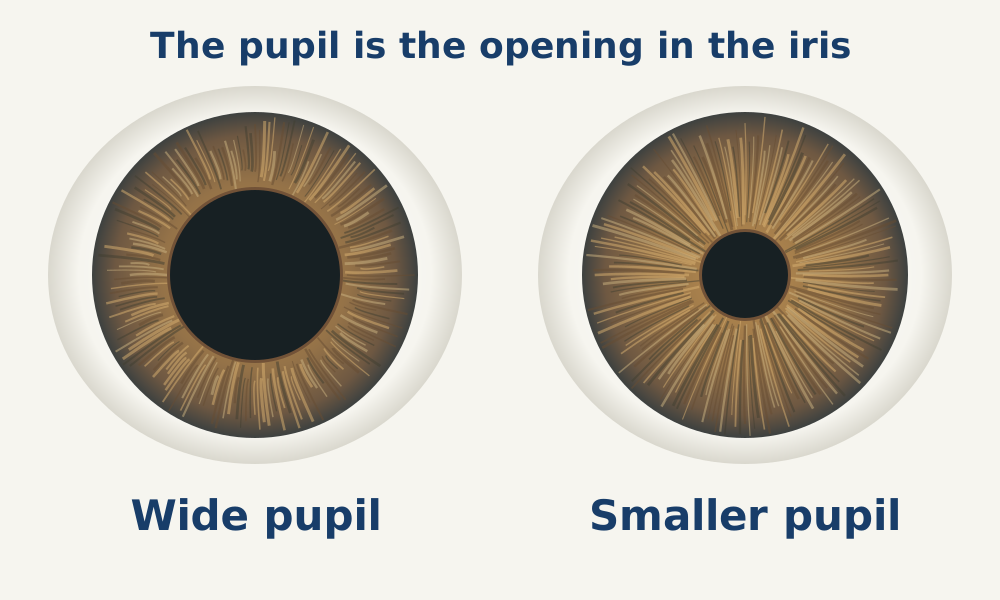
Read the articleSmall pupils restrict the view during cataract surgery. Learn why they occur and how viscoelastic, iris hooks and Malyugin rings help.
Read the articleCataract surgery with uveitis usually needs a quiet eye, a check of the macula and an individual anti-inflammatory plan before and after surgery.
Read the articleWhen is it time for cataract surgery? A patient guide to daily activities, glare, eye checks, waiting, benefits and risks.
Read the articleWhat glasses, lighting and glare control can help with, what the evidence says about cataract drops and supplements, and when to discuss surgery.
Read the articleUnderstand multifocal lens implants: less dependence on glasses, haloes and night vision, who should avoid them, alternatives and what to ask before cataract surgery.
Read the articleThe vitreous gel does not grow back after vitrectomy. Learn what replaces it, how the eye stays filled and why an adult eye can function without the gel.
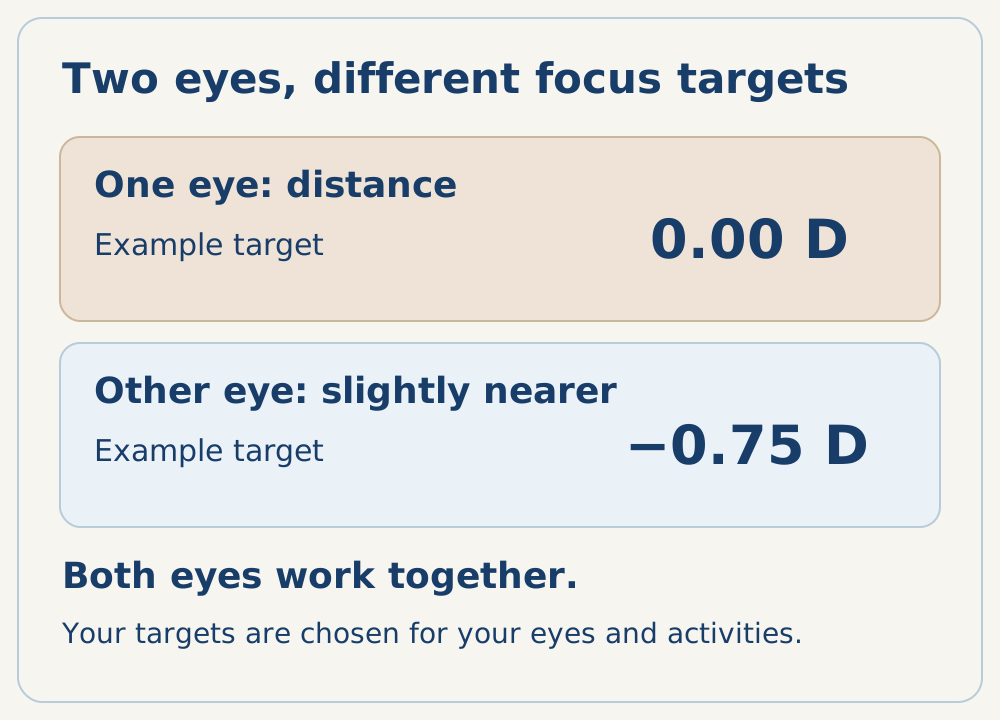
Read the articleIf you are short-sighted, aiming for 6/6 or 20/20 distance vision after cataract surgery can change your reading vision. Compare distance and near targets.
Read the articlePersistent eye floaters can affect everyday life, even with good eyesight. Dr Simon Chen explains the pebble-in-your-shoe analogy and what studies show.
Read the articleSulcoflex is an add-on lens placed in front of an existing implant. Compare its aspheric, toric and trifocal options, evidence and surgical risks.
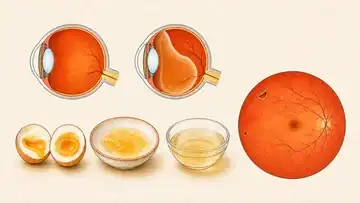
Read the articleDr Simon Chen uses an egg analogy to explain how ageing vitreous gel becomes more liquid, separates from the retina and can sometimes cause a retinal tear.
Read the articleA gas bubble acts like a temporary internal splint after retinal surgery. Learn how it supports macular hole closure and retinal detachment repair.
Read the articleA tissue-paper analogy explains why some distortion can remain after membrane peeling or macular hole closure, and why retinal recovery takes time.
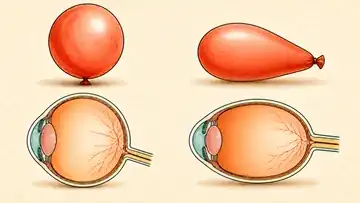
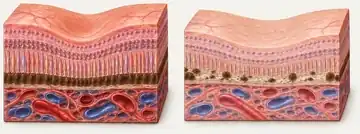
Read the articleA balloon analogy explains how a longer short-sighted eye can be more vulnerable to retinal tears, retinal detachment and myopic macular degeneration.
Read the articleWhat a Weiss ring is made of, how it forms during posterior vitreous detachment, why it is named after Weiss, and what patients and optometrists should know.
Read the articleThere is no single best lens implant, just as there is no single best car. The right IOL depends on your lifestyle, visual priorities and eye health.
Read the articleA friend’s favourite lens implant may not suit your eyes or priorities. Cake and jacket analogies explain cataract lens choice, focus and visual trade-offs.
Read the articleCompare EDOF, multifocal and monofocal lens implants: glasses independence, contrast, haloes, optical trade-offs and realistic expectations after cataract surgery.
Read the articleHow previous RK changes cataract measurements, lens calculations, wound placement and IOL choice, with realistic expectations for fluctuations and refractive surprises.
Read the articleUnderstand RayOne Galaxy’s spiral optics, reading vision, haloes, toric option and lens materials, with current study evidence and practical limitations.
Read the articleCompare acrylic lens materials, capsule clouding, calcification, older Oculentis lenses, glistenings and the effects of air or gas in retinal and corneal surgery.
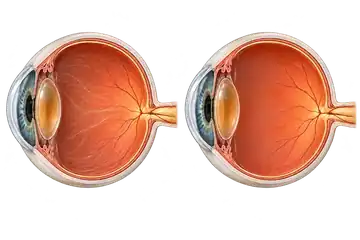
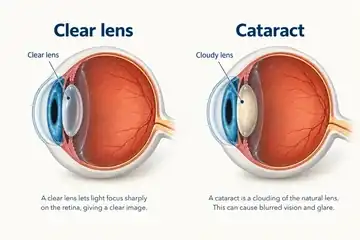
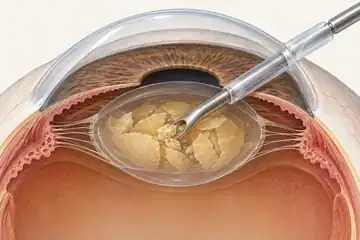
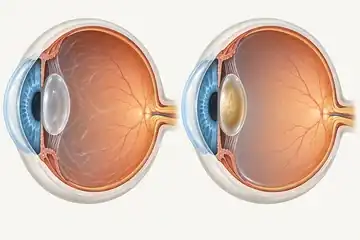
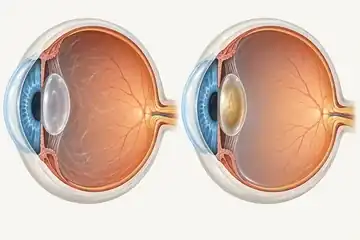
Read the articleWhat cataracts are, and what to consider before surgery.
When is it time for cataract surgery? A patient guide to daily activities, glare, eye checks, waiting, benefits and risks.
Read the articleWhat glasses, lighting and glare control can help with, what the evidence says about cataract drops and supplements, and when to discuss surgery.
Read the articleMost cataracts develop with age, but other factors can contribute. Why cataracts form, what may cause them earlier, and when further checks can help.
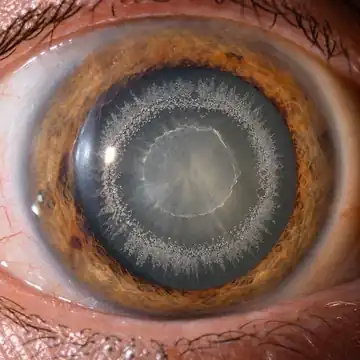
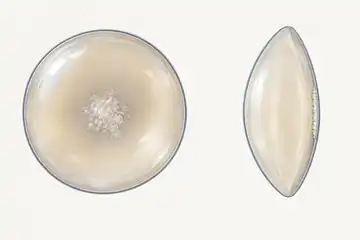
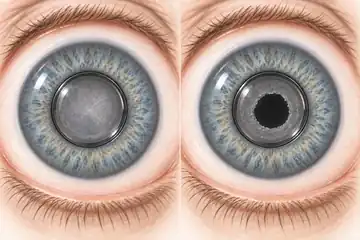
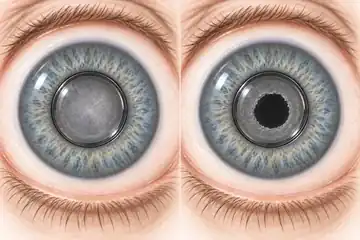
Read the articleA visual guide to common cataract patterns, injury-related changes and selected childhood cataracts, showing where clouding forms inside the lens.
Read the articleLaser eye surgery acts on the cornea, not the lens. Why people who had LASIK often need cataract surgery earlier, and when implant lenses can cause cataract.
Read the articleChoosing a cataract surgeon in Sydney: questions about experience, retinal checks, lens calculations, anaesthesia, complications and aftercare.
Read the articleCompare public and private cataract surgery in Australia: waiting times, surgeon choice, supervised training, lens options, equipment and costs.
Read the articleWhy dry eye matters for cataract lens measurements, toric planning and recovery. Learn about surface treatment, repeat scans and symptoms needing urgent help.
Read the article →Find out when to stop soft, rigid and scleral contact lenses before lens measurements, including advice for keratoconus, previous RK and corneal grafts.
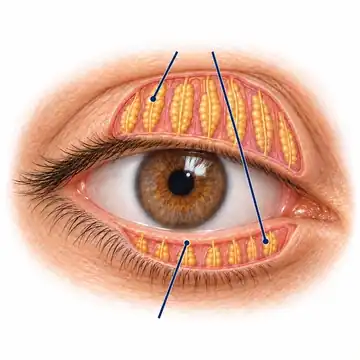
Read the article →Learn where the meibomian glands are and how to warm, gently massage and clean your eyelids to help control blepharitis symptoms.
Read the article →Taking tamsulosin or took it years ago? Learn why it matters for cataract surgery, how surgeons plan for floppy iris syndrome and why not to stop it yourself.
Read the article →How a short-sighted eye changes cataract planning, from retinal checks and lens power to reading vision, monovision and anaesthesia.
Read the articleHad LASIK, PRK or SMILE? Learn how previous laser surgery changes cataract measurements, lens choice and expectations, and which records to bring.
Read the articleHow previous RK changes cataract measurements, lens calculations, wound placement and IOL choice, with realistic expectations for fluctuations and refractive surprises.
Read the articleWhat pseudoexfoliation means for cataract surgery: weak zonules, dropped nucleus, capsular tension rings, glaucoma, genetics and retinal surgical support.
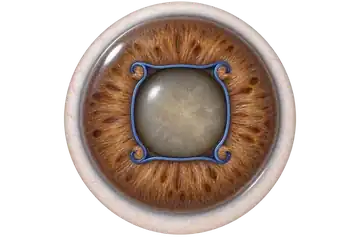
Read the articleSmall pupils restrict the view during cataract surgery. Learn why they occur and how viscoelastic, iris hooks and Malyugin rings help.
Read the articleCataract surgery with uveitis usually needs a quiet eye, a check of the macula and an individual anti-inflammatory plan before and after surgery.
Read the articleWhat a capsular tension ring does during cataract surgery, why it may help with weak zonules or pseudoexfoliation, and its limitations.
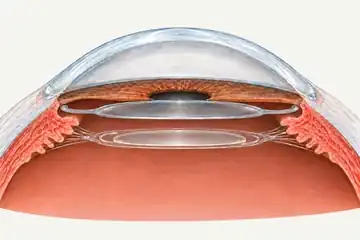
Read the articleHow the types of lens implant differ, and how one is matched to your eyes and priorities.
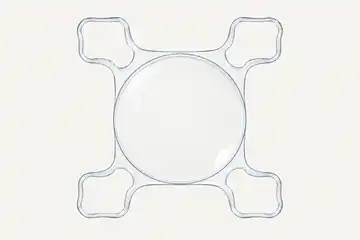
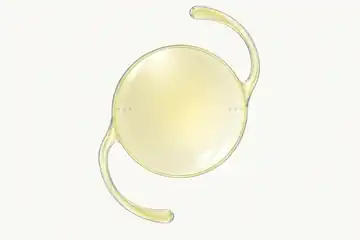
There is no single best lens implant, just as there is no single best car. The right IOL depends on your lifestyle, visual priorities and eye health.
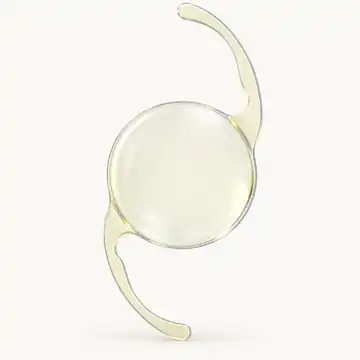
Read the articleMonofocal, enhanced monofocal, EDOF, multifocal and toric implants, what each is for, and how the choice is made.
Read the articleA friend’s favourite lens implant may not suit your eyes or priorities. Cake and jacket analogies explain cataract lens choice, focus and visual trade-offs.
Read the articleDr Simon Chen explains eye doctors’ personal lens choices and the trade-offs of monofocal, mini-monovision and EDOF lenses.
Read the articleUnderstand multifocal lens implants: less dependence on glasses, haloes and night vision, who should avoid them, alternatives and what to ask before cataract surgery.
Read the articleCompare EDOF, multifocal and monofocal lens implants: glasses independence, contrast, haloes, optical trade-offs and realistic expectations after cataract surgery.
Read the articleToric implants can reduce astigmatism during cataract surgery. How they work, why measurements and alignment matter, and when glasses may still be needed.
Read the articleHow mini-monovision uses different focus in each eye to reduce reliance on glasses. Understand reading, night driving, lens choices and the trade-offs.
Read the article →If you are short-sighted, aiming for 6/6 or 20/20 distance vision after cataract surgery can change your reading vision. Compare distance and near targets.
Read the articleHow AMD stage, contrast, astigmatism and everyday goals affect cataract lens choice, including monofocal, toric, enhanced monofocal and EDOF options.
Read the article →Compare acrylic lens materials, capsule clouding, calcification, older Oculentis lenses, glistenings and the effects of air or gas in retinal and corneal surgery.
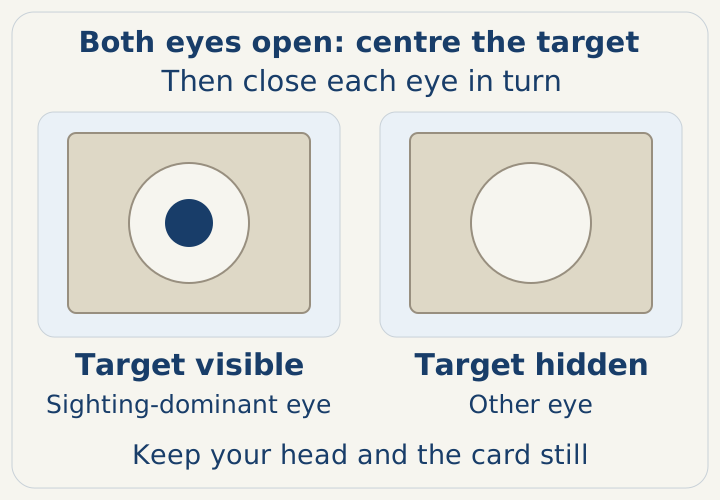
Read the articleLearn how to test your dominant eye, why home tests have limits, and how ocular dominance helps guide monovision in cataract and laser eye surgery.
Read the article →How to read the graph used to compare lens implants, what its shape means, and the questions it cannot answer.
Read the articleIndividual lens implants available in Australia, grouped by type.
Clareon is a monofocal cataract lens designed for a clear main focus. Its material, edge design, evidence and limits.
Read the articleHow Rayner RayOne EMV extends focus, what mini-monovision adds, Australian availability, toric options, clinical evidence and remaining glasses needs.
Read the articleAlcon's non-diffractive extended-focus lens, with realistic expectations for glasses and night vision, and the evidence behind the design.
Read the articleA detailed guide to PureSee's refractive EDOF design, the vision to expect, its specifications and the evidence behind its benefits and limits.
Read the articleTwo extended depth of focus implants used in Australia, compared on range of vision, night driving and the head-to-head evidence.
Read the articleUnderstand PanOptix Pro trifocal lens implants: glasses, haloes, night driving, astigmatism, suitability and how the newer design compares with earlier PanOptix.
Read the article →Understand the Bausch + Lomb enVista Envy trifocal lens: glasses use, haloes, toric correction, suitability and the Australian recall history.
Read the article →Understand RayOne Galaxy’s spiral optics, reading vision, haloes, toric option and lens materials, with current study evidence and practical limitations.
Read the articleHow the Light Adjustable Lens works, Australian registration and access, LAL versus LAL+, adjustment visits, UV glasses, benefits, risks and evidence.
Read the articleHow the 1stQ AddOn supplementary sulcus lens can correct a remaining prescription or add near focus after cataract surgery, with benefits, risks and alternatives.
Read the articleSulcoflex is an add-on lens placed in front of an existing implant. Compare its aspheric, toric and trifocal options, evidence and surgical risks.
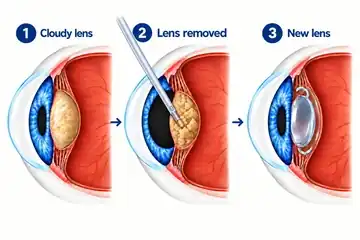
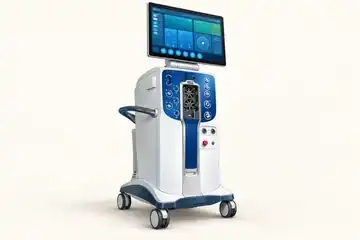
Read the articleHow the operation is carried out and the equipment used.
How image-guided registration helps align toric lens implants, how it compares with manual marking, and why perfect alignment and glasses-free vision are not guaranteed.
Read the article →A plain-English guide to how UNITY VCS controls ultrasound, fluid, cutting and light during cataract and retinal surgery.
Read the articleLearn how irrigation, aspiration and surge control help keep eye pressure stable during cataract surgery, and what clinical studies have shown.
Read the article →When an implant cannot rely on the eye's usual support, Yamane fixation anchors it behind the iris. How it works and how it compares.
Read the articleWhat to expect afterwards, and what can be done if vision is not as expected.
What to expect in the first six weeks after cataract surgery, from drops and sleeping to driving, work and new glasses.
Read the articleHow to put in eye drops, space doses, use aids, store and travel with bottles, arrange repeat prescriptions and know when to ask a pharmacist for help.
Read the article →Will you need glasses after cataract surgery? Explore lens choices for reading, screens and night driving, with realistic benefits and trade-offs.
Read the articleWhy a lens implant can cause a visible reflection in the pupil, what the AcrySof research shows, and how this differs from glare or flickering vision.
Read the articleWhy vision may be blurry after cataract surgery, what a rotated toric lens can change, and when to seek urgent help.
Read the articleA dark arc at the outer edge of vision can occur after lens implantation. The suspected lens-edge mechanisms, how symptoms may change, and options that remain.
Read the articleWhy the capsule can cloud after cataract surgery, how YAG laser clears it, the two treatment patterns, recovery, floaters and retinal risks.
Read the article →Why YAG changes the capsule, how lens exchange can still be performed, and why unresolved lens-related symptoms should be assessed before laser.
Read the article →IOL exchange: why an implant is sometimes replaced, what the alternatives are, how a replacement is secured, and what the risks are.
Read the articleHow Sulcoflex and 1stQ AddOn supplementary lenses can correct a remaining prescription after cataract surgery, with alternatives, recovery and risks.
Read the article →What the first six weeks after refractive lens exchange are really like, from the gap between the two eyes to night driving, sport, work and new glasses.
Read the articleWhat a dropped nucleus means, why it happens, how vitrectomy and a fragmentome help, and what patients and optometrists can expect.
Read the articleWhat floaters are, when flashes or floaters are urgent, and the options if they persist.
Learn what new flashes, floaters or a fixed shadow can mean, how your retina is examined, and when to contact an eye-care professional.
Read the articleNew floaters after cataract surgery are often floaters that were already there, now easier to see, or a few specks from healing. Later, changes in the gel can add more. What to check, and when it is urgent.
Read the articleWhy floaters can appear after YAG capsulotomy, how long they may last, what changes after vitrectomy, and when to seek urgent eye care.
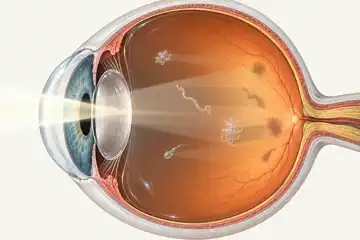
Read the articleWhat eye floaters are made of: collagen strands, Weiss rings, blood and inflammatory material, how they cast shadows, and when new symptoms need urgent care.
Read the article →You see the pattern a floater leaves on your retina, not the floater itself. Why distance, bright light and movement change what you notice.
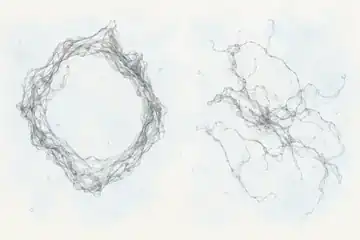
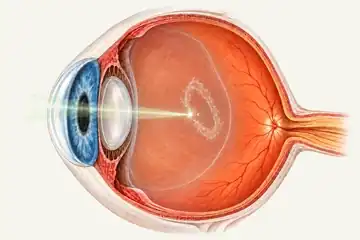
Read the articleWhat a Weiss ring is made of, how it forms during posterior vitreous detachment, why it is named after Weiss, and what patients and optometrists should know.
Read the articleDr Simon Chen uses an egg analogy to explain how ageing vitreous gel becomes more liquid, separates from the retina and can sometimes cause a retinal tear.
Read the article →Persistent eye floaters can affect everyday life, even with good eyesight. Dr Simon Chen explains the pebble-in-your-shoe analogy and what studies show.
Read the articleA balloon analogy explains how a longer short-sighted eye can be more vulnerable to retinal tears, retinal detachment and myopic macular degeneration.
Read the article →Most floaters settle with time. An honest look at VitroCap N, low-dose atropine, enzyme supplements and other non-surgical options.
Read the articleWhich floaters suit laser treatment, what improvement is realistic, the risks, and how it compares with surgery or leaving them alone.
Read the articleLaser or surgery for persistent floaters? How the type and position of your floaters, your lens and your age shape the choice, and what each can realistically achieve.
Read the articleWhen floaters are still getting in the way after several months: what surgery achieves, its real risks, and when waiting or laser is the better choice.
Read the articleFloater surgery varies more between surgeons than many people expect. What each choice aims to do, and what the evidence shows.
Read the articleWhat 25-gauge and 27-gauge mean, how they compare on wound size, stitches, operating time and risks, and what the evidence does and does not show for floater surgery.
Read the articleSurgeons disagree about whether to lift the gel off the retina during floater surgery. Pros and cons, and what the studies show.
Read the articleWhat the first days and weeks are really like after floater surgery, from drops and showering to exercise, driving and travel.
Read the articleWhy removing the vitreous gel brings on a cataract in many eyes, who is most affected, and what it means for planning floater and cataract surgery.
Read the articleA vitreous frill is a term used for the visible edge of gel remaining near the edge of the eye after vitrectomy. Some patients notice it as a moving peripheral strand, ripple or shadow after surgery for floaters. Observation may be appropriate once the retina has been checked; persistent, troublesome remnants can sometimes be treated with further surgery.
Read the articleThe vitreous gel does not grow back after vitrectomy. Learn what replaces it, how the eye stays filled and why an adult eye can function without the gel.
Read the article →Retinal conditions, recovery from vitrectomy, and operating on the cataract and retina together.
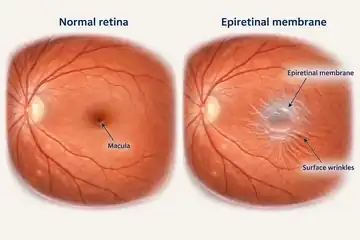
When is epiretinal membrane surgery worth considering? Learn how symptoms, OCT changes and the risk of prolonged traction guide a choice between observation and surgery.
Read the articleHow ageing and vitreous separation can lead to a membrane on the macula, other causes, and what patients and optometrists should look for.
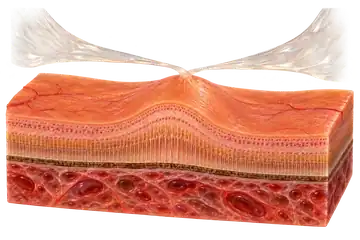
Read the articleVMT can release naturally, but persistent traction may damage central vision. Explore monitoring, macular-hole risk and the benefits and risks of surgery.
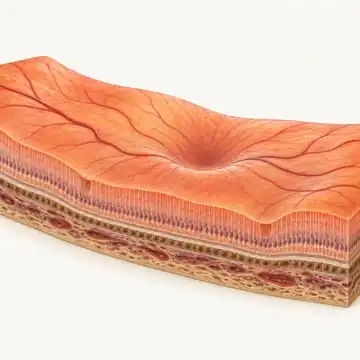
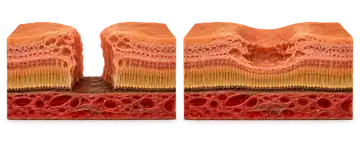
Read the articleDistinguish true holes from schisis, pseudoholes and focal outer-retinal defects, then describe cause, size and referral urgency.
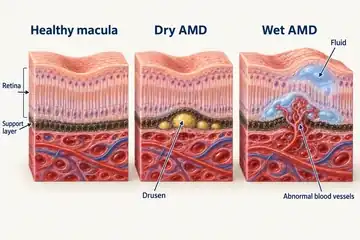
Read the articleWet AMD adds leaking abnormal blood vessels to underlying macular degeneration. Compare wet and dry AMD, their medical names and treatments.
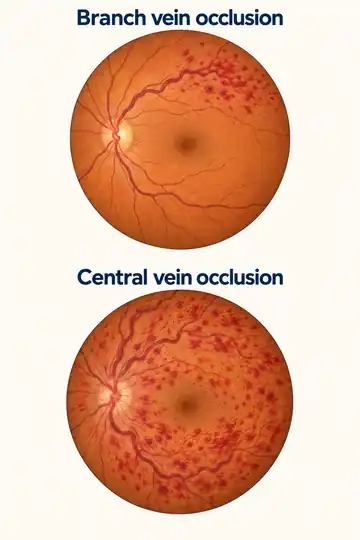
Read the articleA blocked retinal vein can cause bleeding and swelling inside the eye. What treatment can help, what recovery depends on, and why ongoing checks matter.
Read the articlePlan the first days and weeks after vitrectomy, understand gas and positioning restrictions, and know when to ask for help.
Read the articleFollow your individual positioning plan with practical advice on the 50-minute routine, sleeping, fallback positions and home support.
Read the articleA gas bubble acts like a temporary internal splint after retinal surgery. Learn how it supports macular hole closure and retinal detachment repair.
Read the articleA tissue-paper analogy explains why some distortion can remain after membrane peeling or macular hole closure, and why retinal recovery takes time.
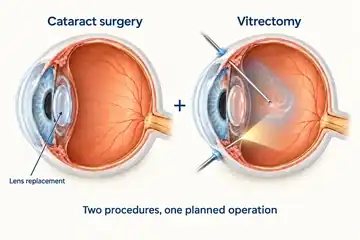
Read the articleCombining cataract surgery and vitrectomy can mean one anaesthetic and one recovery. When that helps, when separate operations are better, and what the evidence shows.
Read the articleCataract first, membrane first or both together? Learn how symptoms and OCT guide surgery, lens choice and realistic visual expectations.
Read the article →Why a cataract follows vitrectomy, what makes the operation different in that eye, and how the lens implant and timing are chosen.
Read the articleWhy removing the vitreous gel usually brings on a cataract, how soon it happens, why age matters, and whether to combine the two operations.
Read the articleAppointments and enquiries are made through Vision Eye Institute Chatswood.
Level 3, 270 Victoria Avenue, Chatswood NSW 2067Optometrists, GPs and ophthalmologists can refer through Oculo or with the PDF referral form.
Vision Eye Institute confirms your appointment after you submit your request. The request form is not for emergencies. A referral is not strictly essential to request an appointment, but you need a valid one to claim a Medicare rebate for your consultation.