Clareon Vivity lens: benefits, limitations and how it works
Clareon Vivity is an artificial lens used in cataract surgery to provide clear distance vision and a broader range of focus than a standard monofocal lens. Its main strength is vision for everyday tasks at arm’s length, such as using a computer or seeing a car dashboard. It can also provide useful near vision, although reading glasses may still be needed for small print or prolonged reading.

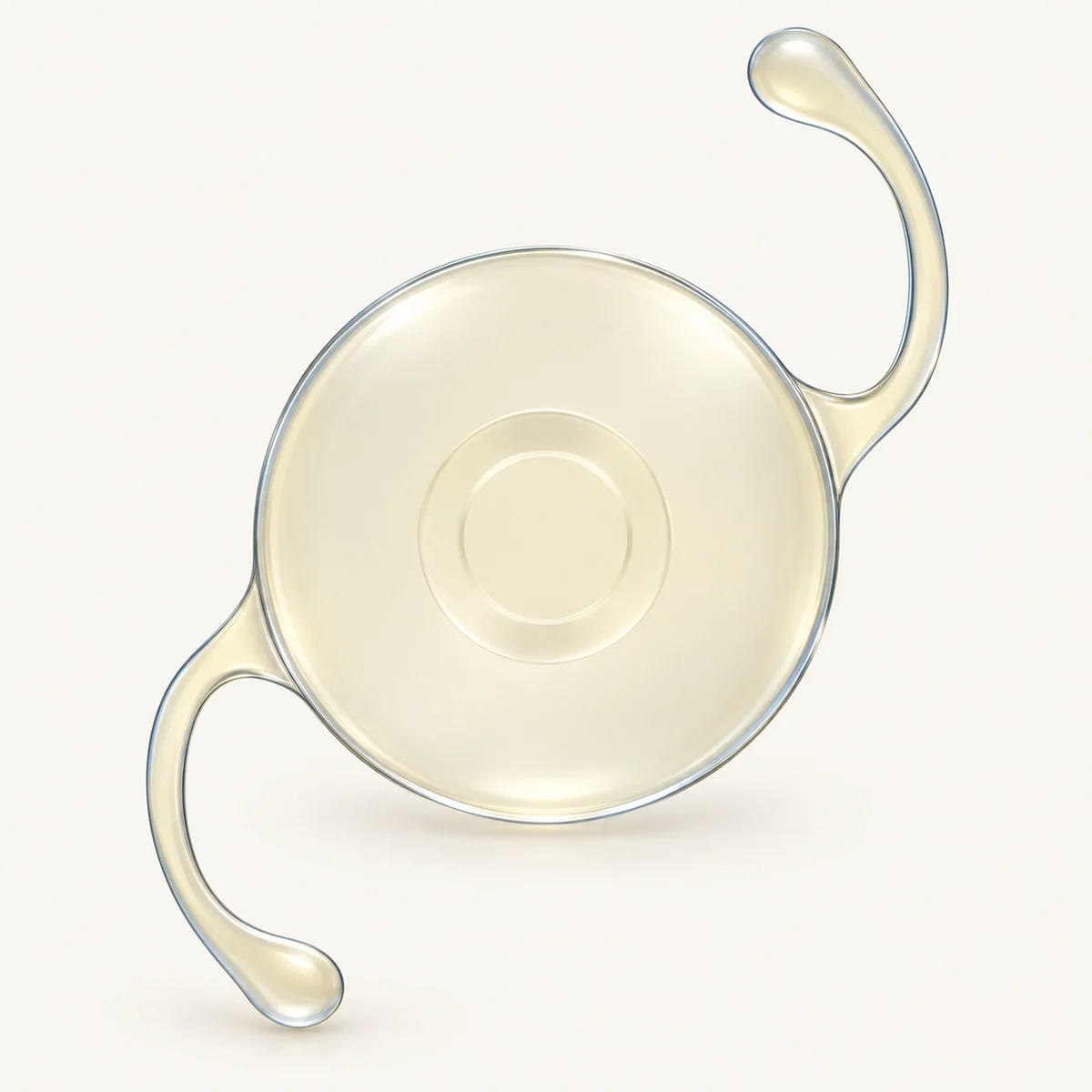
The lens combines Alcon’s Vivity optical design with its newer Clareon acrylic material. It is one option for people who would like less dependence on glasses and are willing to accept some compromise in contrast and close-up vision. It does not guarantee freedom from glasses or night-time visual symptoms.
What is an extended depth-of-focus lens?
An intraocular lens, or IOL, replaces the cloudy natural lens removed during cataract surgery. A standard monofocal IOL has one main focus, usually set for distance. Glasses then provide the extra focusing power needed for closer work.
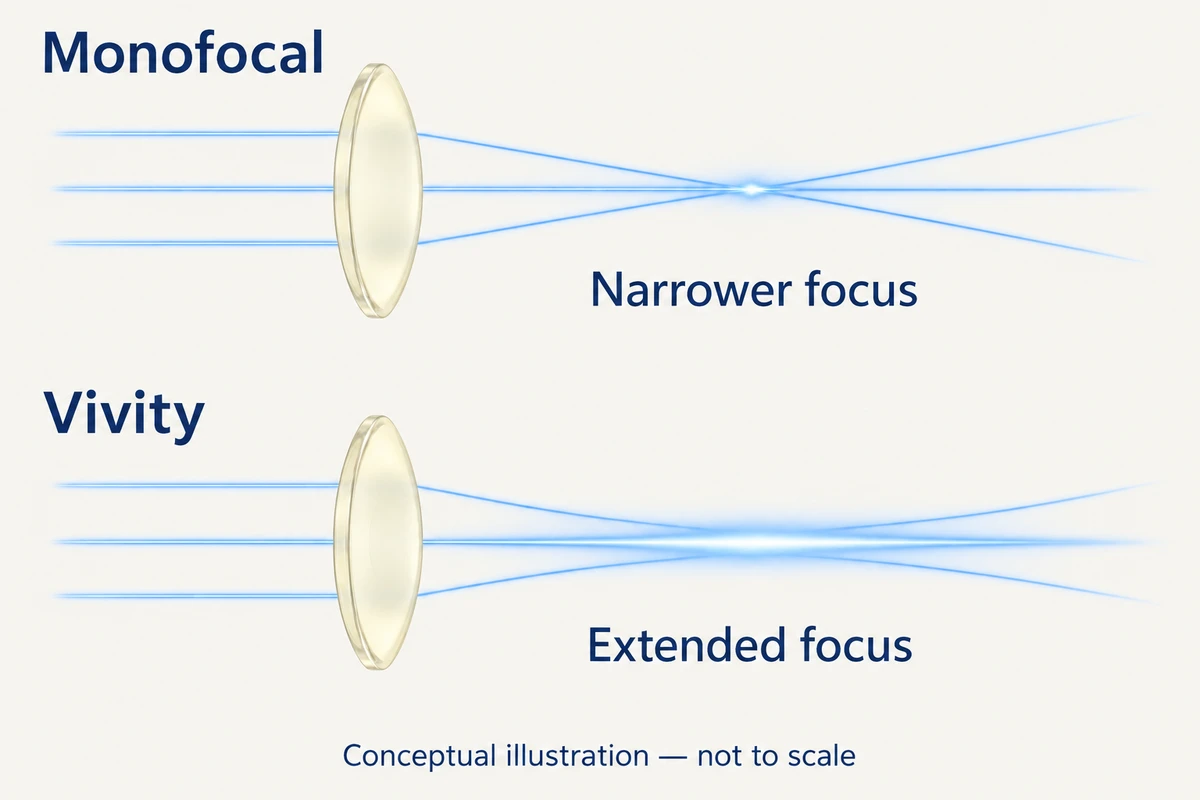
Vivity is an extended depth-of-focus, or EDOF, lens. It spreads useful focus over a broader range. Unlike a trifocal lens, it does not use a series of diffractive rings to create separate distance, intermediate and near focal points. It also does not change shape to focus like a young natural lens.
Clareon Vivity and Clareon PanOptix are different lenses. They share a material family, but PanOptix is a diffractive trifocal. “Clareon” describes the material platform; “Vivity” identifies the extended-focus optical design.
How does Vivity’s optical design work?
Alcon calls the technology X-WAVE. Two very small surface changes in the central 2.2 mm of the front of the optic alter how light travels through the lens. One includes a raised region approximately one micrometre high; the other changes the curvature across this central zone. One micrometre is one-thousandth of a millimetre.
These features modify the shape of the light wavefront, creating an elongated range of focus. Alcon describes their combined effect as stretching and shifting the wavefront. The whole lens still bends light, as other IOLs do; “non-diffractive” does not mean that it works without refraction.
The result is a smoother transition from distance towards intermediate vision, with some useful near vision. The trade-off is that extending focus can reduce contrast compared with a monofocal lens. Being able to read small black letters on a bright chart is not the same as distinguishing a grey object against a dim background.
What is the Clareon material?
Clareon is a flexible hydrophobic acrylic material. The lens can be folded for insertion through a small incision and then unfold inside the eye. It is a single-piece implant: the optic and supporting arms are made from the same material.
Compared with the older AcrySof material, Clareon incorporates hydroxyethyl methacrylate, or HEMA, and has a higher equilibrium water content: approximately 1.5% at body temperature. It is still classified as hydrophobic acrylic. This change was designed to improve material clarity and resistance to glistenings, which are tiny fluid-filled spaces that can develop within some acrylic lenses.
Material studies are reassuring, but “glistening-free” should not be read as a guarantee that every implant will remain perfectly clear for life. A three-year randomised study of Clareon and another modern acrylic lens found no significant difference in visual acuity, glistenings or contrast sensitivity. That study examined monofocal lenses; it was not a three-year trial of Vivity’s extended-focus optics.
The commonly described Australian CNWET models filter ultraviolet and some blue light, giving the implant a faint yellow tint. UV-absorbing variants are also recorded in Australian listings, so the exact model matters. A blue-light filter should not be taken as a promise of protection against macular degeneration.
When was Clareon Vivity introduced in Australia?
The original Vivity lens became commercially available in Australia in April 2020. The updated Clareon Vivity was launched in March 2024. It is the same Vivity optical design in the Clareon material.
Availability nationally is not the same as availability at an individual surgical facility, and it does not establish a patient's insurance benefits or out-of-pocket cost.
What vision can I realistically expect?
Distance: the aim is useful distance vision when the lens is calculated for that target. Glasses may still improve sharpness if there is residual short-sightedness, long-sightedness or astigmatism.
Intermediate: this is Vivity’s main advantage over a standard distance-targeted monofocal lens. Computer work, cooking and other tasks around arm’s length may be easier without glasses.
Near: larger print or a phone held at a comfortable distance may be manageable. Fine print, needlework and sustained reading are less predictable, especially in poor lighting. A trifocal generally places more emphasis on near vision, with a different pattern of optical trade-offs.
Results depend on the health of the whole eye, the accuracy of the lens calculation, astigmatism, the focusing target in each eye, lighting and the task itself. “Less dependence on glasses” is a more realistic expectation than “no glasses”.
What are the main advantages and disadvantages?
The main potential advantages are:
- A broader range of useful vision than a conventional monofocal, particularly at intermediate distances.
- A non-diffractive design intended to limit the halos associated with ring-based multifocal optics.
- A modern acrylic material designed to resist glistenings.
- A toric option to correct suitable corneal astigmatism at the same operation.
The main limitations are:
- Reading glasses may still be needed, even when distance vision is excellent.
- Contrast sensitivity can be lower than with a monofocal lens, particularly relevant in dim light.
- Halos, glare, starbursts, blurred vision or a dark peripheral shadow can still occur.
- A residual focusing error or uncorrected astigmatism can reduce the benefit.
- The lens may be a less suitable compromise for someone whose overriding priority is maximum contrast or very close work without glasses.
Alcon’s US safety information warns that most recipients are likely to have a significant reduction in contrast sensitivity compared with a monofocal lens. It advises caution with night driving and poor visibility. A “monofocal-like” rate of reported light disturbances does not mean identical optical performance. Rarely, symptoms can be troublesome enough for a patient to consider further treatment or lens exchange.
What do the clinical studies show?
The evidence is encouraging for a wider range of vision, but the lens model and study design need to be kept in view. Older Vivity studies often used AcrySof, while newer studies examine Clareon Vivity directly.
Direct Clareon comparison with monofocal lenses
An Alcon-sponsored study, NCT05852470, assessed people three to six months after implantation. Its posted results included 73 Clareon Vivity patients and 75 Clareon monofocal patients for the main visual-acuity measurements. It was not randomised.
Vivity provided better average distance-corrected intermediate vision at 66 cm and near vision at 40 cm. Corrected distance vision met the study’s predefined noninferiority criterion. On average, intermediate vision improved by about one chart line relative to the monofocal group.
However, only 21.4% of 70 Vivity questionnaire respondents said they had never needed glasses during the preceding week, compared with 4.1% of 73 monofocal respondents. Better range of vision did not mean complete spectacle independence for most participants. These are publicly posted registry results rather than a peer-reviewed trial publication, and nonrandomised groups can differ for reasons beyond the lens itself.
The earlier AcrySof Vivity randomised trial
A US registration study implanted 107 participants with AcrySof Vivity and 113 with an AcrySof monofocal lens. At six months, Vivity improved intermediate vision by about 1.6 chart lines, extended depth of focus by 0.54 dioptres at the specified acuity threshold, and maintained comparable corrected distance acuity under the study’s noninferiority criteria.
This supports the Vivity optical concept, but it is not direct evidence about the newer Clareon material. The participants were carefully selected, with other important causes of reduced vision excluded.
Smaller Clareon studies
A Japanese prospective study followed 24 people with bilateral Clareon Vivity for three months. All reported spectacle independence for distance and intermediate tasks, while 9 of 24 still required near glasses. None reported severe light-related symptoms. The small size and absence of a comparison group limit what can be predicted for other patients.
A separate mini-monovision study analysed 25 people at three months. One eye was targeted for distance and the other for mild short-sightedness. Of 24 questionnaire respondents, 11 reported complete spectacle independence. This was an uncontrolled study; it does not establish that this strategy is better for everyone.
Comparison with another EDOF lens
A 2026 randomised study compared Clareon Vivity with Symfony Optiblue, with 31 participants in each group completing three-month follow-up. Overall binocular performance in dim light was similar. Symfony had small advantages on some acuity measures; Vivity performed better on a halo-and-starburst simulation assessment. Patient-reported visual-disturbance questionnaires did not show a significant difference between groups.
This illustrates why one lens cannot be described as best on every measure. The study was supported by Johnson & Johnson Vision; several Vivity studies were supported by Alcon. Funding does not invalidate a study, but study design, size, follow-up and disclosures all matter.
What are the technical specifications?
The following summarises Alcon’s Australian professional specification for the CNWET family. Other delivery systems and light-filter variants have different model codes. Specifications and supply should be checked for the actual implant being ordered.
- Non-toric model: CNWET0.
- Toric models: CNWET2 to CNWET6.
- Optical design: aspheric, biconvex, non-diffractive EDOF; toric surface correction in toric models.
- Optic diameter: 6.0 mm.
- Overall diameter: 13.0 mm.
- Haptics: two supporting loops, with 0° planar angulation.
- Listed spherical powers: +6.0 to +30.0 D in 0.5 D steps; +31.0 to +34.0 D in 1.0 D steps.
- Toric cylinder at the IOL plane: T2 1.00 D; T3 1.50 D; T4 2.25 D; T5 3.00 D; T6 3.75 D.
- Material and filtering: hydrophobic acrylate/methacrylate copolymer; ultraviolet and blue-light filtering for these CNWET models.
- Delivery: Alcon lists the Monarch IV system for this family. Australian lists also contain AutonoMe versions with different codes.
Dioptres describe optical power. The toric cylinder values above are measured at the implant, inside the eye; they are not interchangeable with a glasses prescription or the measured astigmatism at the cornea.
For clinicians, published optical descriptions report a refractive index of approximately 1.55 and negative spherical-aberration correction of approximately −0.20 micrometres. Alcon’s Australian table lists optical SRK/T A-constant 119.2 and theoretical ultrasound A-constant 118.8. Constants require the appropriate formula, biometry method and optimisation; they are not a recommendation for an individual calculation.
Does the toric version work differently?
The toric version adds correction for regular corneal astigmatism while retaining the Vivity extended-focus design. Astigmatism means that the front of the eye has different focusing powers in different directions.
A toric implant must be aligned with the planned axis. Rotation away from that position can reduce its correction; occasionally repositioning is needed. Accurate corneal measurements and assessment of the tear film are therefore important. A toric lens does not correct every cause of irregular or blurred vision.
Who may be a suitable candidate?
Clareon Vivity may be worth considering when cataract surgery is appropriate, distance and intermediate tasks are priorities, and occasional reading glasses are acceptable. The choice should reflect what you actually do: computer work, night driving, reading distance, hobbies and tolerance of optical symptoms.
Extra care is needed when there is macular disease, glaucoma or other optic nerve damage, significant corneal irregularity, previous laser vision correction, or an unstable tear film. These conditions can already reduce visual quality or make the result harder to predict. Being non-diffractive does not make Vivity automatically suitable for every eye with retinal disease.
The implant is designed for placement inside the natural lens capsule. Weak supporting fibres or damage to that capsule during surgery may require a different lens or surgical plan.
For some people, a monofocal or enhanced monofocal lens offers a better balance. Others place greater value on near vision and may consider a trifocal. The broader options are explained in the lens implant guide and EDOF lens guide.
Can one eye be set slightly nearer?
Sometimes a surgeon targets one eye for distance and leaves the other slightly short-sighted. This is called mini-monovision. It may improve near function, but it changes how the two eyes work together and can affect distance clarity, depth perception or comfort.
The small Clareon study used a target of −0.50 D in the non-dominant eye. That is a research example, not a universal prescription. The intended result in each eye should be discussed before surgery, including the possibility that glasses will still be useful.
What other risks and follow-up should I understand?
Vivity is implanted during cataract surgery and shares the general risks of that operation, including infection, inflammation, retinal swelling, retinal detachment and an unexpected refractive result. The likelihood depends on the eye and the procedure, not simply the lens brand. The cataract surgery guide explains the operation and its risks.
The capsule behind the implant can become cloudy later, called posterior capsule opacification, or PCO. This is different from glistenings inside the acrylic and does not mean the original cataract has grown back. It may be treated with a YAG laser when appropriate. If vision is disappointing, the cause should be assessed first, particularly if lens exchange is being considered.
A useful preoperative discussion should establish the intended focus in each eye, the role of a toric lens, the likely remaining need for glasses, and the importance of night vision for your daily life. The aim is a lens choice that fits both the health of your eyes and your expectations.
Sources and further reading
- Alcon Australia: Clareon Vivity design and specifications .
- Kohnen and colleagues: optical design of a non-diffractive EDOF lens , 2023.
- ClinicalTrials.gov: direct Clareon Vivity versus Clareon monofocal study results, NCT05852470 .
- McCabe and colleagues: US AcrySof Vivity randomised registration trial , 2022.
- Suzuki and colleagues: binocular outcomes with Clareon Vivity in Japanese patients , published online 2025.
- Kuo and Prasertsit: Clareon Vivity with mini-monovision , 2025.
- De Rojas and colleagues: Clareon Vivity versus Symfony Optiblue in dim light , 2026.
- Miyata and colleagues: three-year randomised study of Clareon material , 2025.
- Alcon US: Clareon Vivity safety information .
- mivision: Australian and New Zealand Clareon Vivity launch report , June 2024.
- Insight: early Australian Clareon Vivity use , July 2024; original AcrySof Vivity launch report , September 2020.
- November 2023 Prescribed List , including the initial CNWET0 listing.
- Australian Prescribed List: June 2026 instrument .
- Niknahad and colleagues: optical bench comparison , 2025.