
Toric lens implants: correcting astigmatism during cataract surgery
A toric lens implant can correct regular astigmatism at the same time as cataract surgery. It replaces the cloudy natural lens and compensates for the uneven curvature of the cornea, the clear window at the front of the eye. For suitable eyes, this can make distance vision clearer without glasses. It does not guarantee perfect vision or remove the need for all glasses.

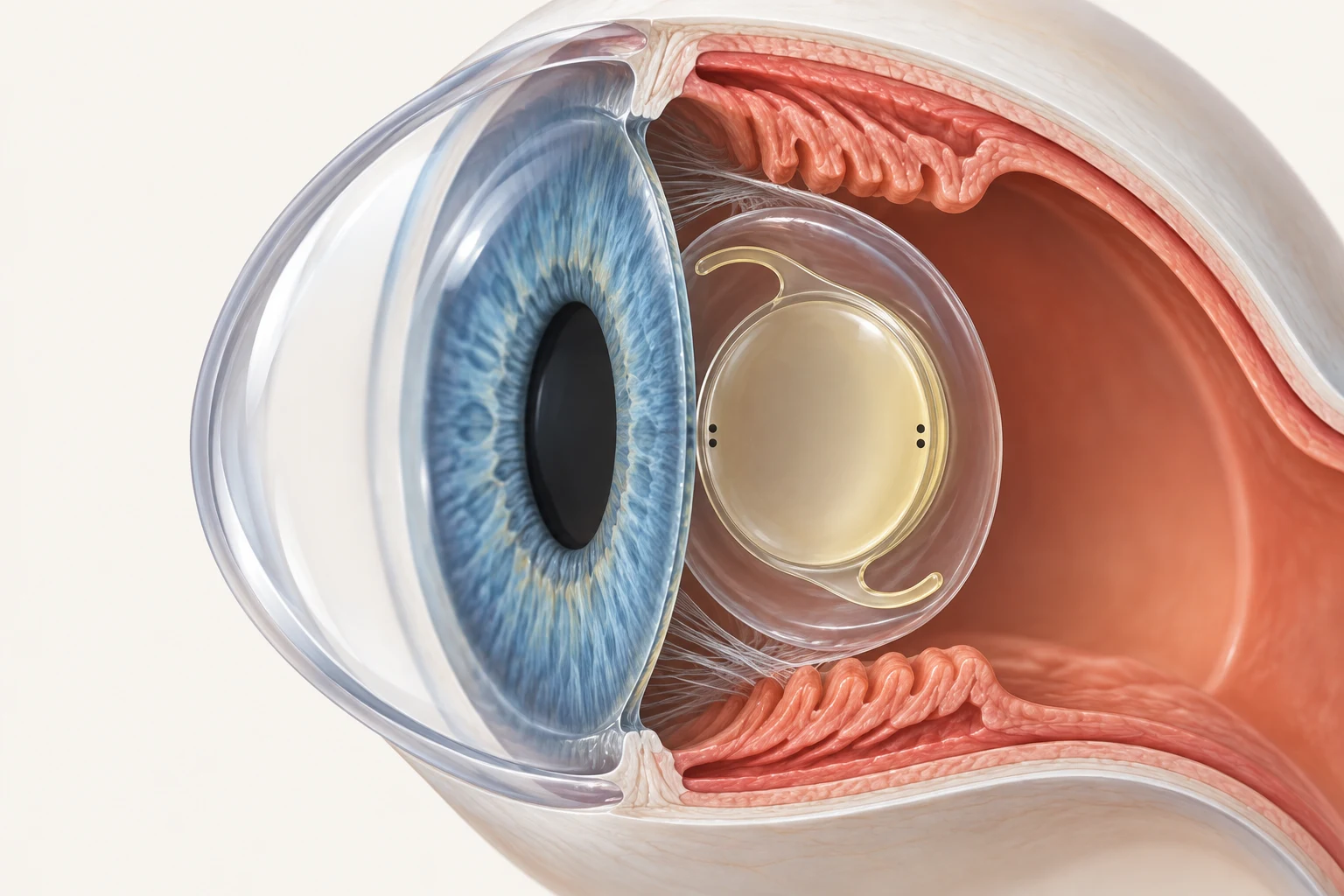
The decision depends on the type and amount of astigmatism, the health of the eye and the vision you want after surgery.
What is astigmatism?
Astigmatism means the eye focuses light differently in different directions. With regular corneal astigmatism, the cornea curves more steeply in one direction than in the direction at right angles to it. A rugby ball and a round ball are a useful comparison, although the actual differences in the eye are much smaller.
This can make details look blurred or stretched at both near and far distances. Glasses and contact lenses can correct it. Astigmatism is measured in dioptres, written as D; its direction is described as an axis.
Some astigmatism comes from the natural lens inside the eye. Cataract surgery removes that lens, but it does not reliably remove the astigmatism coming from the cornea. That is the part a toric implant is designed to address.
How does a toric lens implant work?
An intraocular lens, or IOL, is the small artificial lens placed inside the eye during cataract surgery. A toric IOL has different focusing powers in different directions, chosen to balance the corneal astigmatism.
The implant usually sits inside the thin capsule that previously held the natural lens, behind the coloured iris. It corrects the optics from inside the eye; it does not reshape the cornea.
Does toric mean multifocal?
No. “Toric” describes astigmatism correction. “Monofocal”, “extended depth of focus” and “multifocal” describe how a lens provides focus across different distances. A lens can combine toric correction with one of these designs.
A monofocal toric lens set for distance generally leaves you needing glasses for reading and other close work. Some people choose a different focusing target, but that needs a separate discussion.
Extended-depth-of-focus and multifocal toric lenses offer different ranges of vision and different trade-offs, including possible haloes and glare. Being toric does not, by itself, make a lens suitable for every eye or guarantee freedom from glasses. The focusing design and the astigmatism correction are two separate decisions.
Who might benefit from a toric implant?
Toric implants are most straightforward when corneal astigmatism is regular, stable and large enough to affect the intended result. The likely benefit also depends on how important distance vision without glasses is to you.
A measurement of around 1 D is often a starting point for discussing toric correction, rather than a rule that everyone above that number needs one. Your surgeon considers the astigmatism expected after the operation, not simply the number on your current glasses prescription.
Irregular astigmatism, corneal scarring or keratoconus needs a more individual assessment: a toric lens cannot correct every irregularity. Previous laser eye surgery also makes careful assessment especially important. Other conditions, such as macular disease, may limit vision even when the focusing error is well corrected.
What measurements are needed?
The planning measurements establish the eye's focusing power, the amount and direction of corneal astigmatism, and the appropriate implant.
Corneal mapping helps show whether the curvature is regular. The calculation also needs to account for the back surface of the cornea and the effect of the surgical incision. This is why the cylinder value in a glasses prescription cannot simply be copied onto an implant order.
The tear film can affect the readings. If the surface is dry or measurements do not agree, treatment and repeat measurements may be needed before deciding on the lens. If you wear contact lenses, follow the clinic's instructions about leaving them out before testing.
How much difference can it make?
For suitable eyes, a toric implant can reduce the astigmatism left after surgery and make everyday distance tasks easier without glasses.
In one randomised trial, 84% of people receiving toric monofocal lenses reported not needing distance glasses at six months, compared with 31% receiving non-toric monofocal lenses. These were 31 of 37 and 14 of 45 people with available follow-up responses, respectively.
The trial involved selected patients with regular astigmatism in both eyes and older lens models. Its results illustrate a possible benefit; they are not your personal chance of avoiding glasses, and they do not describe freedom from reading glasses.
Some astigmatism or another focusing error can remain after any lens calculation. Glasses may still provide the sharpest vision for particular tasks.
Why does the angle of the implant matter?
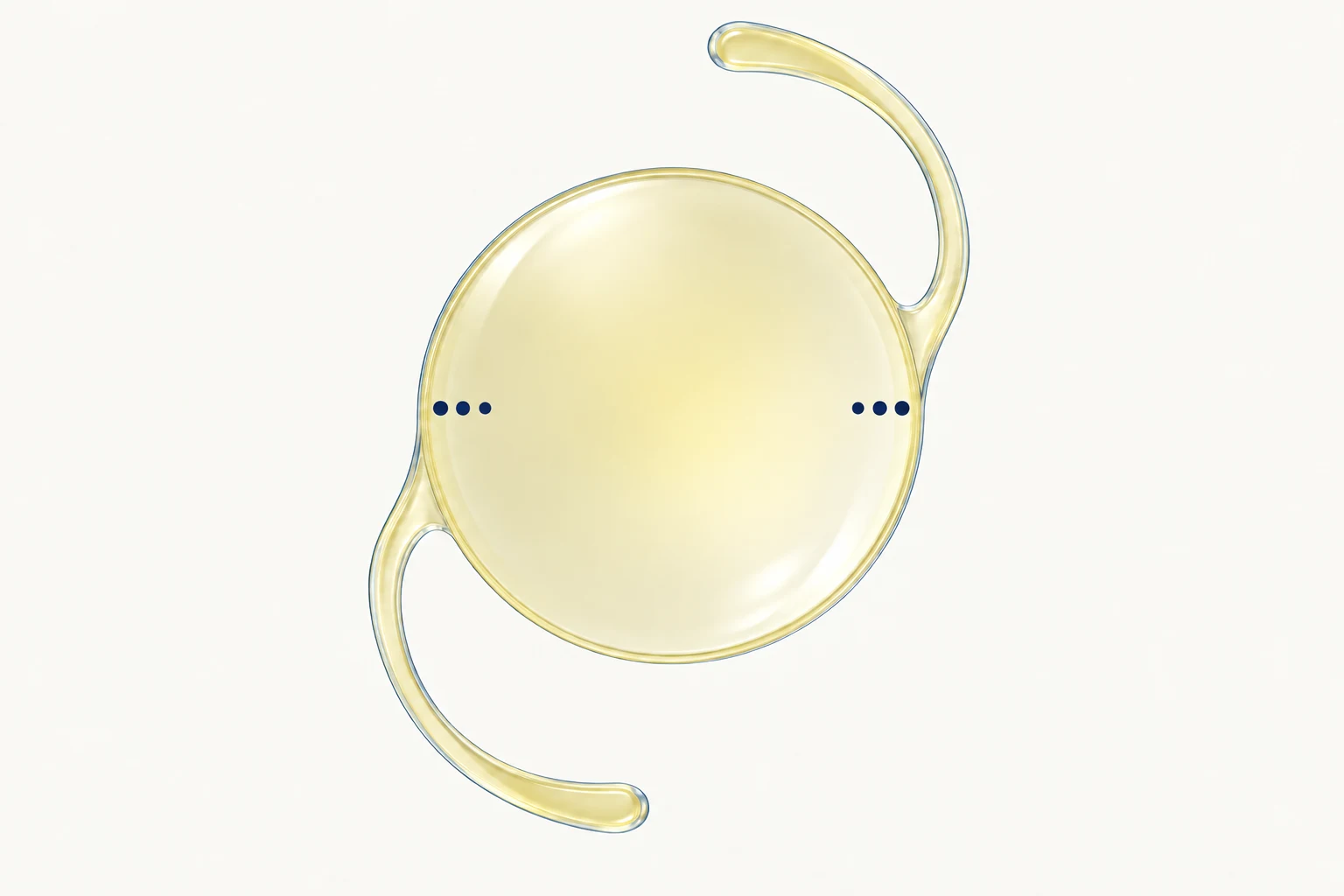
A toric implant must line up with the planned direction of correction. Small marks on the lens help the surgeon orient it. The correct angle is individual to the eye; it is not always horizontal.
If the lens is placed away from the intended angle, or rotates afterwards, it may correct less astigmatism than planned. A lens that has rotated enough to affect vision may need another operation to reposition it. The decision depends on the examination, the remaining prescription and the benefit expected from moving it.
Blurred vision does not automatically mean the lens has rotated. Healing, dryness, other focusing errors and other eye conditions can also be responsible.
How is the axis marked during surgery?
The eye rotates slightly when you lie down, so the axis measured while you are sitting upright is not exactly where it will be on the operating table. That difference has to be allowed for.
One way is to mark the eye by hand with ink while you are sitting up, then line the implant up with those marks during the operation. The other is a digital marking system. An image of the front of your eye, taken at the measurement visit, is matched to the live view down the operating microscope using the pattern of your iris and the blood vessels on the white of the eye. The intended axis is then projected into the surgeon’s view and follows the eye as it moves.
Dr Chen uses the ZEISS CALLISTO eye system with the operating microscope, so the axis is guided digitally rather than by ink marks.
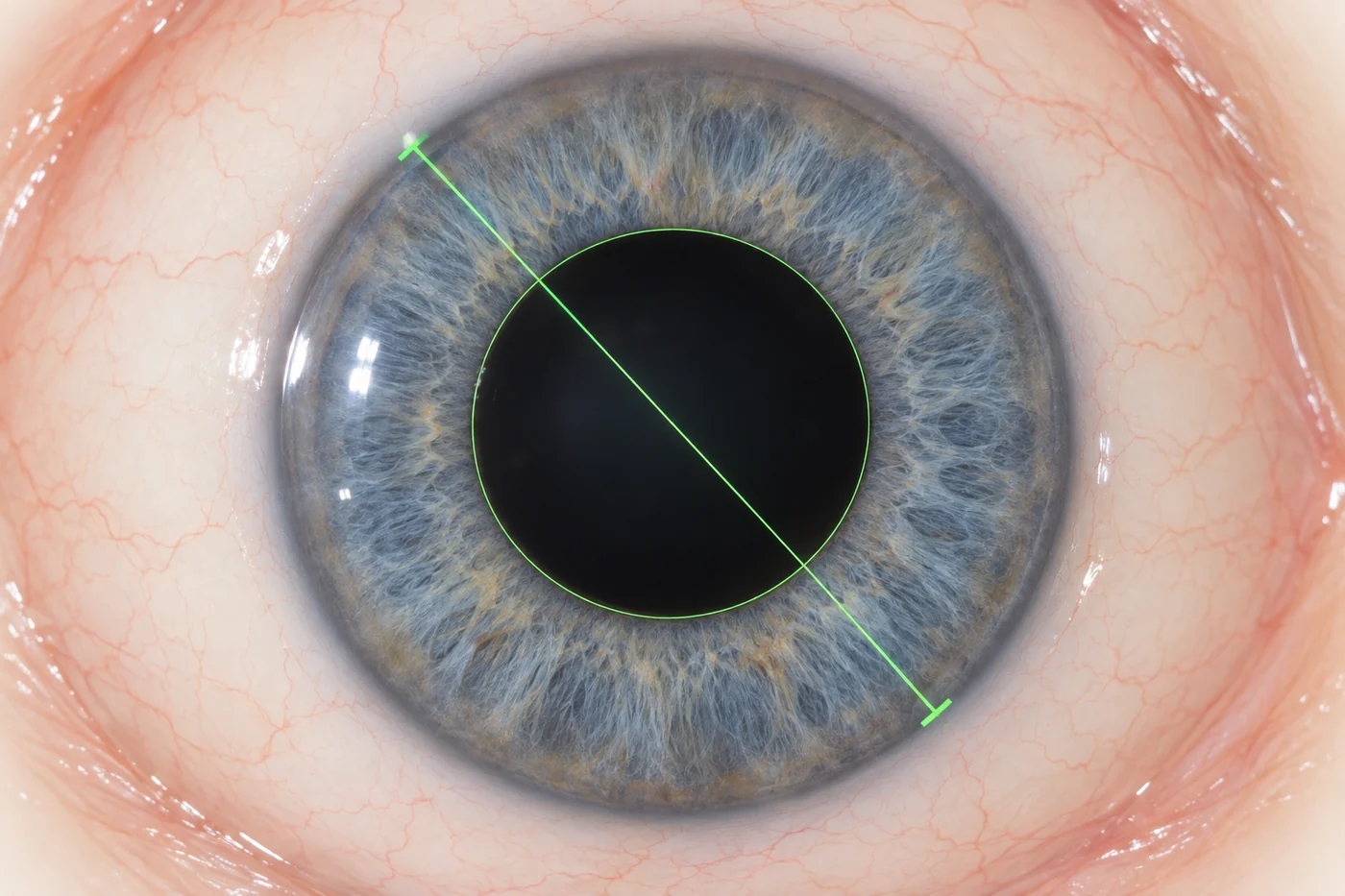
Digital guidance removes the ink step and the error that goes with hand marking, and it allows for the eye rotating between sitting and lying. It does not make the measurements themselves more accurate, and it does not stop a lens rotating after surgery.
What are the alternatives?
A non-toric implant with glasses afterwards is a reasonable option. Contact lenses may also correct remaining astigmatism when appropriate.
For some eyes, small relaxing incisions in the cornea can reduce astigmatism. These may be made manually or with a femtosecond laser. They change corneal curvature, whereas a toric implant compensates for it inside the eye.
Neither approach is best for every situation. In a 2025 randomised trial of 196 people with mild to moderate regular astigmatism, laser corneal incisions and toric implants did not show a statistically significant overall difference in remaining astigmatism at three months. That does not prove they are equivalent for every eye.
The choice depends on the amount and pattern of astigmatism, the rest of the eye and your preferences about glasses.
What risks and limitations should I understand?
Toric implants share the general risks of cataract surgery, including infection, inflammation, swelling, retinal complications and an unexpected visual result. Some complications can threaten sight. Your surgeon should explain the risks relevant to your eye.
The additional issue with toric correction is alignment: residual astigmatism may occur even after careful planning, and significant misalignment can require repositioning. Some people need glasses or, in selected circumstances, a further procedure to improve the result. Another procedure has its own risks.
After surgery, seek urgent advice for worsening vision, severe pain, increasing redness, new flashes or floaters, or a curtain across your vision. Contact your surgical team promptly; if you cannot reach them, seek urgent eye care or attend an emergency department. Do not wait for a routine follow-up appointment.
What should I ask before deciding?
- Is my astigmatism regular, and how much is likely to remain without a toric lens?
- What focusing range and target are being proposed, and when will I still need glasses?
- Could another eye condition limit the benefit?
- How will the implant's alignment be checked, and what would happen if the result needs adjustment?
The aim is to choose a correction that suits your eye and your daily activities. A toric implant can be a useful part of that plan, with realistic expectations about glasses and the limits of surgery.
Sources
- ESCRS recommendations for cataract surgery .
- Visser and colleagues: toric versus non-toric monofocal lenses, randomised trial, 2014 .
- Zhong and colleagues: laser corneal incisions versus toric implants, randomised trial, 2025 .
- Hu: toric lens repositioning, retrospective study, 2023 .
- Koch and colleagues: posterior corneal astigmatism, 2012 .
- National Eye Institute: astigmatism .
- National Eye Institute: cataract surgery .
- Epitropoulos and colleagues: tear film and measurement repeatability, 2015 .
- Schneider and colleagues: tear osmolarity and measurement repeatability, 2026 .