Alcon Clareon monofocal lens: design, benefits and limitations
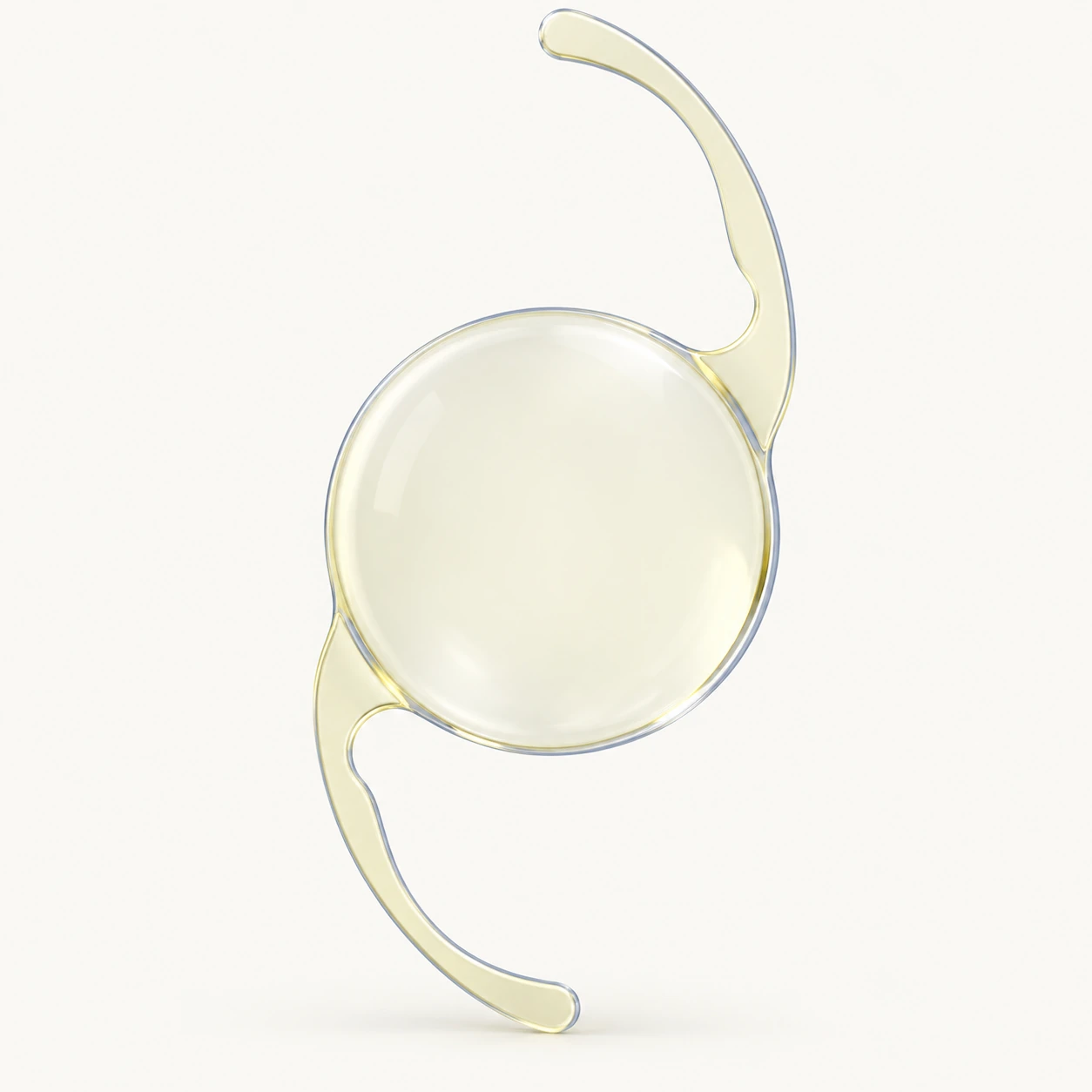
The Alcon Clareon monofocal is a small artificial lens that replaces the cloudy natural lens during cataract surgery. It is designed to provide a clear main focus, usually for distance, using a smooth aspheric optic and an acrylic material engineered to resist microscopic changes called glistenings. Reading glasses are usually still needed when both eyes are set for distance.

Published studies support good distance vision and stable performance over several years, but they do not establish it as the best lens for every eye. The health of the eye, the accuracy of the measurements and the chosen focus are all important.
Which Clareon lens does this guide describe?
This guide concerns the original Clareon monofocal lens, including its toric version for astigmatism. Common model names include CNA0T0 and SY60WF. Model codes also distinguish the light filter and whether the lens comes preloaded in an injector.
Clareon is also the name of the acrylic material platform used for other Alcon lenses. Clareon Vivity has an extended-depth-of-focus design, while Clareon PanOptix is a trifocal. Alcon also announced Clareon TruPlus, a distinct enhanced monofocal design, in the US in 2026. Results and availability for these lenses should not be assumed to apply to the original Clareon monofocal.
A toric lens corrects astigmatism; that feature does not turn a monofocal into a multifocal. The lens implant guide explains the broader choices.
How does the lens work?
Clareon works by refraction: its curved surfaces bend incoming light to help focus an image on the retina, the light-sensitive layer at the back of the eye. The implant takes over the focusing role of the natural lens removed during cataract surgery. The cornea continues to provide much of the eye's focusing power.
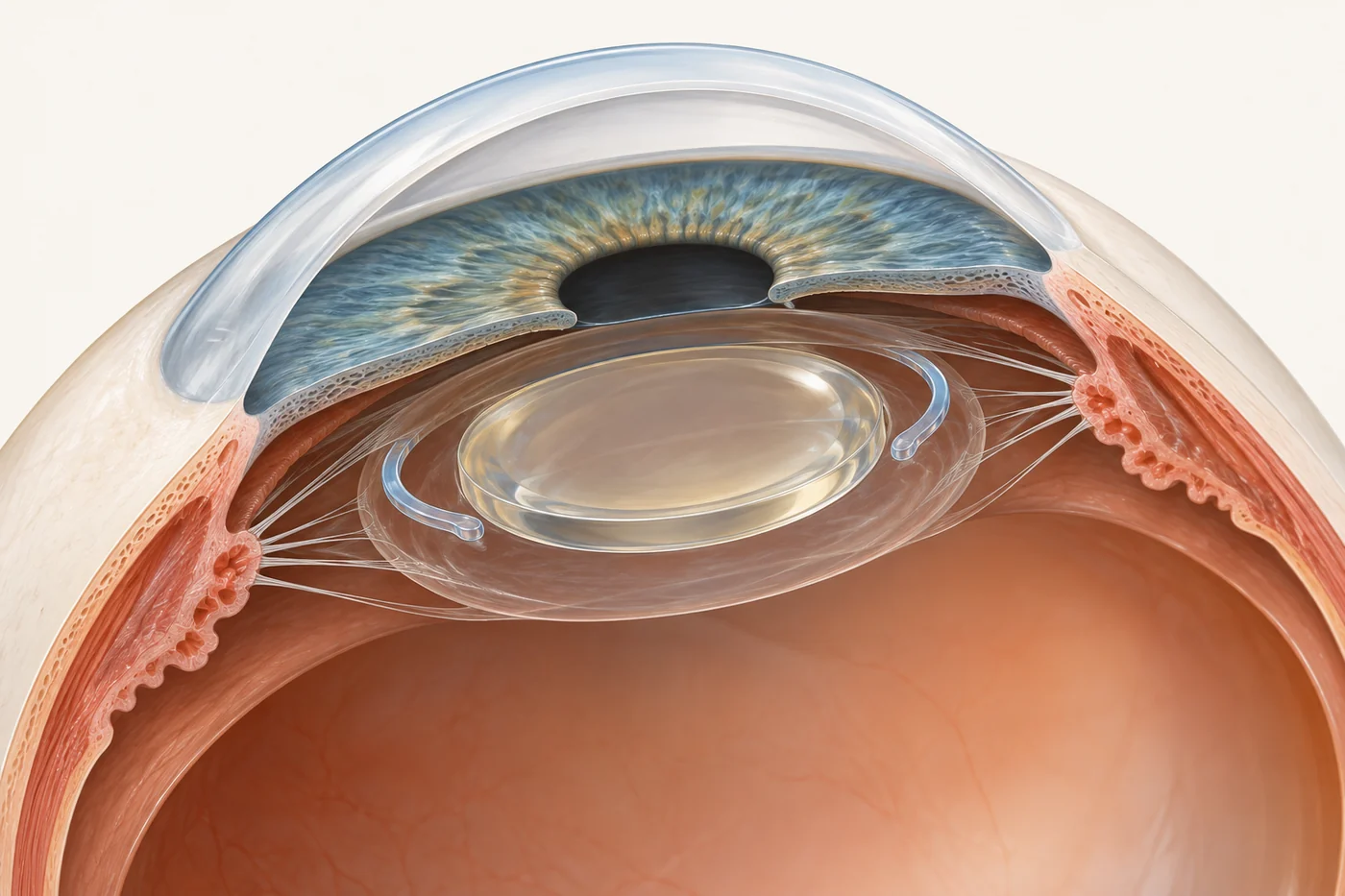
The monofocal optic has one principal focus. For many people, the chosen lens power aims for clear distance vision. Another person may choose a nearer focus, accepting the need for distance glasses. The implant does not actively change shape to switch between distances as a young natural lens does.
Aspheric describes a surface whose curvature is more complex than part of a simple sphere. Clareon's front surface is designed to offset some of the average cornea's spherical aberration, an optical imperfection in how central and peripheral light rays focus. This is a subtle surface shape, not a set of visible multifocal rings. It does not correct every optical imperfection in every eye.
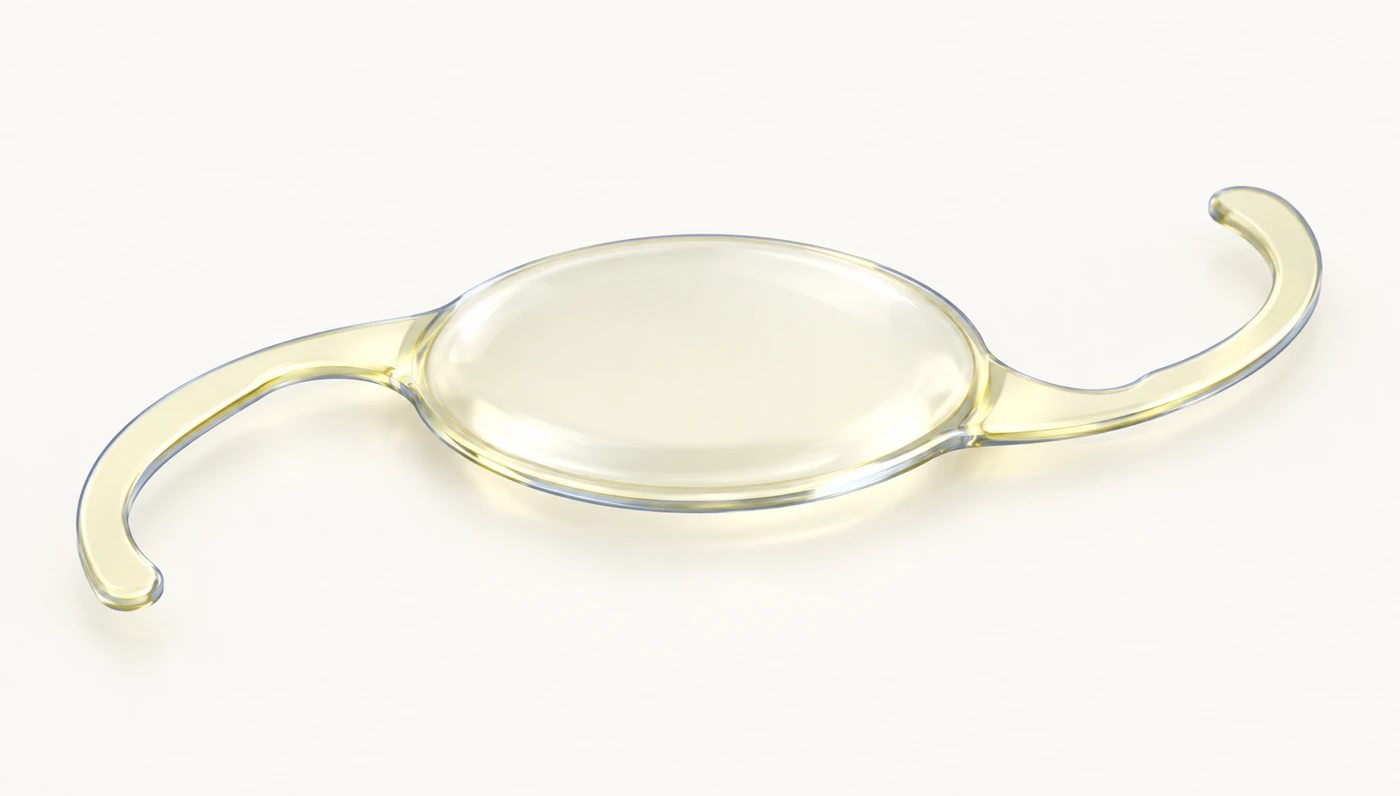
The two curved supports, called haptics, hold the optic within the natural lens capsule. This is the thin, transparent envelope retained during routine cataract surgery. The lens is designed to sit inside that capsule, rather than being a general-purpose implant for every alternative fixation technique.
What is Clareon made from?
Clareon is made from a flexible hydrophobic acrylic copolymer. The optic and haptics form one piece. The material can be folded for insertion and then unfolds inside the eye.
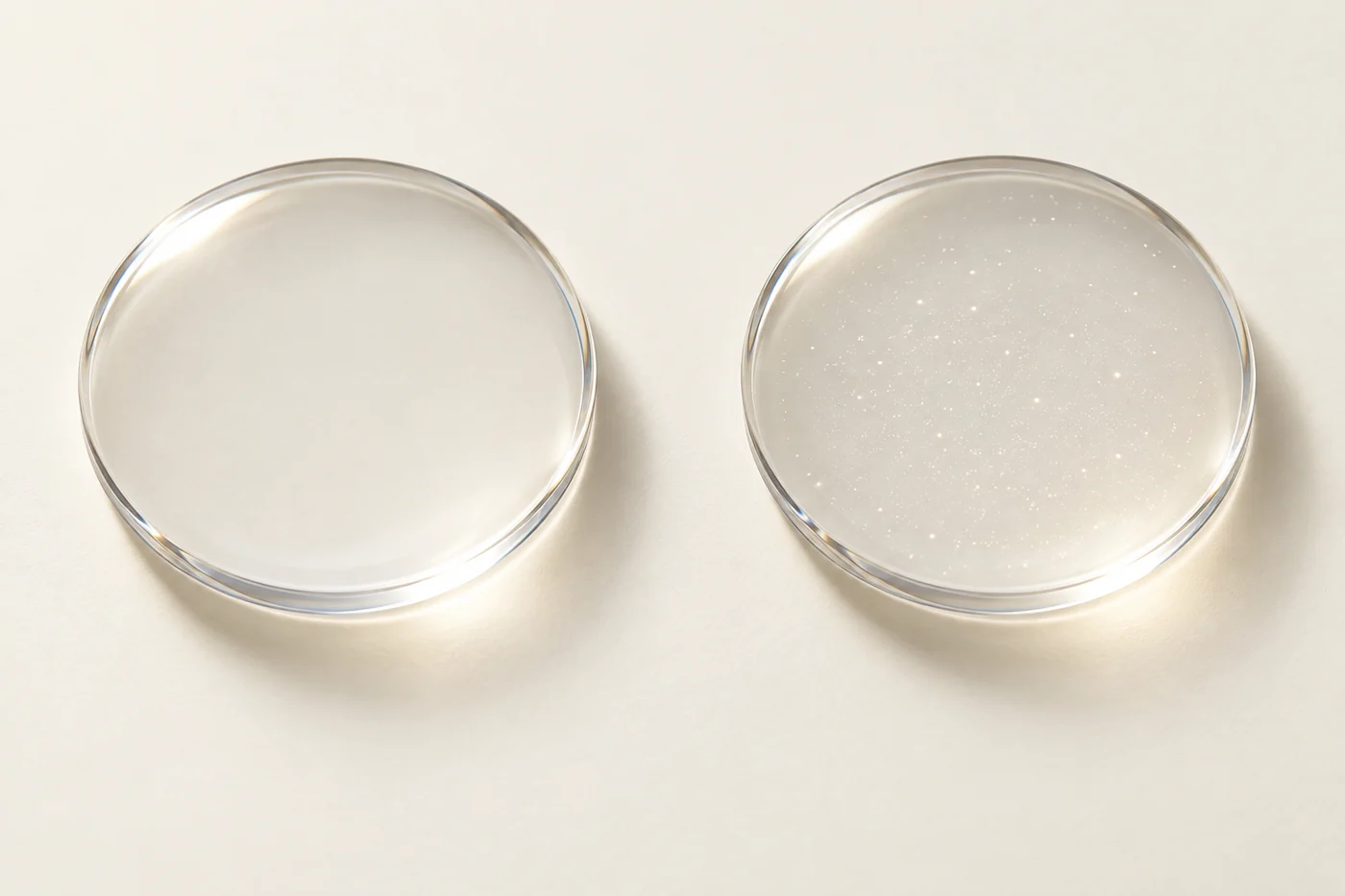
Its polymer includes phenylethyl acrylate and HEMA, short for 2-hydroxyethyl methacrylate. Compared with Alcon's older AcrySof material, the formulation replaces one component, PEMA, with HEMA. Its equilibrium water content is approximately 1.5% at 35°C, compared with about 0.4% for AcrySof. Although HEMA helps the material accommodate water, the finished lens is still classed as hydrophobic acrylic.
This change was intended to reduce tiny water-filled spaces within the plastic, known as glistenings. Manufacturing changes also aim for a smooth optical surface and less light scatter. These are material and design features; they are not a guarantee that every patient will see better than with a different modern lens.
Why are some Clareon lenses pale yellow?
Blue-light-filtering models contain a yellow chromophore, a molecule bound into the acrylic that absorbs part of the shorter-wavelength visible light spectrum. They also filter ultraviolet light. UV-only Clareon models are different and should not be described as having the same blue-light filter.
The filter is an optical feature. It should not be interpreted as a treatment for, or a guarantee of protection against, macular degeneration. Retinal health still needs its own assessment.
What are the main technical specifications?
For the established original monofocal platform, the principal specifications are:
- Optic diameter: 6.0 mm across the central focusing disc.
- Overall length: 13.0 mm from one haptic tip to the other when uncompressed.
- Construction: one-piece, foldable hydrophobic acrylic.
- Optical shape: biconvex, with an aspheric front surface; no multifocal rings.
- Spherical-aberration correction: nominally −0.20 micrometres in Alcon's optical-design description.
- Refractive index: approximately 1.55 at 35°C, describing how strongly the material bends light.
- Water content: approximately 1.5% at 35°C.
- Supports: two open-loop STABLEFORCE modified-L haptics, with 0° angulation.
- Common spherical power range: +6.0 to +30.0 dioptres; the technical documentation specifies 0.5-dioptre steps.
- Light filter: UV plus blue-light filtering, or UV-only, depending on model.
A dioptre is a unit of optical power. A higher number is not a higher-quality lens: it is a different strength selected from the eye's measurements. The optic's thickness changes with power, so one illustration cannot show the exact profile of every available strength.
These details describe the established platform. The surgical team uses the current Australian instructions and packaging for the precise model being implanted.
What do the edge and haptics contribute?
The posterior optic has a sharp-edge design intended to discourage lens cells from moving across the capsule behind it. This may help reduce posterior capsule opacification, or PCO: clouding of the retained capsule that can develop months or years after surgery.
PCO is different from the implant material becoming cloudy. It can still occur with Clareon and may need a YAG laser capsulotomy to open a clear window in the capsule. The edge does not create a complete guarantee against cell growth.
Alcon also describes a precision edge intended to reduce unwanted edge reflections. Laboratory and model-eye work supports the optical rationale, but that does not prove every patient will have less glare than with another lens.
The modified-L haptics flex within the capsule to support the lens position. Stable positioning matters for the focusing result, and stable orientation is particularly important for a toric lens. Capsule contraction, weak supporting structures and other eye conditions can still affect position.
How is Clareon inserted, and what is AutonoMe?
After the cataract has been removed, the folded lens is delivered through an injector into the capsule, where it unfolds. AutonoMe is the delivery device, not a different type of vision correction.
In the preloaded version, the lens is supplied within a single-use injector. Compressed gas drives delivery, while the surgeon controls advancement with a lever. A depth guard helps limit nozzle insertion. “Automated” describes this assisted delivery mechanism; the surgeon remains in control of the operation.
Other Clareon packaging and compatible delivery options exist. The injector does not determine whether the lens is monofocal, toric or presbyopia-correcting.
What are the advantages?
A straightforward distance-focused design. The original monofocal has a smooth optic without diffractive rings that split light between several focal points. It can suit someone who prioritises distance vision and is comfortable using reading glasses. A smooth optic does not eliminate all glare or halos.
A material designed for optical clarity. The revised acrylic formulation was developed to reduce glistenings and related light scatter. Several clinical studies have found little or no glistening formation over their observation periods.
Documented performance over several years. Prospective studies report good corrected distance acuity and stable results. There are also direct comparisons with other contemporary monofocals, which help identify limitations as well as strengths.
An astigmatism-correcting option. A toric version allows the surgeon to address suitable corneal astigmatism at the same operation. Careful measurements and alignment remain essential.
What are the disadvantages and limitations?
Reading glasses are usually needed. Setting both original monofocal lenses for distance generally leaves near work, such as reading a phone or small print, dependent on glasses. Computer vision varies with working distance, pupil size, lighting and the final focusing result.
The target may not be achieved exactly. Residual short-sightedness, long-sightedness or astigmatism can remain. Glasses, further assessment or occasionally additional treatment may be needed. No lens brand removes measurement uncertainty.
Optical symptoms are possible. Glare, halos, streaks or an arc-shaped shadow at the side of vision can occur after lens implantation. These symptoms have several possible causes and are not all due to glistenings.
PCO and ordinary surgical risks remain. Cataract surgery can involve infection, inflammation, swelling at the macula, pressure problems, retinal complications, capsule damage or lens-position problems. The Clareon material does not remove these risks. The cataract surgery guide explains the operation and its risks in more detail.
Long-term and comparative evidence has limits. Three-year results cannot promise lifelong optical perfection. Some studies are manufacturer-funded, and the results do not establish a universal advantage over other modern monofocals.
What have clinical studies found?
Study results describe groups of patients, often selected to exclude important eye disease. They are not a prediction for an individual eye. “Corrected vision” means the best result measured with any necessary glasses in place; it is not the same as being glasses-free.
Distance vision and clarity at three years
A 2023 multinational study by Nuijts and colleagues implanted Clareon in 424 eyes of 215 patients. At three years, 365 eyes were assessed: 82.2% achieved corrected 6/6 vision or better, and 93.4% achieved 6/7.5 or better. These are good distance-acuity results, but the study had no concurrent comparison lens and was sponsored by Alcon.
Every assessed lens was classed as grade 0 for glistenings using a scale that allowed up to 25 microscopic vacuoles per square millimetre. Thus, the study's “grade 0” result should not be read as proof that no microscopic changes can ever occur.
A direct comparison with another monofocal
A 2024 study by Leydolt and colleagues randomly placed Clareon in one eye and Vivinex in the other eye of 100 patients; 67 returned at three years. Corrected vision was similar. The objective capsule-clouding score was slightly higher with Clareon: 1.5 versus 1.0 on a 0–10 scale.
YAG laser treatment rates were 9.0% with Clareon and 7.5% with Vivinex, a difference that was not statistically significant. Some low-grade glistenings were detected, including in Clareon lenses. The study used a different grading method and lost a third of the original participants to follow-up. It shows why claims of “no PCO” or “never develops glistenings” would be too strong.
Does Clareon give better computer vision?
The evidence is mixed. A 2023 non-randomised study by Micheletti and colleagues compared 310 patients with bilateral Clareon or Eyhance lenses. Eyhance's average intermediate result was about 2.5 chart letters better, but the difference fell within the study's preselected margin for calling Clareon non-inferior. Alcon funded the study. Non-inferior within a margin does not mean identical.
A smaller 2024 randomised study by Giglio and colleagues included 90 patients across Clareon, Eyhance and another Tecnis monofocal. Intermediate vision favoured Eyhance, while distance vision and the visual-function questionnaire did not show significant differences. This study had short follow-up and an older Clareon group; it received a Johnson & Johnson Vision grant.
A 2026 single-arm study also reported useful intermediate performance, but its three-month follow-up and lack of a comparison group cannot establish superiority or change the original lens into an EDOF design. It is sensible to plan for computer glasses if needed, rather than rely on a promise of glasses-free intermediate vision.
Does Clareon correct astigmatism?
The toric version can reduce suitable pre-existing corneal astigmatism. Its optic has different powers in different meridians, and small axis markings allow the surgeon to orient it according to the treatment plan. Unlike a multifocal, this does not involve rings providing several focal distances.
Australian listings include toric cylinder powers from 1.00 to 6.00 dioptres at the lens plane, depending on model. The number written for the implant is not the same as the amount corrected at the corneal surface. The surgeon uses measurements and a toric calculation to select both power and alignment.
A toric implant still has a main focus and usually does not remove the need for reading glasses. Rotation away from its intended alignment reduces the astigmatism correction and can occasionally require repositioning. Not every irregular cornea can be corrected adequately with a toric implant.
How long does the lens stay in the eye?
The implant is intended to stay in the eye permanently; there is no routine replacement schedule. The removed natural lens cannot develop another cataract, but clouding of the capsule behind the implant can blur vision later.
Occasionally an implant needs repositioning or replacement because of a lens- related problem or an unsatisfactory result. That is a separate decision involving additional surgery. A three-year study cannot guarantee how an individual implant and eye will perform over the rest of a person's life.
Who might consider the original Clareon monofocal?
It may be a reasonable option for someone who wants a conventional monofocal approach, prioritises a chosen focus and accepts glasses for other tasks. The choice also depends on retinal and optic-nerve health, the cornea, previous eye surgery, the condition of the capsule and the amount of astigmatism.
People who strongly prioritise a wider range without glasses may discuss an EDOF lens or a multifocal lens, with their different trade-offs. Some consider monovision, setting the two eyes for different distances. That approach changes the focusing plan; it does not change Clareon's optical design, and it does not suit everyone.
Useful questions for the consultation include:
- Which exact Clareon model are you recommending, and why?
- What focus are we aiming for in each eye?
- Will I need glasses for my usual reading and computer distances?
- Would a toric lens help my astigmatism?
- Does my retina, cornea or previous surgery limit the likely result?
- Which alternative lens would be most relevant to my priorities?
Clareon is one established monofocal option. A sound choice connects the particular lens and focusing plan to the needs and health of the individual eye.
Sources and further reading
Evidence checked 21 September 2026. Manufacturer documents describe the device; clinical papers below report patient outcomes. Manufacturer funding is identified in the study summaries above.
- Alcon: Clareon monofocal and toric design and technical information .
- Alcon: Australian intraocular lens portfolio .
- US FDA: Clareon safety, effectiveness and technical specifications, 2020 .
- Australian Government: July 2026 Prescribed List data, XML .
- Nuijts and colleagues: three-year Clareon outcomes, 2023 .
- Leydolt and colleagues: randomised Clareon–Vivinex comparison, 2024 .
- Micheletti and colleagues: intermediate vision with Clareon and Eyhance, 2023 .
- Giglio and colleagues: randomised comparison of three monofocal designs, 2024 .
- Ćubela and colleagues: short-term Clareon outcomes, 2026 .
- Blehm and Hall: material background and short-term refractive stability, 2023 .
- Lehmann and colleagues: twelve-month developmental Clareon study, 2021 .
- Alcon: separate US Clareon TruPlus announcement, 2026 .