
YAG laser for floaters: suitability, benefits and risks
YAG laser vitreolysis can reduce the impact of floaters in carefully selected patients. The most suitable target is usually a clearly visible, isolated floater that can be treated safely away from the retina and the eye's natural lens. The aim is to make floaters less intrusive; completely clear vision should not be promised.


In my practice, I assess both how much the floaters affect everyday life and whether there is a suitable target for treatment. Setting realistic expectations is an essential part of that discussion.
New flashes, a sudden increase in floaters, a shadow or curtain, or sudden loss of vision need urgent assessment. These symptoms can indicate a retinal tear or detachment. If you cannot obtain prompt eye care, attend your nearest emergency department. Do not wait for a routine floater-treatment appointment.
How does YAG laser vitreolysis work?
YAG laser vitreolysis uses focused laser pulses to break up selected floaters within the eye. Floaters are opacities in the vitreous, the gel behind the lens. They can cast shadows on the retina and appear as moving spots, strands or cobwebs in your vision.
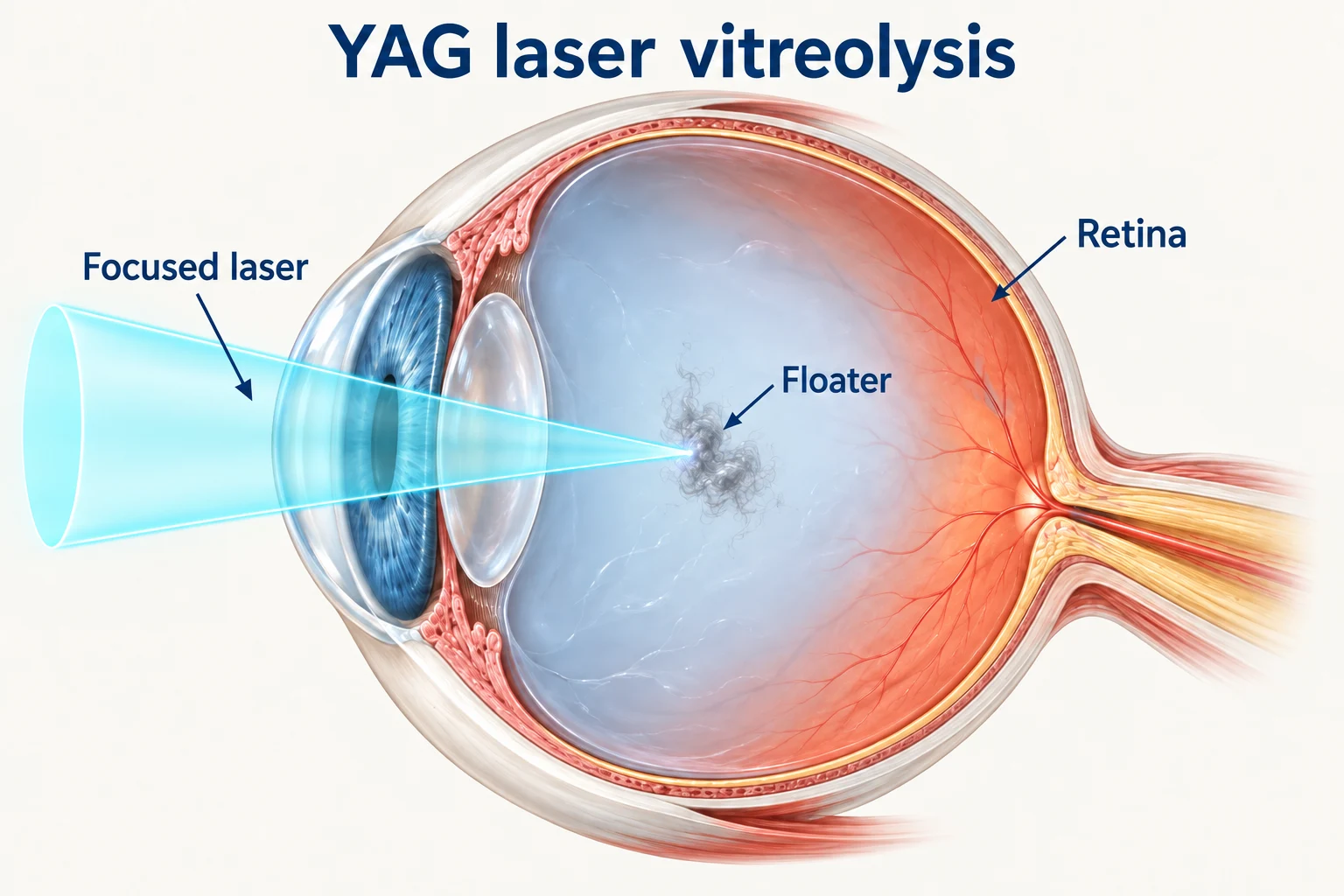
Treatment is performed through a contact lens placed on the eye after numbing drops, with the pupil dilated. It targets particular floaters; it does not remove the vitreous gel. Floater treatment options.
Vitreolysis is a different procedure from YAG capsulotomy, which treats a cloudy capsule behind an artificial lens after cataract surgery. Cloudy vision after cataract surgery.
Who is suitable for YAG laser treatment for floaters?
The most favourable target is a distinct, clearly visible floater that can be treated safely away from the lens and retina. That is what I look for during assessment. A small number of distinct floaters in the middle of the vitreous cavity is generally a more favourable starting point than many diffuse opacities throughout the eye.
One example is a Weiss ring, a ring-shaped opacity that can form when the vitreous separates from the back of the eye. Much of the randomised trial evidence concerns this particular type of floater.
An examination through a dilated pupil is needed to assess the floaters and retina. The discussion should also establish how long the symptoms have been present, what activities they interrupt and whether allowing more time is reasonable. Being troubled by floaters is a good reason to seek assessment; it does not automatically mean laser will help.
Why might a very troublesome floater be difficult to treat?
Some patients have severe symptoms from translucent, wispy floaters that are difficult to see clearly during examination. Their symptoms are real, but a poorly defined target can make laser treatment unsuitable.
Other practical limitations include:
- A floater close to the natural lens. Laser energy can damage the lens and cause a cataract. I would not recommend treating a target that is too close.
- A floater close to the retina. The potential for retinal injury limits what can safely be treated.
- A very mobile floater. Rapid movement can make it harder to keep the target clearly in view and safely positioned.
- A pupil that does not dilate well. A restricted view can make it difficult to identify and treat the floater safely.
These are reasons to reconsider suitability, even when the patient is keen to proceed. Lens and retinal injuries are among the complications reported after vitreolysis.
Does age or previous cataract surgery matter?
In my experience, younger patients often benefit less from YAG vitreolysis than older patients. However, age alone does not determine suitability: the nature and position of the floaters, the examination findings and the person's expectations remain central. There is no single age above which treatment is automatically appropriate.
Previous cataract surgery can make treatment planning more straightforward because the natural lens has already been removed, so laser cannot cause a new cataract in that lens. This does not remove the other risks. The artificial lens can still be damaged, and the retina and eye pressure still require consideration. Implant damage was documented in the.
Can YAG laser remove floaters completely?
Complete disappearance is possible for some patients, but it should not be expected or promised. A useful result may be that a floater is less noticeable while reading, using a screen or going about daily activities. Some residual floaters may remain. I advise patients to think in terms of reducing the impact of their symptoms, rather than expecting every spot or strand to disappear.
In a small randomised trial, 19 of 36 people treated with laser reported significant or complete improvement at six months, compared with none of 16 people receiving sham treatment. These were selected patients with a Weiss ring; the result cannot be applied to everyone with floaters. It also combines significant improvement with complete resolution, so it is not a complete-clearance rate.
Before-and-after photographs may show that a floater has changed, but they cannot fully describe the patient's visual experience. Follow-up should consider how the symptoms affect everyday life as well as what the examination or images show.
What if YAG laser has not improved my floaters?
A fresh assessment is more useful than assuming another session will help. I regularly see patients seeking a second opinion after YAG vitreolysis has provided little or no appreciable benefit. Some have had several sessions, with the accompanying cost and stress, and remain troubled by their floaters.
That experience deserves a fresh assessment. Before another session, I would want to establish whether there is a clearly visible, safely treatable target and why further treatment is expected to help. Previous treatment details, including any available images, can be useful.
More than one session may be appropriate in an individual case. However, continuing symptoms alone are not a sufficient reason to keep repeating laser. Useful questions include:
- Which remaining floater would another session target?
- What improvement is reasonably expected, and what may remain?
- Has there been any meaningful benefit from treatment so far?
- At what point should we stop and reconsider the options?
Deciding against further laser can be a reasonable outcome of that review.
What are the risks of YAG laser vitreolysis?
YAG vitreolysis does not require an incision, but it can still cause harm. Reported complications include raised eye pressure and glaucoma, cataract or damage to the lens capsule, retinal bleeding, retinal tears or detachment, blind spots, and an increase in floaters. Some complications can threaten sight.
Small trials cannot reliably measure uncommon serious complications. Retinal tears were also reported during longer follow-up of the original Weiss-ring trial, although that study could not establish whether laser caused them. The precise long-term risks remain uncertain.
How strong is the research evidence?
There is evidence of benefit, with important limitations. A second small randomised trial also reported improvement in symptoms. A review published in 2026 found improved patient-reported visual function across the available studies, but most of those studies were observational rather than randomised.
The UK's National Institute for Health and Care Excellence (NICE) recommends that YAG vitreolysis be used only in research because it considers the evidence insufficient. This is UK guidance, rather than an Australian prohibition, but it highlights the continuing uncertainty about benefits and safety.
For an individual patient, a careful examination and an honest discussion of these limits are essential before deciding whether to proceed.
What are the alternatives to YAG laser for floaters?
Observation is a reasonable option once the retina has been assessed and any urgent problem addressed. Floaters may become less troublesome with time. No procedure is needed simply because floaters are present.
For persistent symptoms that substantially affect daily life, vitrectomy can be discussed. This operation removes vitreous gel containing the floaters. It has different risks, including cataract in an eye with a natural lens, retinal tears or detachment, infection and possible loss of vision. It requires a separate discussion of likely benefit, recovery and risk; having laser first is not a prerequisite. See the vitrectomy information for more on that operation.
References and further reading
- Shah CP, Heier JS. YAG laser vitreolysis vs sham YAG vitreolysis for symptomatic vitreous floaters: a randomised clinical trial. JAMA Ophthalmology. 2017;135:918–923. Read the study .
- Ludwig GD and colleagues. Efficacy and safety of Nd:YAG laser vitreolysis for symptomatic vitreous floaters: a randomised controlled trial. European Journal of Ophthalmology. 2021;31:909–914. Read the abstract .
- Shah CP, Heier JS. Long-term follow-up of efficacy and safety of YAG vitreolysis for symptomatic Weiss ring floaters. Ophthalmic Surgery, Lasers and Imaging Retina. 2020;51:85–88. Read the abstract .
- Hahn P and colleagues. Reported complications following laser vitreolysis. JAMA Ophthalmology. 2017;135:973–976. Read the abstract .
- Alnajres A and colleagues. Nd:YAG laser vitreolysis for primary symptomatic vitreous floaters: a systematic review and meta-analysis. Ophthalmology Retina. Published online 31 July 2026. Read the abstract .
- NICE. YAG laser vitreolysis for symptomatic vitreous floaters (HTG644). Read the recommendations .
- American Society of Retina Specialists. Patient information on floaters and vitrectomy and retinal tears .
These are the published sources behind this article. They are written for clinicians and do not replace advice about your own eye.
How do I make an appointment with Dr Chen?
Appointments and enquiries through Vision Eye Institute, Chatswood.
Clinic appointments: (02) 9424 9999