One anaesthetic, one recovery
Two operations become one visit to theatre, one anaesthetic and one period of drops and reviews, instead of two.
 Dr Simon ChenCataract & Retina Surgeon
Combined surgery, also called phacovitrectomy, performs cataract surgery and vitrectomy in one operation when an eye needs both. It can mean one anaesthetic and one recovery, although for some eyes separate operations are the better plan.
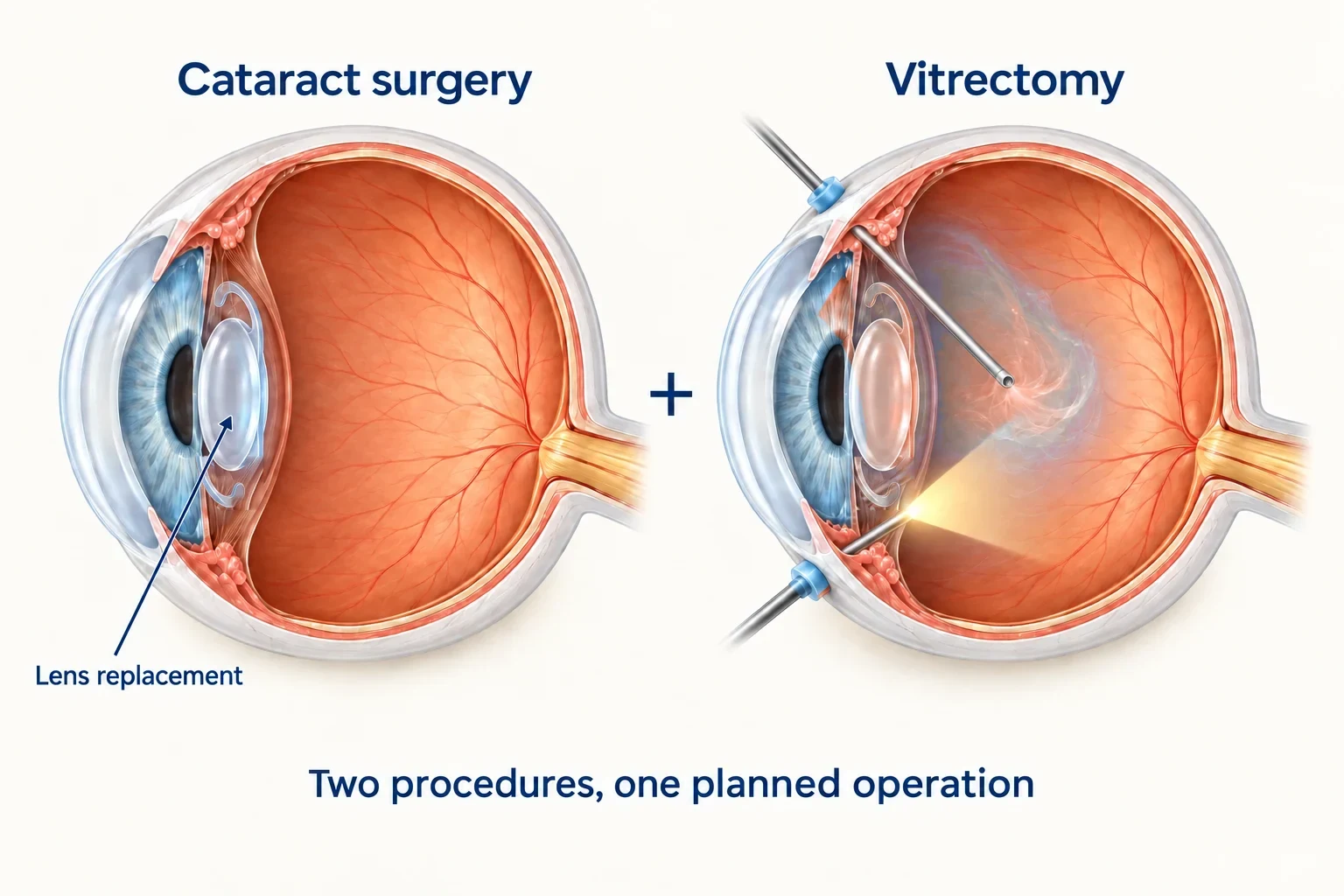
Two parts of one planned operation. Cataract surgery replaces the cloudy lens; vitrectomy gives access to treat the retinal condition. The retinal steps depend on the diagnosis.
Enlarge diagramCombined surgery means cataract surgery and vitrectomy performed in one sitting, in an eye that needs both.
Vitrectomy is retinal surgery: the clear gel that fills the back of the eye, the vitreous, is removed through small openings in the wall of the eye so the retina can be reached and treated. Cataract surgery removes the cloudy natural lens and replaces it with a clear artificial one. When an eye needs both, the two can often be done as a single operation. It is also called phacovitrectomy, from phacoemulsification, the ultrasound technique that removes the cataract, and vitrectomy.
What cataract surgery involves IOL exchange and complex cataract
Dr Chen has over 20 years of experience in cataract and retinal surgery and can personally perform both parts of a combined operation.
Two operations become one visit to theatre, one anaesthetic and one period of drops and reviews, instead of two.
A cataract commonly progresses after vitrectomy, so an eye that already has some lens clouding may well need cataract surgery within a year or two of the retinal operation.
A cataract makes the back of the eye harder to see. Removing it can give a clearer view of the retina during the retinal part of the operation, and clearer examination and imaging afterwards.
The cataract step comes first, then the retinal step, in the same sitting.
The cataract is removed by phacoemulsification and an artificial lens is placed in the capsule, as in ordinary cataract surgery. The retinal part follows: fine instruments are passed through small openings in the wall of the eye, the vitreous gel is removed, and the retinal problem is treated according to the diagnosis, whether that is a membrane peeled, a macular hole addressed or a detachment repaired. A gas bubble or another tamponade may be placed at the end, in which case posturing and travel advice follow the retinal part rather than the cataract.
The lens choice is settled beforehand, because the retinal condition affects it. What the macula can be expected to deliver, whether a gas bubble is planned, and whether further retinal treatment may be needed all bear on which lens is sensible for that eye. Some designs that suit an otherwise healthy eye are less appropriate when the macula is affected.
Intraocular lens choices Femtosecond laser cataract surgery
Dr Chen was the first surgeon in the world to perform femtosecond laser cataract surgery combined with retinal surgery.
The technique is described in a peer-reviewed paper he co-authored.
Bali SJ, Hodge C, Chen S, Sutton G. Femtosecond laser assisted cataract surgery in phacovitrectomy. Graefe’s Archive for Clinical and Experimental Ophthalmology. 2012;250(10):1549–1551. Read the publication on PubMed . DOI: 10.1007/s00417-012-2080-y.
Read the research paper
Not every eye is suited to having the two operations together.
Sometimes the retinal problem needs attention now and the cataract does not. Sometimes the retinal condition makes the lens calculation less reliable, and the sounder plan is to treat the retina first and choose the lens afterwards. Sometimes the eye, the state of the lens or the view during surgery makes staging the two operations the better course.
Recovery reflects the retinal condition rather than the cataract. Where cataract surgery alone usually settles over a few weeks, the pace after combined surgery follows the retinal part: the posturing, the gas bubble if one is used, and how the macula recovers. What vision can be expected afterwards depends on the state of the retina, and is discussed before anything is booked.
Retina care
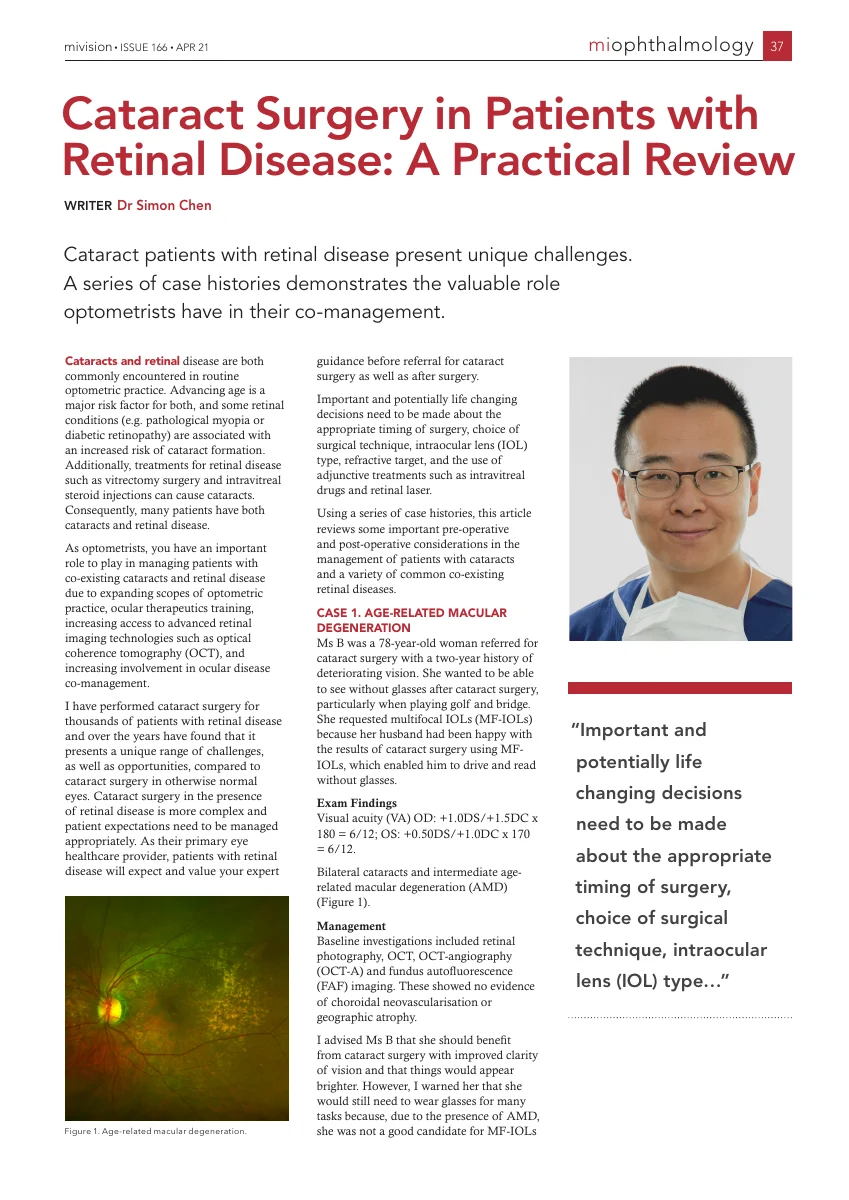
Published in mivision · April 2021
Dr Chen uses clinical case examples to explain how retinal health influences the timing of cataract surgery, lens selection and follow-up. The review also discusses when cataract and retinal treatment can be combined.
Read Dr Chen’s articleFor a closer look at macular degeneration and lens choice, read Dr Chen’s article in Optometry Connection.
One. The cataract step and the retinal step are performed in the same sitting, under one anaesthetic.
It joins phacoemulsification, the ultrasound technique that removes a cataract, with vitrectomy, the removal of the vitreous gel so the retina can be reached and treated.
Sometimes that is exactly the plan. Staging is chosen when the cataract is mild, when the lens calculation would be more reliable afterwards, or when the eye is better served by two shorter operations.
Not if the cataract is removed as part of the combined operation. A cataract commonly progresses after vitrectomy, which is one of the reasons the two are sometimes done together.
It can. The retinal condition is part of the decision, and some designs that suit an otherwise healthy eye are less appropriate when the macula is affected.
It follows the retinal part of the operation rather than the cataract, including any posturing if a gas bubble is used. The expected pace is explained beforehand.
Longer articles by Dr Chen go into these questions in more detail, including what the research shows.
Appointments and enquiries are made through Vision Eye Institute Chatswood.
Level 3, 270 Victoria Avenue, Chatswood NSW 2067Optometrists, GPs and ophthalmologists can refer through Oculo or with the PDF referral form.
Vision Eye Institute confirms your appointment after you submit your request. The request form is not for emergencies. A referral is not strictly essential to request an appointment, but you need a valid one to claim a Medicare rebate for your consultation.