Main strength
Useful vision at several distances, including closer tasks.
 Dr Simon ChenCataract & Retina Surgeon
Multifocal lens implants provide more than one focusing distance. Trifocal designs aim to cover distance, intermediate and near tasks, reducing the need to reach for glasses throughout the day.
Main strength
Useful vision at several distances, including closer tasks.
Glasses
Less dependence is the aim; complete independence is not assured.
Trade-off
Haloes, glare and reduced contrast must be weighed against the wider range.
The central optic is the clear part of the lens. The curved arms, called haptics, help support it inside the eye.
Compare lens designs and optional features. Surface details and tint are enhanced for illustration; actual lenses vary.
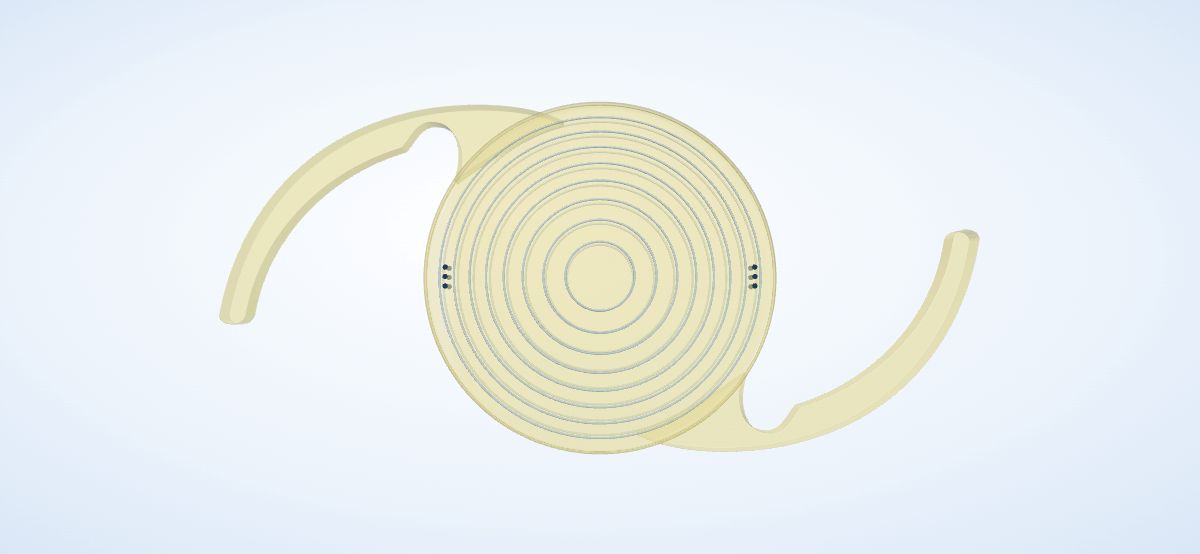
These implants distribute incoming light between different focuses. A trifocal design provides distance, intermediate and near focuses; other multifocal designs use a different arrangement. Your visual system learns to use the image most helpful for the task.
The exact reading and screen distances vary between models and patients. Holding a phone slightly farther away or using better lighting may help, but glasses may still improve demanding tasks.
The explanation below describes this graphic. Drawing it requires JavaScript.
Schematic distribution of light with distance from the eye. A monofocal concentrates light at one distance, a trifocal divides it between three, and an extended depth of focus lens keeps it together but spreads it along the range. Heights and widths are illustrative and are not measured values. Some light is lost or scattered in any lens.
Dividing light brings a compromise. Compared with monofocal lenses, multifocal designs can make haloes or rings around lights more noticeable and reduce contrast, particularly in dim conditions. This matters if you drive frequently at night or depend on very fine visual detail.
Adaptation can take time, and some people remain troubled by optical effects. A lens should be selected with this possibility in mind. If symptoms persist, the eye needs checking for other causes such as dry eye, a remaining prescription or capsule clouding before treatment is considered.
The explanation below describes this graphic. Drawing it requires JavaScript.
Illustrations of the kind of effect each design can produce, drawn for teaching. They are not photographs, not measurements of any particular lens, and not a prediction of what you will see. Most people notice far less than this, and many stop noticing it over months. Moving the slider shows why haloes are more obvious in the dark: the pupil is wider, so more of the lens is being used.
A regular cornea and healthy macula help make the most of a multifocal image. Macular disease, significant glaucoma, corneal irregularity or previous surgery can change the recommendation.
These lenses may appeal if reducing glasses for near tasks is a high priority and you accept the optical compromises. Someone who prioritises night vision may prefer a different approach.
Dr Chen uses multifocal lenses where the examination and discussion support that choice. A toric version can also address regular corneal astigmatism when appropriate. No single design is right for every eye.
Ask what vision you can reasonably expect for your usual reading distance, screen and night driving. Discuss the plan for both eyes, the chance of still needing glasses and what would happen if the result did not meet your expectations.
An artificial lens is intended to remain in the eye. Exchanging it later is a further operation with additional risks. In particular, discuss dissatisfaction with the implant before having YAG treatment to the capsule behind it, because an open capsule can complicate exchange.
Understanding vision after cataract surgery and IOL exchange →
Yes. “Multifocal” is the broader term. A trifocal lens is designed to provide three principal focusing ranges: distance, intermediate and near.
No. They may become less noticeable, but some people continue to see them. Discuss your tolerance of night-time effects before choosing the lens and report persistent troublesome symptoms afterwards.
Longer articles by Dr Chen go into these questions in more detail, including what the research shows.
Appointments and enquiries through Vision Eye Institute, Chatswood.
Clinic appointments: (02) 9424 9999