
Epiretinal membrane: when should you consider surgery rather than observation?Epiretinal membrane: surgery or observation?
Surgery is worth discussing when an epiretinal membrane causes troublesome or worsening vision. If symptoms are mild and stable, observation may be reasonable. Your symptoms, daily activities, eye examination and optical coherence tomography (OCT), a detailed retinal scan, all help guide the decision.

Being referred to a retinal surgeon does not mean you have agreed to an operation. It gives you a chance to understand the likely benefit, the risks and what continued observation would involve.
What does an epiretinal membrane do?
An epiretinal membrane (ERM) is a thin layer of tissue on the inner surface of the retina. When it contracts over the macula, the area responsible for detailed central vision, it can wrinkle the tissue beneath it. It is sometimes called a macular pucker.
This can make straight lines look bent, letters appear crowded or objects look a different size through one eye. Some people notice blur; others have little difficulty. The diagnosis by itself does not establish a need for surgery.


Why can vision feel poor even if you read the eye chart well?
An eye chart measures how small a letter you can identify. It does not fully describe how comfortable reading feels, whether a face looks distorted or whether the two eyes provide matching images.
A useful discussion therefore goes beyond “What line can I read?” For example, you might explain that:
- words bend or run together even with your usual reading glasses;
- detailed work has become slower or more tiring;
- objects seem a different size or shape through each eye;
- vision feels less comfortable with both eyes open.
 ClearDistorted
A better-seeing fellow eye may compensate, but that is not always the whole story. Studies have assessed changes in distortion, binocular function and quality of life after surgery because these can matter even when chart acuity is relatively good. Improvement in one measure does not guarantee improvement in all of them.
When is observation reasonable?
Observation can be sensible when you are managing your usual activities, symptoms are acceptable and the findings are stable enough to monitor. It is an active plan, with a baseline and follow-up, rather than a decision to ignore the membrane.
In a small randomised trial of 53 people with mildly symptomatic membranes and relatively good vision, immediate surgery did not produce a statistically significant advantage in average chart vision at one year compared with initial observation. However, eight of the 33 people initially observed went on to have surgery because their symptoms worsened.
That is reassuring for selected mild cases, but it does not prove that waiting is equally safe for everyone. The study was small and did not answer what happens after many years or in more advanced disease.
Your clinician can agree when to repeat the examination and OCT scan. The interval should reflect your symptoms, findings and any previous change. Ask what should bring the appointment forward. Recording a few specific difficulties, such as losing your place while reading, can make change easier to describe at the next visit.
| If the membrane is stable | If symptoms or the scan are changing |
|---|---|
| Agree on follow-up and the changes that should bring review forward. | Discuss whether membrane traction explains the change and whether surgery could help. |
| Keep track of reading, distortion and daily tasks, not just chart letters. | Weigh possible visual benefit against surgical risks and the chance of incomplete recovery. |
What makes surgery worth considering?
A surgical discussion becomes more useful when the membrane is causing difficulties that matter to you, particularly if they are increasing. Examples include persistent distortion that interferes with reading or work, reduced useful vision, or troublesome differences between the two eyes.
A documented decline in acuity or a changing OCT can strengthen the case for review. Equally, it is reasonable to discuss troublesome symptoms before acuity becomes poor. There is no universal rule that you must reach a particular chart line before an operation can help.
The surgeon will also assess whether the membrane explains the problem. Cataract and other eye conditions can contribute to blur or reduced function. Removing a membrane will not correct every cause of poor vision.
The practical question is: is the improvement reasonably expected from surgery valuable enough to you to justify its risks and recovery? The answer can differ between people with similar scans.
What does the OCT scan add?
Optical coherence tomography (OCT) is a scan that creates detailed cross-sectional images of the macula. It helps the surgeon see the membrane's effect on the retinal shape and layers, and compare the eye with earlier scans.
In a normal OCT, the centre of the macula has a small dip called the foveal dip. A membrane may appear as a thin bright line on the retinal surface. When it pulls harder, the dip may flatten or disappear and the retina may thicken; some eyes develop small fluid spaces. These features help explain what the membrane is doing, but no single OCT feature predicts your experience or your result.
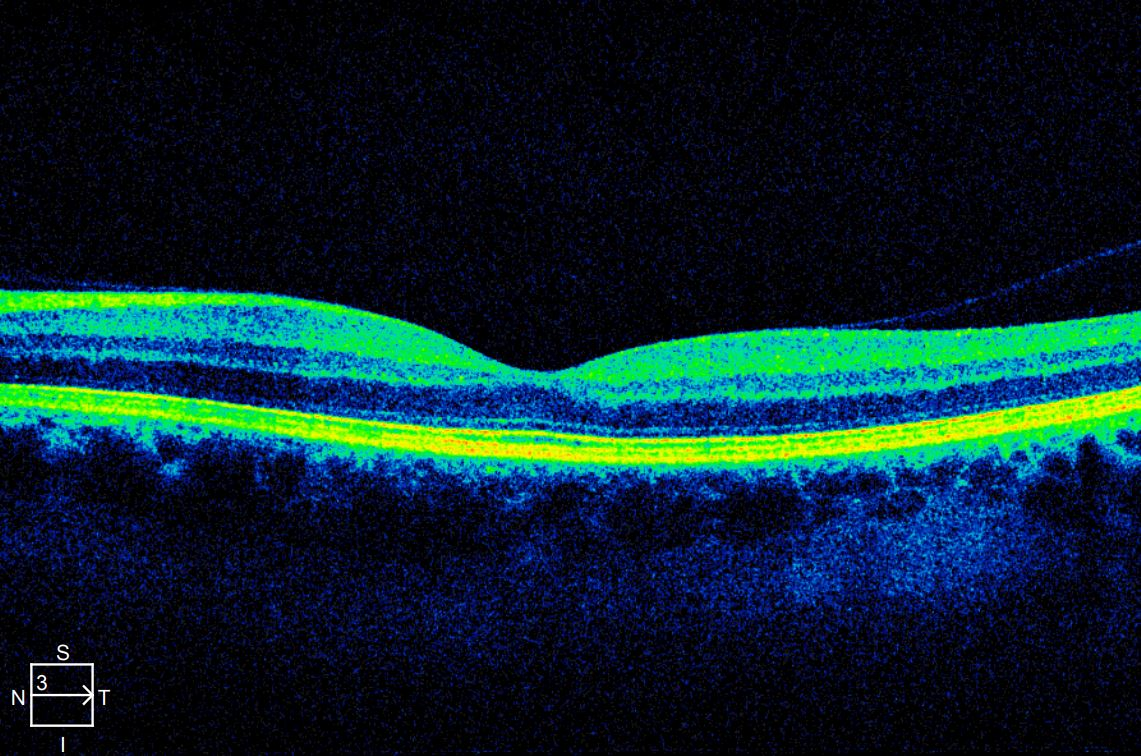
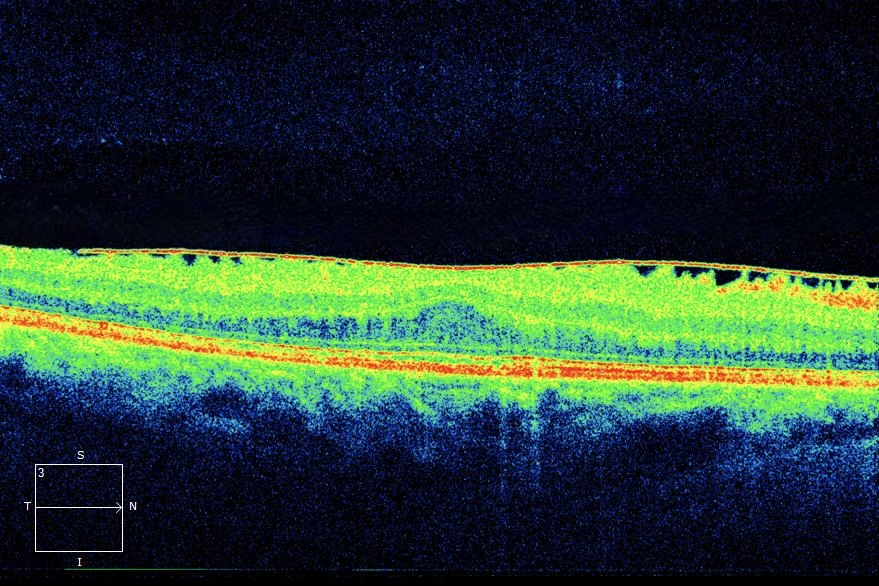
Ask your surgeon to explain what has changed on the scan, whether it fits your symptoms and whether another macular problem is present. OCT supports the decision; it does not replace the conversation about your vision.
Is there a best time to operate?
There is no single best time for every person. Stable, manageable symptoms may favour continued observation. Increasing functional difficulty may shift the balance towards surgery.
The macula is delicate. If a membrane is progressively pulling on it, the tissue may become thicker, sometimes with fluid spaces and disruption of its fine layers. Peeling the membrane releases that pull and can help stabilise vision or improve it. The retina may not fully recover its original shape or function, particularly after a long period of progressive change. Surgery can still help later, but the improvement may be smaller than if the traction had been addressed before substantial changes developed.
This is a reason to review a progressing membrane with meaningful visual symptoms promptly, not a reason to operate on every membrane. Many mild membranes remain stable. There is no fixed number of months after which surgery stops working, and a thicker scan by itself does not mean urgent surgery. Your symptoms, changes over time, retinal layers, cataract and surgical risks all matter.
If you choose observation, keep the decision open. A review is an opportunity to reconsider your priorities and any changes, rather than a test of whether the original choice was right or wrong.
What if you also need cataract surgery?
A cataract and an epiretinal membrane can both affect vision. Before cataract surgery, it is worth checking which condition is contributing to your symptoms and what the macular OCT shows.
In some eyes, retinal swelling or membrane-related changes may worsen after cataract surgery. That possibility deserves particular attention when the membrane is already causing traction, swelling or troublesome distortion. It does not mean every membrane needs to be removed: many mild, stable membranes remain stable after cataract surgery, and cataract surgery alone may improve vision.
If both conditions need treatment, cataract surgery and membrane peeling can sometimes be performed at the same operation or as separate operations. The choice depends on your symptoms, the OCT findings, which condition is limiting vision, and the likely benefits and risks of each approach. If the membrane is monitored, arrange follow-up so any change in vision or the macula can be reassessed.
What improvement is realistic after surgery?
The operation involves vitrectomy and peeling the membrane from the retinal surface. Its aim is to relieve traction and improve useful vision. The epiretinal membrane guide explains the procedure in more detail.
Vision may become clearer and distortion may lessen, but the result is not guaranteed. Some distortion can remain, and removing the membrane cannot always reverse changes already present in the retina. People starting with good chart vision may have less room for improvement on the chart even if another aspect of vision improves.
Recovery is gradual. It is usually more useful to think in months than days, and different aspects of vision may recover at different speeds. Ask which of your particular difficulties is most likely to improve and which might persist. The vitrectomy guide covers the wider operation and recovery considerations.
Which risks need to be weighed against the benefit?
Vitrectomy can accelerate cataract in an eye that still has its natural lens. This is another reason to discuss the cataract and membrane together when planning treatment.
Retinal tears or detachment, infection, bleeding, pressure changes and swelling can occur. Some complications require further treatment or surgery. Vision can fail to improve or become worse, and a membrane can recur.
Recovery arrangements matter too: follow-up visits, help at home and time away from demanding activities. A gas bubble is not usually needed for vitrectomy with epiretinal membrane peeling, but it may be used in some cases, such as when a retinal tear also needs treatment. Ask what recovery will involve in your case.
What should you bring to the consultation?
Bring a short description of what has become difficult and what you most hope to improve. Previous OCT scans and vision measurements are useful if available through your referring clinician.
Questions worth asking include:
- How much of my difficulty comes from the membrane rather than cataract or another condition?
- If I need cataract surgery, should the membrane be monitored, removed at the same operation or treated separately?
- What improvement is realistic for my reading, distortion and use of both eyes together?
- What would we monitor if I wait, and what change would make you recommend another discussion?
- What are the main risks for my eye, and what would recovery involve?
A useful decision is one you understand: why observation or surgery currently fits your situation, what its limitations are and when to reconsider it.
Which changes need urgent attention?
Seek urgent eye assessment for sudden new flashes, a sudden increase in floaters, a dark curtain or shadow, or sudden loss of vision. A curtain or sudden visual loss warrants immediate emergency assessment. Do not assume these symptoms are simply your known membrane, or wait for a routine follow-up appointment.
Sources and further reading
- ASRS: epiretinal membranes.
- Moorfields: deciding about ERM surgery.
- Kofod and colleagues: randomised trial of immediate surgery or observation, 2016.
- Luu and colleagues: natural history with good visual acuity, 2019.
- Nakashizuka and colleagues: surgery in patients with good acuity, 2019.
- Khanna and colleagues: visual function and quality of life after surgery, 2022.
- Healthdirect Australia: retinal detachment symptoms.
- Romano and colleagues: foveal configuration after membrane surgery, 2022.
- Momenaei and colleagues: ERM progression following cataract surgery, 2025.
- Vallejo-Garcia and colleagues: OCT changes after cataract surgery in eyes with ERM, 2020.
- Abraham and Talcott: surgical management of ERM, 2025.
- University Hospitals Plymouth: epiretinal membrane surgery and aftercare.