
Recovery after refractive lens exchange: what to expect in the first six weeksRefractive lens exchange recovery: the first six weeks
Most people see well enough to manage at home the day after refractive lens exchange, and are back at a desk within a few days. Comfort, night vision and the final focus take longer, usually four to six weeks after the second eye, and sometimes longer again with an extended-depth or multifocal lens.


Refractive lens exchange (RLE) is the same operation as cataract surgery, so the healing is the same. What differs is the starting point. You did not have a cloudy lens, so you are comparing the new vision with the good corrected vision you already had in glasses or contact lenses. That makes the first fortnight feel different, and it is worth knowing in advance.
This guide describes recovery after uncomplicated surgery. Your own discharge instructions take priority.
Which symptoms need urgent help?
Contact your surgical team immediately if you notice:
- Severe or increasing eye pain.
- Vision that becomes worse rather than better.
- Increasing redness or sticky discharge.
- New flashes of light, or a sudden shower of new floaters.
- A shadow or curtain moving across part of your vision.
Use the urgent contact number on your discharge paperwork. If you cannot reach your team promptly, go to an emergency department. Do not wait for the next booked appointment, and arrange for someone else to drive.
The last two matter particularly after RLE, because many people who consider it are short-sighted, and short-sighted eyes carry a higher risk of retinal detachment after any lens surgery. That risk is not confined to the first six weeks: report flashes, a sudden increase in floaters or a curtain at any time in the years afterwards, and say that you have had lens surgery when you do.
Mild grittiness, watering, light sensitivity and fluctuating focus are ordinary in the early days. The distinction that matters is the direction of travel. Symptoms should be settling, not becoming more painful or clearly worse.
What should I organise before the day?
Arrange someone to take you home, and follow the hospital's instructions about having an adult with you afterwards if you have had sedation. If both eyes are being done close together, plan for both dates at once rather than improvising between them.
Before you leave hospital, make sure you have:
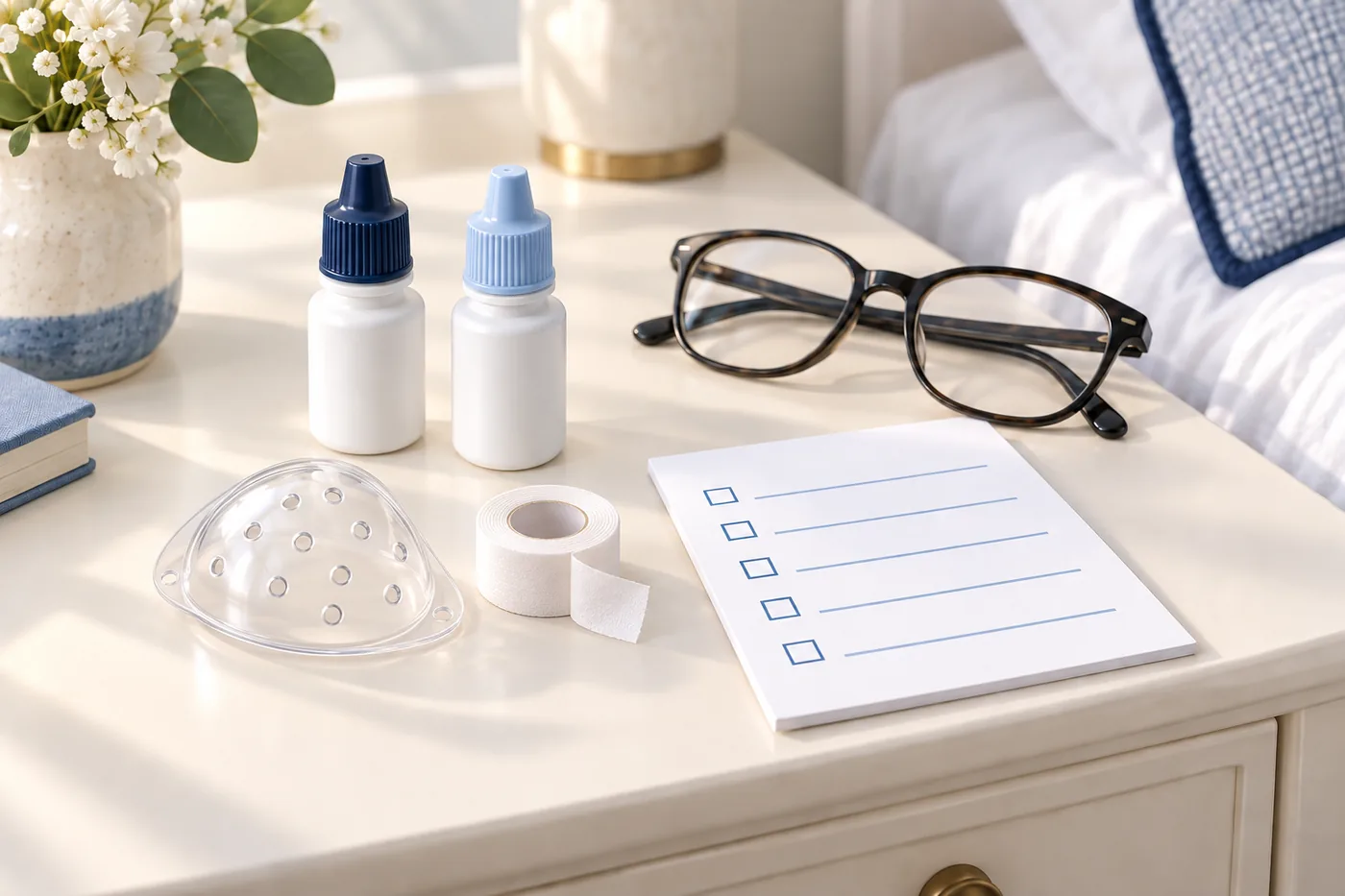
- Your prescribed drops and a written schedule showing which eye to treat.
- Clear instructions about the eye shield and any other medicines.
- Your follow-up appointments and an urgent contact number.
- Dark glasses for the trip home.
Stop wearing contact lenses when you are told to before surgery, and do not put one back in the operated eye afterwards. If you drive to work, plan the first week as though you will not be driving. Cooking, shopping and heavy household jobs are easier done in advance than negotiated on day two.
How soon is the second eye usually done?
Both eyes are almost always treated in RLE, because the point of the operation is how the two eyes work together. The second eye usually follows a week or two after the first. The exact interval depends on how the first eye settles and on what suits your work and travel.
The gap can be the least comfortable part. One eye now focuses in a new way while the other still needs its old correction, so your old glasses may feel wrong and judging steps and kerbs takes more care. A contact lens in the unoperated eye is sometimes an option; having one lens removed from a spare pair of glasses is another. Ask before the first operation what you should do in between, rather than working it out on the day.
Tell your surgeon if the imbalance is interfering with work or driving. It is a normal stage, not evidence that the first eye has gone wrong, but it can be managed.
How does recovery usually progress?
These stages are a guide, not deadlines, and each eye has its own timetable.
The day of surgery
Expect to do very little. Vision is often hazy and the eye may water. A shield may cover it. Do not drive yourself home, and take care on steps and uneven ground while your vision is unfamiliar.
During the first week
Most people notice clear distance vision within a day or two, with the clarity coming and going through the day. Mild surface irritation, light sensitivity and a gritty feeling are common. Desk work is usually possible within a few days. Use the drops exactly as prescribed and attend the early check.
During weeks two and three
Everyday life feels close to normal, and the second eye is often done in this period. Restrictions on swimming, heavy exercise, dusty work and eye rubbing may still apply. Keep using the drops even when the eye feels well; feeling better is not a reason to stop them.
Around weeks four to six
This is the usual point for checking the result and the glasses prescription, counted from the second eye rather than the first. Night-time haloes and the ease of reading often go on improving after this. Six weeks is a common review point, not a guaranteed finishing line.
How do I manage my eye drops?
Use the medicines, doses and duration on your own schedule. Different eyes need different plans, so do not copy someone else's drops or restart an old bottle without advice.
For most drop bottles:
- Check the label, the correct eye and the expiry date. Shake only if instructed.
- Wash your hands, then sit or lie comfortably with your head tilted back.
- Look upwards and gently draw the lower eyelid down to make a small pocket.
- Place one drop into the pocket, keeping the nozzle clear of the eye, lashes and skin.
- Close the eye gently, without squeezing or rubbing it.
- Leave at least five minutes between different drops unless you are told otherwise.
When both eyes are operated on a week or two apart you may be running two different schedules at once. Write them down, or set two sets of phone reminders, and label the bottles for the left and right eye. Ask your pharmacist or clinic what to do about a missed dose, storage and repeat supplies.
When can I go back to work and screens?
Reading, television and computer work do not harm a healing eye, and you can start as soon as they feel comfortable. Begin with short sessions, increase the text size and take breaks when the eye feels tired or dry. Screens do not slow healing; they do make dryness more noticeable, because people blink less at a screen.
For a desk job, most people take somewhere between two days and a week. Where you fall in that range depends on the job itself, how much close work it involves, how strong your glasses prescription was, and how well you cope in the gap before the second eye is done. Manual work, dusty or dirty environments, workshop and outdoor trades, and any job where an eye injury is a real possibility need longer and a specific clearance. Jobs that depend on fine near vision or on night driving may be the last to feel normal.
Tell the surgical team what your work actually involves before the operation, including lifting, machinery, protective eyewear and travel. Reduced hours or temporary lighter duties are often more useful than a single return-to-work date. Ask for a certificate if you need one.

How will my eyes adapt to the new lens?
Your brain has to learn the image the new lens produces, and that takes longer than the eye takes to heal. With a monofocal lens set for distance the adjustment is usually quick. With an extended-depth or multifocal lens, small print, dim light and headlights at night commonly improve over weeks to months rather than days.
Rings, starbursts or glare around lights at night are common early on with some lens designs, and usually become less noticeable and less bothersome as the weeks pass. Most people stop noticing them. A minority remain aware of them, which is why the trade-off is discussed before surgery rather than after it.
Vision that fluctuates through the day in the first weeks is usually the ocular surface rather than the lens. Dryness is very common after lens surgery, is often worse in air-conditioned offices and on screens, and responds to preservative-free lubricants. Ask before adding anything to your regime.
Tell your surgeon if something is not settling, or if a symptom is getting worse instead of better. Judging the result is a conversation for the six-week review, not the first fortnight.

When can I drive again?
There is no single day on which everyone is safe to drive. Do not drive on the day of surgery. After that you need to meet the Australian eyesight standards and be able to drive safely with both eyes working together, which is a different question from reading a chart with one eye.
Ask your treating team when to resume, including whether you need a check or updated glasses first. While one eye is done and the other is not, depth judgement and glare can both be affected even though the new eye sees well. Commercial driving has separate requirements.
Daytime and night-time driving are different demands. Haloes and glare around headlights are common in the first weeks and settle for most people, so give night driving its own trial on a familiar road before relying on it, and arrange transport to any appointment where dilating drops may be used.

When can I exercise, swim or play sport?
Walking is fine straight away, and light exercise returns quickly. The three early concerns are straining, getting water or dirt into the eye, and a blow to the eye.
- Walking. From the first day.
- Gym, running and cycling. Usually about a week. Leave heavy lifting and hard straining until you are cleared.
- Swimming, surf, spas and saunas. Water carries organisms into a healing eye, so these wait longer than showering, and longer again in a spa or in the surf.
- Anything that could put a blow on the eye. Allow about six weeks, then use protective eyewear for the sports that warrant it. This is explained below, because it is the restriction people most often misunderstand.
- Scuba diving. Discuss it specifically before booking anything.
Ask about the actual activity you care about, with a date, rather than working from a general rule. And do not rub the eye, at any point: rubbing does more harm in the early weeks than most of the activities people worry about.
What counts as a "contact sport" after lens surgery?
The phrase is misleading, because what matters to an operated eye is not body contact but whether something can strike the eye. A ball, a racquet, an elbow, a stick or a finger are all the same problem. Judged that way, the sports to be careful with are:
- Racquet and ball sports, which are the most under-rated. Squash is the classic example: a squash ball is smaller than the eye socket and travels fast enough to reach the eye behind the brow. Tennis, cricket, hockey, basketball, netball, water polo, football, rugby and AFL all belong on the same list.
- Martial arts, boxing and wrestling, where a blow to the eye is part of the sport rather than an accident.
- Paintball and air-rifle shooting, which cause severe eye injuries in people who are not wearing proper protection.
Two things follow. First, after about six weeks these sports are usually possible again, but the sensible habit afterwards is protective eyewear made for sport: polycarbonate lenses in a wraparound frame, made to the sports standard (in Australia, AS/NZS 4066 and its replacement AS/NZS 18527.2 for racquet sports). Ordinary spectacles and sunglasses are not protection, and can make an injury worse. Properly fitted sports eye protectors prevent the large majority of these injuries.
Second, boxing and full-contact martial arts are a different conversation, and not a six-week one. Useful eye protection cannot be worn in them, and the international guidance is that people who have had eye surgery, or who depend heavily on one eye, should not take part at all. If that applies to you, raise it before the operation rather than afterwards.

How do I shower, wash my hair and sleep?
Shower normally, keeping soap, shampoo and a direct stream of water away from the operated eye, and pat rather than rub the lid dry. Help with hair washing makes the first few days easier.
Wear the protective shield at night for as long as your team advises. It is there to stop accidental rubbing or pressure while you are asleep. Avoid sleeping with the operated eye pressed into the pillow. Ordinary lens surgery does not require face-down positioning.
Leave eye makeup until you are told you can restart it, because applying and removing it brings particles and rubbing to the lid margin. The same caution applies to facial treatments, eyelash work and anything that sprays near the eye.
Can I travel or fly?
Flying is not restricted after routine refractive lens exchange. Unlike some retinal operations, no gas bubble is placed in the eye, so cabin pressure is not an issue.
The practical question is being away from care. Discuss planned travel before the operation, particularly long trips, remote destinations and anything in the first fortnight or between the two eyes. Keep your drops and instructions in your cabin bag, take sunglasses, use lubricants on a long flight because cabin air is very dry, and know how to reach the clinic from wherever you are going.
Will I still need glasses, and when is the result final?
That depends on the lens that was chosen and on how your eyes settle, and it is worth revisiting what you agreed before surgery rather than judging it in week one. No lens design guarantees freedom from glasses, and many people keep a pair for small print, long driving at night or demanding close work.
Do not buy new glasses early. The prescription is usually checked around four to six weeks after the second eye, once healing and the ocular surface have settled, and a prescription taken before then can be wrong enough to waste the money. If you need something to manage in the meantime, ask; inexpensive temporary readers are often the sensible answer.
Two later possibilities are worth knowing about. The capsule that holds the implant can become hazy months or years afterwards, which is cleared with a brief laser treatment and is more common in younger eyes. And if the focus is not where it was meant to be, the cause is assessed first; laser correction or a lens exchange is considered only after the eye is stable and the additional risks have been discussed. Neither is an emergency, and neither should be decided in the first month.
What should I check at my follow-up?
Keep the appointments even when the eye feels well. They are how the plan is adjusted.
Useful questions include:
- Are my drops continuing, reducing or stopping, and on which dates?
- When can I return to my particular work, sport and water activities?
- Am I ready to drive, including at night?
- When should I book the final glasses check, and with whom?
- What should I do about the gap before the second eye?
- What should make me contact you urgently, and on which number?
Recovery is easier when the instructions fit your week. If something is unclear or hard to follow, contact the team rather than guessing. For the operation itself and how suitability is assessed, read; for the lens designs and their trade-offs, read.
Sources and further reading
- Healthdirect Australia: cataract surgery .
- Vision Eye Institute: cataract and lens surgery questions .
- NHS: cataract surgery and recovery .
- Moorfields Eye Hospital: using eye drops .
- Royal Devon: cataract surgery and everyday activities .
- Austroads: vision and driving assessment .
- Royal Australian and New Zealand College of Ophthalmologists: patient information .
- Sports Medicine Australia: eye injuries .
- American Academy of Ophthalmology and American Academy of Pediatrics: protective eyewear for young athletes .
Refractive lens exchange is an elective operation on an eye that is otherwise healthy, and the decision to have it is separate from the recovery described here. Hospital instructions differ. These resources explain the background; your surgical team's individual advice determines your treatment and activity restrictions.