Main strength
A broader useful range than a conventional monofocal lens.
 Dr Simon ChenCataract & Retina Surgeon
An extended depth of focus lens aims to widen the eye’s useful focusing range. It usually emphasises distance and intermediate vision, such as a computer screen or dashboard.
Main strength
A broader useful range than a conventional monofocal lens.
Glasses
Often still helpful for small print, sustained reading or detailed close work.
Trade-off
Glare, haloes and changes in contrast remain possible; designs differ.
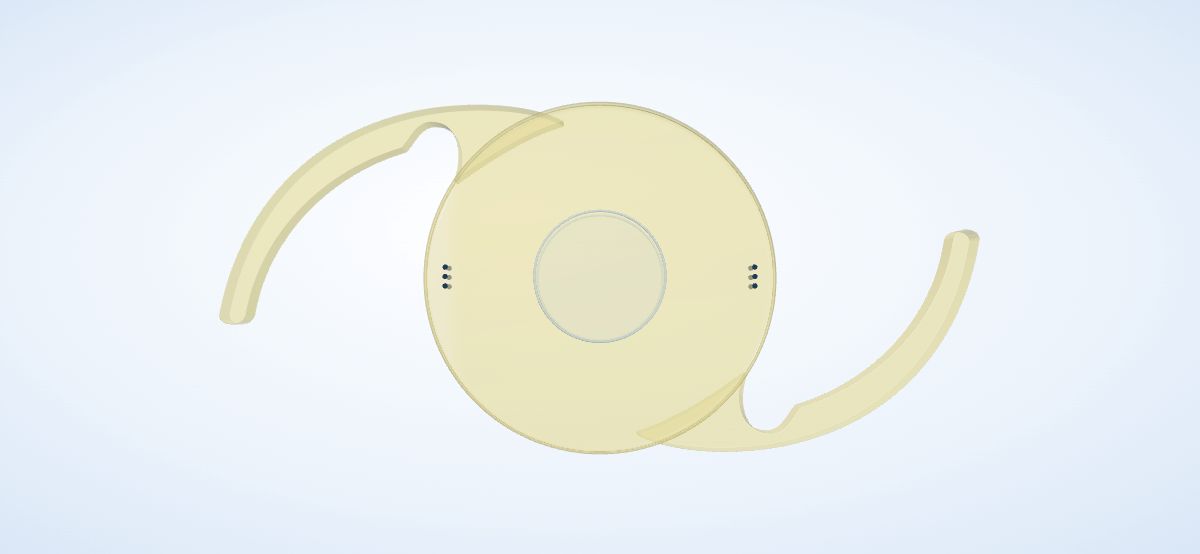
The central optic is the clear part of the lens. The curved arms, called haptics, help support it inside the eye.
Compare lens designs and optional features. Surface details and tint are enhanced for illustration; actual lenses vary.
EDOF lenses broaden focus rather than simply choosing one narrow distance. This may make it easier to move between looking across a room and using a screen without changing glasses.
Intermediate vision is not the same as close reading vision. A desktop monitor, phone and book may sit at quite different distances. Discuss your usual working distances so that the plan reflects your daily life, rather than the general promise of “less dependence on glasses”.
The explanation below describes this graphic. Drawing it requires JavaScript.
How sharply each design holds focus as an object comes closer. The shapes are schematic and no figures are claimed for any particular lens. A monofocal falls away steadily, an extended depth of focus lens falls away more gently, and a trifocal adds a second peak for reading at the cost of dividing the light.
Different optical designs extend focus in different ways. Some use diffractive optics; others use a non-diffractive approach. The label EDOF alone does not tell you exactly how a lens will perform for reading, contrast or night vision.
Enhanced monofocal lenses are another option, offering some additional intermediate range. They are not automatically equivalent to an EDOF lens. Dr Chen can explain the expected range and limitations of the particular implant being considered.
The explanation below describes this graphic. Drawing it requires JavaScript.
Three ways a lens can handle light. Refraction bends it to a single focus, diffraction divides it between separate focal points, and wavefront shaping stretches the focus along a continuous range. The cross-section is schematic and greatly exaggerated in the vertical direction: the surface transitions are about one micrometre high, roughly one seventieth the thickness of a human hair, and cannot be seen with the naked eye.
Reading glasses may make fine print, dimly lit menus or prolonged close work more comfortable. An EDOF lens does not restore the flexible focusing ability of a young natural lens.
Haloes, glare or starbursts can occur, and contrast may be reduced. Some designs have fewer symptoms than some multifocal lenses, but this is not a guarantee for an individual eye.
Some people become less aware of optical effects over time; persistent symptoms need assessment. Do not assume that every new visual disturbance is simply adaptation.
The explanation below describes this graphic. Drawing it requires JavaScript.
Illustrations of the kind of effect each design can produce, drawn for teaching. They are not photographs, not measurements of any particular lens, and not a prediction of what you will see. Most people notice far less than this, and many stop noticing it over months. Moving the slider shows why haloes are more obvious in the dark: the pupil is wider, so more of the lens is being used.
The cornea, tear film, retina and optic nerve all affect suitability. Previous laser vision correction and the vision in the other eye also matter. Dry eye may need treatment before reliable measurements can be obtained.
A toric version may be considered for regular corneal astigmatism. In selected patients a small difference in focus between the eyes may extend nearer vision, but this requires its own discussion about balance and depth perception.
Dr Chen offers EDOF alongside monofocal and multifocal lenses. It may suit your priorities, or another design may offer a better balance. Compare the three approaches.
No. The categories describe different approaches to extending vision, although some designs overlap. EDOF usually prioritises distance and intermediate tasks; trifocal lenses also aim to provide a distinct near focus.
No. Reading ability depends on the lens design, focusing target, lighting and eye health. Plan for the possibility of glasses, especially for small print.
Longer articles by Dr Chen go into these questions in more detail, including what the research shows.
Appointments and enquiries through Vision Eye Institute, Chatswood.
Clinic appointments: (02) 9424 9999