
Cataract surgery after LASIK, PRK or SMILE: what changes in planning?
You can usually have cataract surgery after laser vision correction. The main difference is the planning: your surgeon needs to allow for the changed shape of your cornea when measuring your eye and choosing the replacement lens. Even with careful calculations, you may still need glasses afterwards.

Tell the clinic about any previous LASIK, PRK or SMILE when you book, even if it was decades ago and your vision was excellent afterwards. Bring your old records if you have them, but do not delay an assessment because they are missing.
What did the laser change, and what does cataract surgery change?
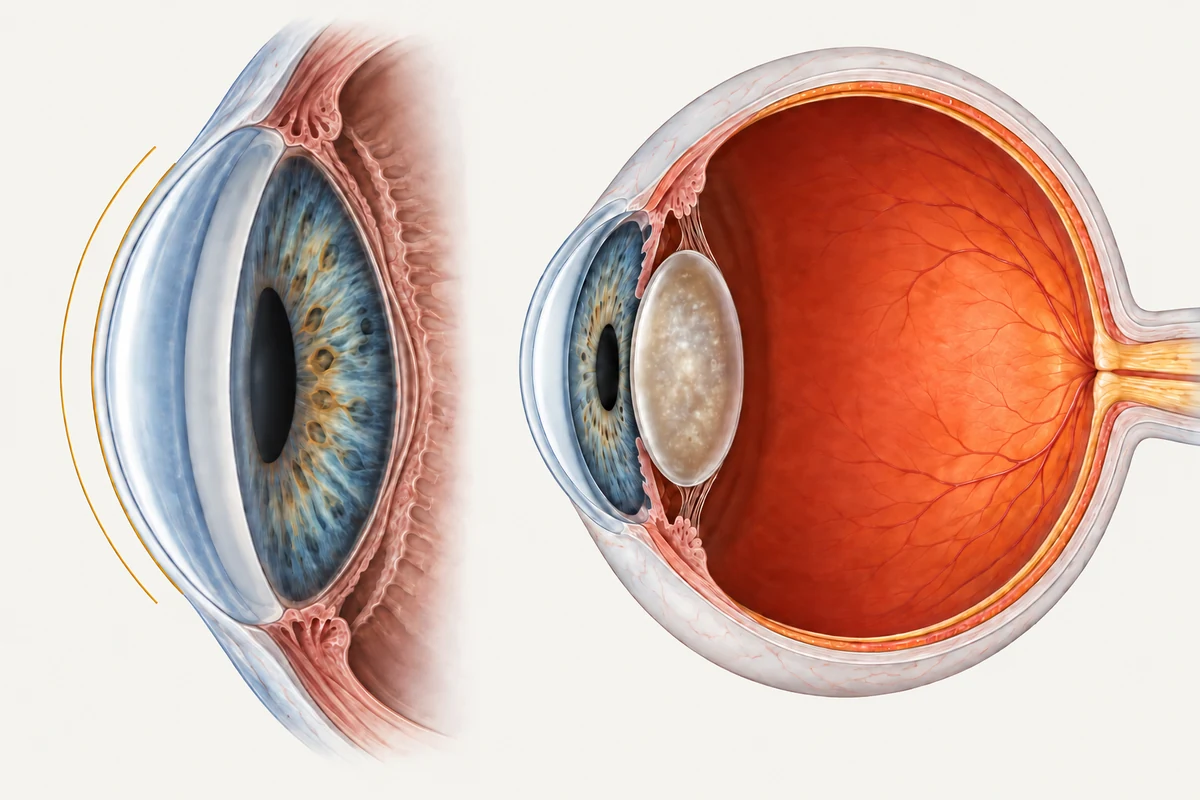
Laser vision correction reshapes the cornea, the clear window at the front of your eye. Cataract surgery replaces the cloudy natural lens inside your eye with an artificial lens, called an intraocular lens or IOL. These are different parts of the eye.
LASIK reshapes tissue beneath a thin corneal flap. PRK reshapes the corneal surface after its outer cell layer is removed. SMILE removes a small disc of tissue from within the cornea through a small opening. All three change the way the cornea focuses light; none replaces the natural lens or prevents an age-related cataract.

Blurred vision years after laser surgery does not automatically mean the laser treatment has worn off. Cataract, dry eye, a changed glasses prescription and other eye conditions can cause similar symptoms. An examination helps identify what is responsible before treatment is chosen.
Why is choosing the lens power more complicated?
A lens implant needs the right focusing power for your eye. Measurements include the length of the eye and the focusing power of the cornea.
Some standard calculations assume a relationship between the front and back surfaces of an untreated cornea. Previous laser surgery changes that relationship. Applying an ordinary calculation without allowing for the treatment can leave an unwanted glasses prescription after surgery.
Specialised calculations, sometimes combined with measurements of the back surface of the cornea, help address this. Your surgeon may compare more than one method when deciding on the implant power. The choice depends on the operation you had, the measurements available and your eye's shape. No single method guarantees an exact result in every eye.
The power of the implant and the type of implant are separate decisions. A lens offering a wider range of focus does not remove uncertainty from the power calculation.
Which old records are worth finding?
Bring whatever you can obtain. Particularly helpful records include:
- The name and date of each laser procedure, which eye was treated, and any later enhancement.
- Your glasses prescription and corneal measurements before the original treatment.
- The laser treatment report and any corneal maps.
- A stable glasses prescription measured after the laser treatment had healed.
- Details of monovision, if one eye was deliberately left better for near work.
Also describe how your vision worked before the cataract developed: whether you needed reading glasses, had difficulty driving at night, or noticed glare or ghost images.
Missing records do not automatically rule out cataract surgery. There are calculation methods that use current measurements without requiring the old measurements. If the original clinic has closed, tell your surgeon what you remember; your optometrist may also have useful correspondence or prescriptions. Do not guess missing numbers.
What extra checks might I need?
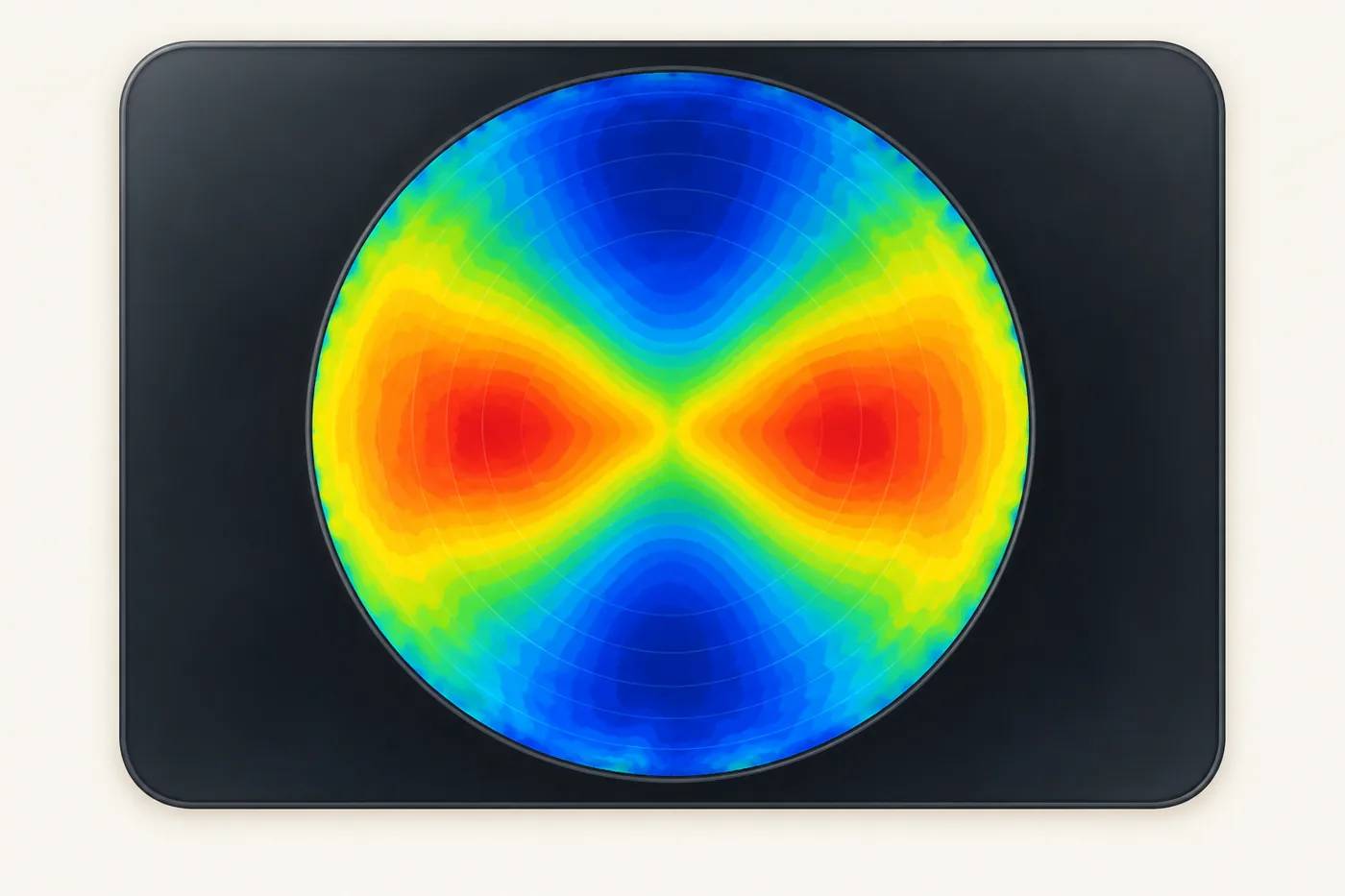
Corneal mapping helps show whether the treated surface is regular and stable. Topography maps its curvature; tomography can add information about its thickness and back surface. These tests can identify irregularity that affects both the measurements and the quality of vision a lens implant can provide.
Dry-eye assessment also matters. An unstable tear film can blur vision and make measurements less consistent. Treating the eye surface and repeating measurements may be more useful than rushing to choose a lens. Follow the clinic's instructions about contact lenses before testing, as these can also affect corneal shape.
The rest of the eye still needs assessment, including the retina. Additional scans depend on the findings and the lens being considered. Not every patient needs every available test.
Can I still choose a toric, extended-focus or multifocal lens?
Previous laser surgery does not automatically restrict everyone to the same implant. The important questions are how regular the cornea is, whether the rest of the eye is healthy, and which visual compromises you are willing to accept.
A monofocal lens aims for a chosen focus. If distance vision is the target in both eyes, reading glasses will usually be needed. You may also need glasses for a remaining distance prescription.
A toric lens can reduce suitable, regular corneal astigmatism. It does not smooth an irregular cornea or remove every source of ghosting. Repeatable measurements are especially important. Toric correction can be incorporated into different lens types.
Extended-depth-of-focus and multifocal lenses may be considered in selected eyes. They have different ranges of focus and trade-offs, including the possibility of halos, glare or reduced contrast. An irregular cornea or troublesome pre-existing night-vision symptoms can make these compromises more significant. A successful result in another person who had LASIK does not establish which lens will suit you.
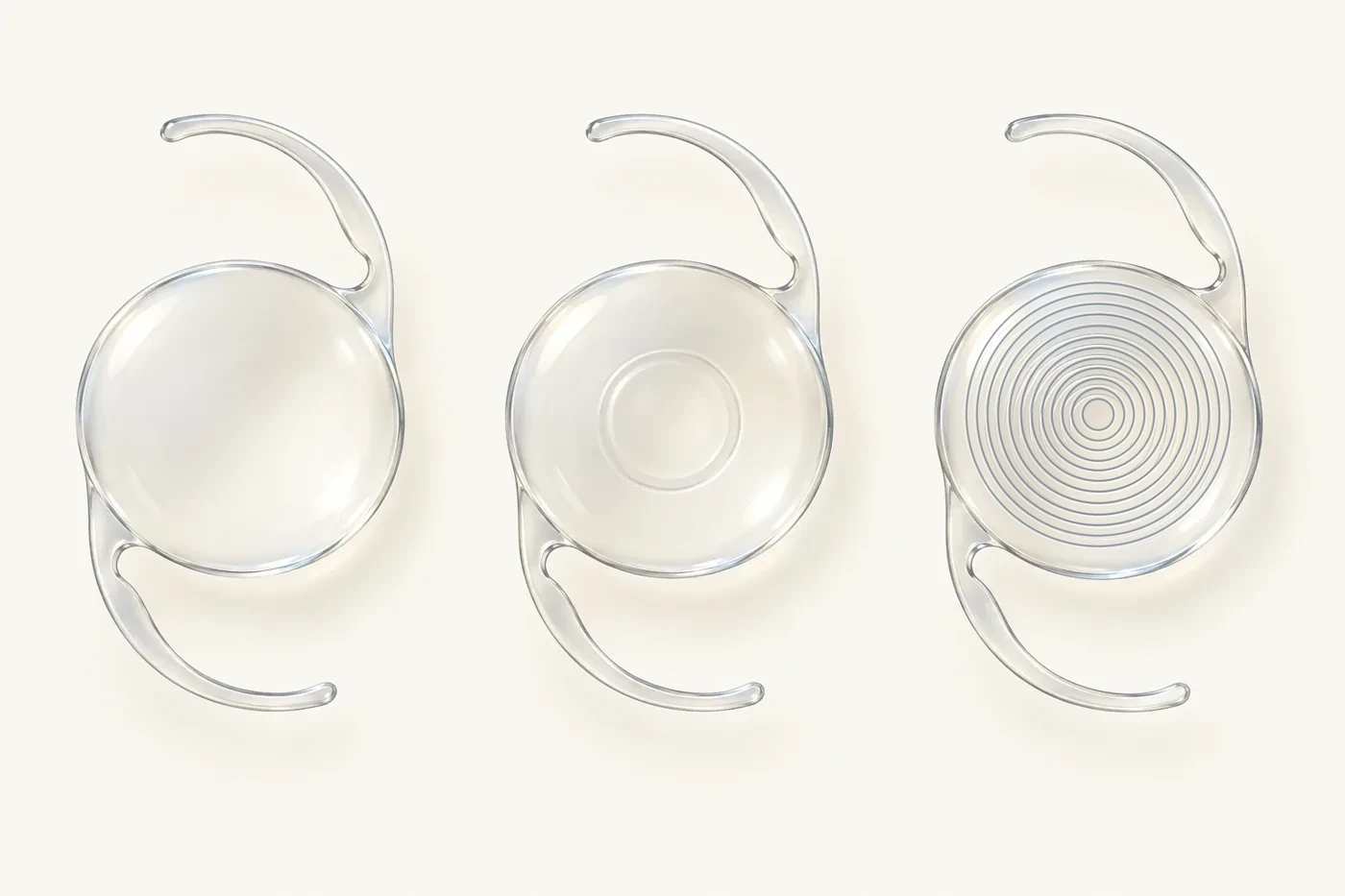
Laser treatment patterns have changed over time. Some older ablation patterns, particularly those with smaller treatment zones, can leave the cornea focusing light less evenly. These subtle optical distortions, called higher-order aberrations, may cause ghosting, glare or poorer contrast, especially at night. Multifocal lenses divide light between different viewing distances; extended-focus lenses widen the range of focus in different ways. If the cornea already gives a less crisp image, some of these lens designs may make the loss of contrast or visual disturbances more noticeable and may not be suitable. The date of your laser surgery alone cannot answer this: your current corneal measurements, symptoms and the particular implant design matter.
Discuss the activities that matter most: night driving, computer work, reading, sport, or detailed hobbies. The lens implant guide explains the main options. For a fuller comparison, read lens implants available in Australia.
What if I was happy with monovision?
Tell your surgeon. Monovision means using one eye mainly for distance and the other for nearer tasks. If you previously adapted well to it, a similar arrangement may be worth discussing for cataract surgery.
The target should be agreed for each eye. Do not assume that replacing the cloudy lenses will automatically reproduce your old balance of vision, or that both eyes should necessarily be set for distance. Glasses may still help for particular activities.

Is planning after SMILE different from planning after LASIK or PRK?
SMILE also changes the cornea, so the history must be included in cataract planning. However, a calculation studied after LASIK cannot simply be assumed to perform identically after SMILE.
Published research includes actual cataract operations after SMILE, but the clinical series remain small. Some larger studies compare calculated outcomes in models rather than results after cataract operations. These are useful for developing methods, but cannot promise how accurately an individual patient's surgery will reach its target.
The practical message is the same: use appropriate measurements and calculations, and discuss the possibility of a remaining glasses prescription.
Will I need glasses or more treatment afterwards?
You may. Removing a cataract can improve vision affected by the cloudy lens, but cannot guarantee freedom from glasses or correct every problem in the cornea or retina.
If the final focus differs from the agreed target, the first step is to identify the reason after appropriate healing. Glasses may provide a straightforward solution. Further treatment is sometimes possible, but another laser procedure is not automatic: suitability depends on factors such as corneal thickness, regularity, stability and the eye surface. Ask before surgery how an unexpected prescription would be assessed and managed.

If you also have a long or highly short-sighted eye, cataract surgery with myopia explains those separate planning issues.
The usual risks of cataract surgery still apply, including infection, swelling and retinal complications, with a possibility of lasting loss of vision. Your individual risk depends on the whole eye, not just the previous laser treatment. The cataract surgery guide covers the operation, recovery and risks.
What should I ask at my consultation?
- Is the cataract the main cause of my symptoms, or is the cornea also contributing?
- Are the measurements consistent, or should the eye surface be treated first?
- How will my previous laser procedure be allowed for in the lens calculation?
- What focus are we aiming for in each eye, and when am I likely to need glasses?
- Which lens trade-offs matter most for my cornea and daily activities?
- What would happen if the final glasses prescription differs from the target?
Bring your available records and a short description of what you want to do more comfortably. That gives the consultation a useful starting point, even when the original laser surgery was many years ago.
Where can I read more about care at Chatswood?
These pages give more background on the clinic, Dr Chen and how lens measurements are planned. The Chatswood history describes the practice as a whole; your own assessment and surgeon depend on the care you need.
Sources and further reading
- ESCRS recommendations for cataract surgery: assessment, previous refractive surgery and lens selection.
- FDA: What is LASIK? and SMILE patient booklet: background anatomy and procedures; US documents, not Australian eligibility guidance.
- Ferguson and colleagues, 2022: lens calculations after myopic and hyperopic LASIK or PRK.
- Gettinger and colleagues, 2024: calculations after myopic LASIK.
- Starr and colleagues, 2019: assessing and treating the eye surface before surgery.
- Cao and colleagues, 2020: toric lenses in selected eyes after LASIK or PRK.
- Fisher and Potvin, 2018: selected post-LASIK eyes with multifocal or monofocal lenses.
- Lischke and colleagues, 2024: a small clinical series after SMILE.
- Li and colleagues, 2023 and de Rojas Silva and colleagues, 2025: modelling studies after SMILE.
- Cione and colleagues, 2023: no-history lens calculations after laser refractive surgery.
- National Eye Institute: cataract surgery: benefits, limits and risks.
- Moshirfar and colleagues, 2021: review of options for residual refractive error.
- Lee and colleagues, 2005 and Mok and Lee, 2005: how conventional laser ablation patterns and treatment-zone size can affect optical aberrations.

How do I make an appointment with Dr Chen?
Appointments and enquiries through Vision Eye Institute, Chatswood.
Clinic appointments: (02) 9424 9999