Which lens implants are available in Australia?
Australia has a wide range of intraocular lenses (IOLs), including monofocal, enhanced monofocal, extended-depth-of-focus and multifocal lenses. Many have


toric versions to correct astigmatism. They differ in how much useful vision they aim to provide without glasses and in the visual effects they can produce. There is no single lens that gives every patient the best result.
This guide explains the main choices and Australian-listed lens families. A lens appearing on an Australian register or reimbursement list does not mean every hospital stocks it. The exact model, power and suitability need to be confirmed with your surgeon. Availability information was checked on 20 September 2026 against the.
What does a lens implant actually do?
An IOL replaces the focusing role of the natural lens removed during cataract surgery. It has a central optical part and supporting arms, called haptics, that help hold it in position. In routine surgery it is placed inside the remaining lens capsule, behind the iris. Most of the choices discussed here provide their range through a fixed optical design; they do not recreate a young natural lens's ability to change shape and focus.
The natural lens is removed and an artificial lens takes its place. This is a simplified illustration of routine cataract surgery; the operation and lens support can differ in complex eyes.
Lens choice is one part of the decision to have surgery. If a cataract is not interfering meaningfully with daily life, updated glasses and monitoring may be reasonable. Replacing a clear natural lens to reduce glasses dependence is refractive lens exchange, which requires a separate discussion of benefits and risks. See the for the basic operation and alternatives.
Which everyday distances matter to you?
Think about the activities you want to do without glasses before comparing lens names. Looking down a street is different from using a desktop monitor; both are different from reading small print. A lens that works well for a computer may still leave you reaching for reading glasses.
Distance: scenery and faces across a room. Intermediate: a computer or kitchen bench. Near: a book, phone or fine handwork. These are examples of tasks, not simulated outcomes for a particular lens.
Your own working distances matter. Bring a description of your reading habits, computer setup, hobbies and night driving to the consultation. Also think about which would trouble you more: wearing glasses for some tasks or noticing rings, glare or starbursts around lights.
How do the main lens types compare?
These are broad starting points, assuming both eyes are aimed mainly at distance. Individual designs and a different target in one eye can change the result.
Monofocal: one main focus
Main aim: clear vision at a chosen distance. When both eyes are set for distance, glasses are generally needed for reading and often for computer work. A near target is also possible, with distance glasses then expected.
Reason to consider it: a relatively straightforward optical design when you are comfortable using glasses or when other eye conditions make visual quality a priority over a wider unaided range.
Main compromise: a limited range without glasses. Monofocal does not mean that glare or other optical symptoms are impossible.
Australian-listed examples: Clareon monofocal, AcrySof IQ monofocal, Tecnis monofocal, Vivinex, enVista and RayOne monofocal, among others. The brand name alone is insufficient because several manufacturers use related names across different lens categories. More about monofocal lenses.
Enhanced monofocal: a little more intermediate range
Main aim: distance vision with some extra range towards dashboard or computer distance. Reading glasses are still likely for small print.
Reason to consider it: an intermediate-vision gain may be useful without choosing a conventional multifocal design. The amount of gain varies between lenses and between patients.
Main compromise: “enhanced” does not mean the same thing across products. Better performance on an intermediate eye chart may not produce a large change in everyday glasses use. An found an intermediate-vision benefit but no significant difference in the change in its quality-of-life questionnaire compared with two monofocal lenses.
Australian-listed examples: Tecnis Eyhance, Isopure Serenity, RayOne EMV and enVista Aspire. Eyhance uses a modified central power profile, while RayOne EMV uses a different optical approach involving spherical aberration. These are separate designs, not interchangeable versions of one lens.
Extended depth of focus: distance and computer emphasis
Main aim: a broader useful range, particularly from distance to intermediate. Some near vision may be possible, but glasses often remain helpful for fine print or reading in dim light.
Reason to consider it: reducing glasses use for a computer and everyday activities is more important than avoiding reading glasses altogether.
Main compromise: contrast, glare and halos still need discussion. Extended depth of focus (EDOF) describes a goal, not a single optical mechanism. A non-diffractive lens is not necessarily free of visual side effects.
Australian-listed examples: Vivity, Tecnis PureSee, LuxSmart, Symfony, AT LARA and ELON. Vivity shapes the wavefront of light; PureSee uses a refractive design. Symfony and AT LARA use diffractive optics. Differences within the category are important when interpreting a study or a manufacturer's description. More about EDOF lenses.
Multifocal, trifocal and full-range: more emphasis on near vision
Main aim: useful distance, intermediate and near vision with less dependence on glasses. A trifocal creates three principal focal ranges; other broad-range designs distribute light differently.
Reason to consider it: reading and close work without glasses are important, and the rest of the eye is suitable for the intended design.
Main compromise: halos, glare, starbursts and reduced contrast can be noticeable, especially around lights at night. Some people tolerate these effects well; others find them intrusive. No lens guarantees complete freedom from glasses, and symptoms should not simply be dismissed as something everyone will adapt to.
Australian-listed examples: PanOptix and PanOptix Pro, Tecnis Odyssey and Synergy, Vivinex Gemetric, enVista Envy, FineVision, AT LISA tri and Liberty. RayOne Galaxy, LuxLife and Precizon Presbyopic NVA illustrate other approaches to broad-range vision. “Full range” does not always mean diffractive rings. More about multifocal lenses.
The named examples above are a selection from the, not a ranking or confirmation of stock at a particular hospital.
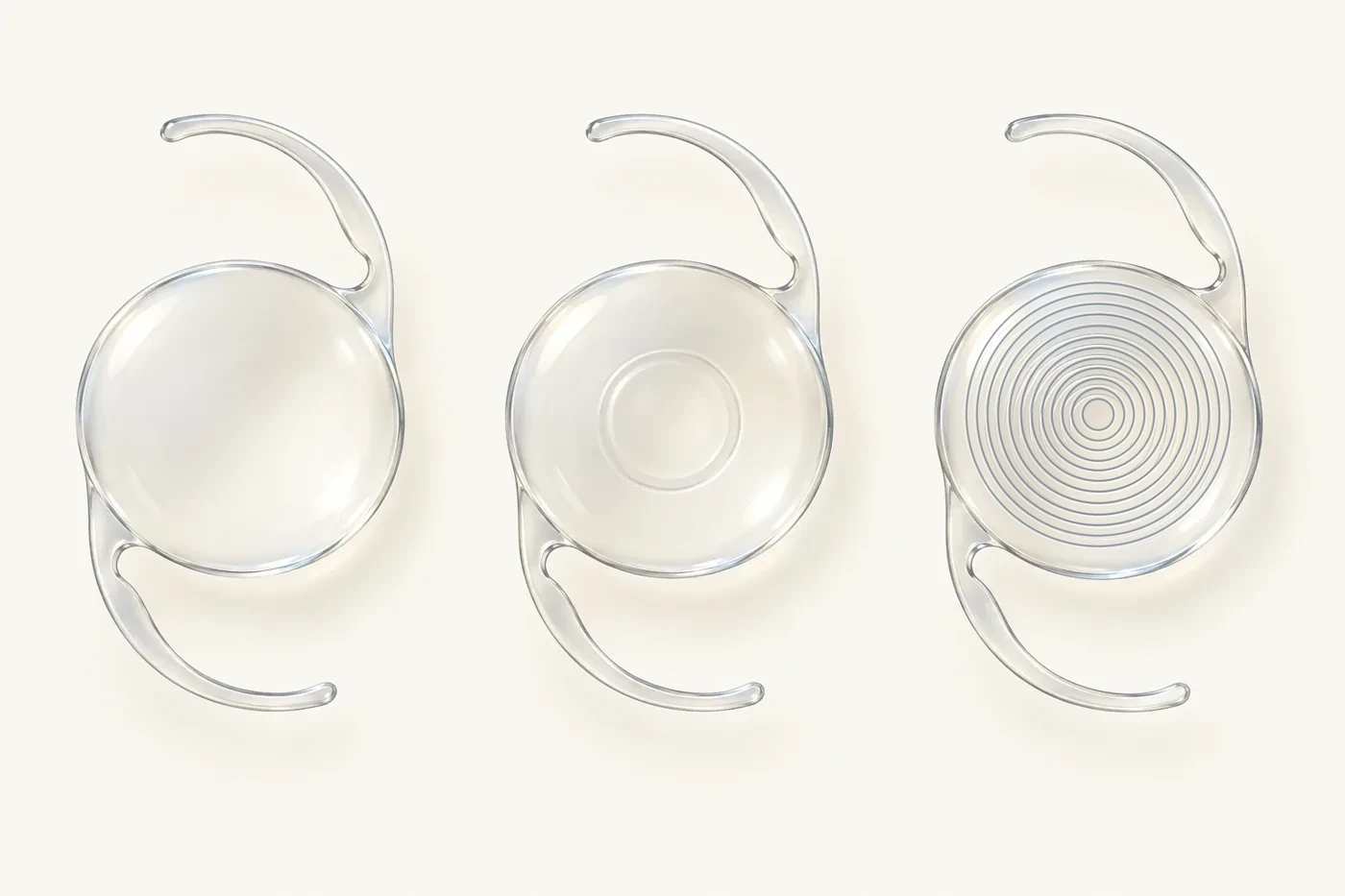
Lens implants can look similar while handling light differently. These are schematic designs, not exact branded products. The central feature shown on the middle lens does not represent every EDOF lens, and some broader-range designs have no diffractive rings.
Is a toric lens an alternative to a multifocal lens?
A toric lens corrects suitable astigmatism: a difference in focusing power between directions in the eye. It is an additional feature, so a lens can be both toric and monofocal, EDOF or multifocal.
Measurements determine whether toric correction is appropriate and how much is needed. The lens must be aligned correctly, and some astigmatism can remain. Ask for the exact proposed model and whether it is the toric version; two lenses with almost identical names may have different specifications. The explains this distinction alongside the main lens categories.
Can the two eyes be set differently?
Yes. In monovision, one eye is aimed more towards distance and the other towards closer work. Mini-monovision uses a smaller difference. This can reduce glasses use, but the balance between the eyes and depth perception also need consideration. It is a targeting strategy, not a separate brand of lens.
This matters when reading research. A study using mini-monovision cannot simply be compared with one aiming both eyes at distance. In a, Isopure, Eyhance and AcrySof Vivity were all used with a small near target in the non-dominant eye. Vivity provided better average near acuity at six months; distance and intermediate differences were not statistically significant. That result concerns those lenses and that targeting strategy.
What do head-to-head studies tell us?
They can help narrow a choice, but a single “best lens” league table would be misleading. Studies may measure different reading distances, use different lighting, include different types of patients or ask different questions about glasses and visual symptoms.
For example, an found a modest average intermediate and near advantage for PureSee, with similar measured distance vision and contrast. This does not mean every patient will notice the same benefit or read comfortably without glasses.
A found broadly comparable measured vision across the tested distances, with less reported glare and starbursts in the PanOptix group. It does not establish that PanOptix Pro is superior to Odyssey: those are different comparisons.
A newer material, a new optical design and a new injector are also different kinds of change. Evidence for the original AcrySof Vivity should not silently be relabelled as a study of Clareon Vivity. Laboratory measurements can explain how a lens behaves, but they do not establish how often patients will need reading glasses or feel comfortable driving at night.
What does “available in Australia” mean?
There are several separate questions. The Australian Register of Therapeutic Goods records regulatory inclusion. The Prescribed List deals with private health insurance benefits for eligible devices. Commercial supply concerns whether the supplier is offering the product here. Your operation also depends on whether your surgeon and hospital can obtain the required model and power.
This distinction is particularly useful for newer products. The has an Australian register entry dated 19 December 2025. That alone does not show which Australian centres can provide treatment. It should not be described as routinely accessible everywhere on the basis of the register entry.
An overseas launch or approval also does not establish Australian access. Check the exact model rather than assuming an internationally advertised lens, a new material generation or a toric version is available locally.
Are there other specialist lens options?
Some lenses address a different problem from routine cataract lens selection. Small-aperture designs such as IC-8 Apthera use an aperture to extend the range of focus and require particular patient selection. Light-adjustable lenses allow postoperative power adjustment using a dedicated treatment system; they involve additional treatment requirements rather than a return of natural accommodation.
A phakic implant, such as an implantable collamer lens, sits in an eye that still has its natural lens. It is a different refractive procedure from replacing a cataract. Supplementary lenses and lenses requiring special fixation have roles in selected eyes, including eyes without adequate support for a routine implant. These choices need their own assessment rather than being treated as another step up a standard lens menu.
How does the health of the rest of the eye change the choice?
An implant can improve focusing, but it cannot remove an epiretinal membrane, repair macular damage or reverse glaucoma. Dry eye, corneal irregularity, previous laser eye surgery, retinal disease and previous operations can affect measurements, visual quality or the accuracy of the predicted result.
The important question is how the proposed lens will work in your eye. A wider unaided range may be less valuable if contrast is already limited. Conversely, an eye condition does not automatically determine one lens for every patient. The assessment should explain which findings change the recommendation and why. For more on surgery in eyes needing additional planning, see complex cataract and lens surgery.
All lens choices still involve the risks of the operation itself. These include infection, inflammation or swelling, retinal complications, capsule problems and an outcome different from the intended focus. Read about cataract surgery and its risks as well as the lens's optical trade-offs.
What should I ask before deciding?
- What is the exact lens model, and is it toric?
- Which activities are likely to need glasses afterwards?
- What does the evidence say about this generation of the lens?
- How might my cornea, retina or previous surgery affect the result?
- What target is planned for each eye, and why?
- What visual effects might I notice, particularly when driving at night?
- What are the alternatives if I prefer a simpler optical design?
The most useful recommendation connects your eye findings with your priorities. A clear explanation of the expected compromises matters more than how new a lens is or how many technical features appear in its brochure.
References and further reading
- VEI patient guide
- Eyhance randomised trial
- July 2026 Prescribed List
- randomised study of 105 patients
- Australia–New Zealand trial of PureSee and Eyhance
- 276-patient trial of PanOptix and Synergy
- RxSight Light Adjustable Lens and Light Delivery Device System
These are the published sources behind this article. They are written for clinicians and do not replace advice about your own eye.
How do I make an appointment with Dr Chen?
Appointments and enquiries through Vision Eye Institute, Chatswood.
Clinic appointments: (02) 9424 9999