
Recovery after vitrectomy for floaters: a week-by-week guide
After vitrectomy for floaters, you may feel ready for simple everyday activities before your vision has fully settled. Plan a quiet start, use your prescribed drops and build up gradually. The important questions are what was done during your operation and how your eye is healing at review.

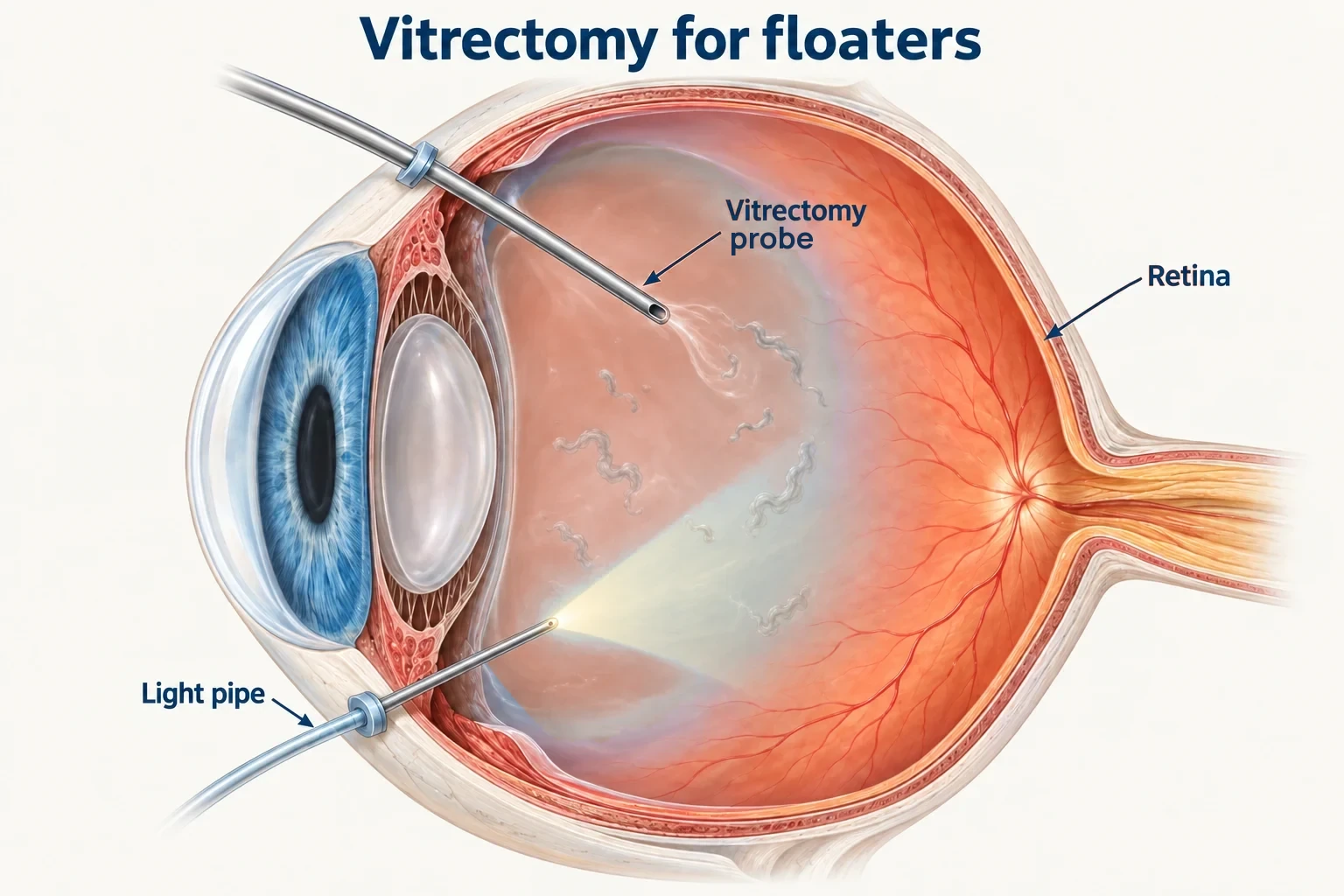
This guide helps you plan life at home. Your own discharge instructions take priority, particularly if surgery also involved a retinal repair or cataract removal.
Sudden loss of vision, severe or increasing pain, or a new curtain or shadow needs urgent assessment. Do not wait for your next appointment. Contact details and other warning signs are at the end of this guide.
What makes floater surgery recovery different?
Vitrectomy removes the vitreous gel containing the troublesome floaters. The space is filled with fluid, and the eye continues to make fluid afterwards; the original gel does not grow back.
An air or gas bubble is not usually needed for routine floater surgery. Most people go home with the space filled by the eye's own fluid, and with none of the bubble restrictions that follow some other retinal operations.
An operation for floaters is also different from repairing a detached retina or closing a macular hole. Advice from someone who had a different retinal operation may not fit your recovery.
What should I expect week by week?
Use this timeline to make plans, rather than as a deadline your eye has to meet.
The day of surgery: arrange help and get home safely
Arrange for someone to take you home. You cannot drive yourself after the operation. Follow the hospital's instructions about having an adult with you after anaesthesia or sedation.
Before leaving, make sure you have your drops, written instructions, follow-up details and a number to call if something worries you. Leave the dressing or shield in place for the time you have been told. Keep the rest of the day simple.
Days 1–3: expect some blur and mild discomfort
Your eye may look red, water or feel gritty. Vision can be blurred, and a bubble, if present, can make it much harder to see through the operated eye. Mild discomfort should become more manageable rather than progressively worse.
Use only the pain relief recommended by your treating team. Severe pain, a marked deterioration in vision or increasing redness needs advice promptly; these are not symptoms to push through.
Have help available for tasks that are awkward with blurred vision, such as preparing meals or managing several bottles of drops. Take extra care on stairs and in unfamiliar places.
The rest of the first week: return to light activities
Gentle walks, short periods of reading and some television or screen use are usually reasonable as comfort allows. Take breaks if your eye feels tired. You do not need to spend the whole week in bed unless your team has given you a specific reason to rest or position yourself.
Use the eye shield for four to seven days as instructed, usually while sleeping. Avoid rubbing or pressing on the eye. Keep your follow-up appointment even if you feel well: some problems, including changes in eye pressure, need an examination to detect.
Week 2: increase activity, with limits
Return to work can range from two days to two weeks, depending on your vision, the operation and what your job involves. A person doing flexible desk work may manage sooner than someone who drives for work, lifts equipment or works in dust. This range is a planning guide, not automatic clearance.
Avoid heavy lifting for the first two weeks. More strenuous activity may need to wait longer if a bubble, retinal treatment or a problem during recovery changes your instructions.
Weeks 3–6 and beyond: allow vision to settle
Comfort, redness and vision may continue to change over the following weeks. Being back at work does not necessarily mean the eye has completely healed. Additional surgery or another eye condition can extend recovery.
Do not rush to buy new glasses while vision is changing. Wait at least four weeks, and ask at review whether your vision is stable enough for a prescription. You may need to wait longer, particularly if cataract surgery was performed as well.
There is no single week when everyone should expect their final result. If progress stalls or something changes, contact the treating team rather than assuming you simply need more time.

How can I make eye drops easier to manage?
Follow your own drop chart: the bottles, frequency and length of treatment can differ between patients. Do not change or stop drops simply because the eye looks better.
A few practical habits help:
- Put the written schedule somewhere easy to see and set phone reminders.
- Wash your hands before using drops, and keep the bottle tip away from your eye, eyelashes and fingers.
- Ask someone to help if you cannot get drops in reliably.
- Bring your bottles and schedule to review if the instructions are unclear.
Ask the team how to continue any drops you were already using. If you miss a dose or confuse bottles, check the instructions or contact the clinic or pharmacist rather than guessing.
Can I shower, wash my hair and sleep normally?
You can generally shower and wash your hair with care, keeping soap, shampoo and direct jets of water away from the operated eye. Avoid rubbing it afterwards. Follow any different instructions on your discharge sheet.
If you have not been prescribed a head position, you do not automatically need to sleep face down after floater surgery. Avoid pressure on the operated eye and use the shield as directed.
If positioning has been prescribed, ask the team to explain how it applies to sitting, sleeping, meals and breaks. Do not choose a position from someone else's experience or a generic online guide. Let the team know if neck, back or breathing problems make the instructions difficult.
Will reading or using a screen slow recovery?
Reading, television and screen use are generally allowed as comfortable. You do not need to avoid them solely because you have had vitrectomy, but blur and irritation may limit how long you want to concentrate.
Try short sessions, comfortable lighting and larger text. A little laptop time at home is different from a full working day: plan a gradual return if your job requires sustained close work. Stop and seek advice if using the eye is associated with significant pain or a new change in vision.
When can I exercise, swim or do housework?
Start with gentle walking and light tasks. Arrange help with shopping bags, bins, gardening and other jobs involving lifting or straining during the first two weeks.
Ask before restarting gym weights, vigorous exercise, swimming or contact sports. There is no single safe date for every activity and every operation. Swimming, dusty work and gardening also expose the eye to contamination, so wait for your team's clearance.
You do not need to invent a strict weight limit or avoid every ordinary bend. Ask for specific advice if your work or caring responsibilities involve regular lifting, and follow any restrictions given for your particular surgery.

When can I drive again?
Do not drive home after surgery. Resume driving only when your treating clinician is satisfied that your recovery and vision make it safe, taking account of Australian licensing requirements.
Blur, double vision or difficulty judging distance can make driving unsafe even when your other eye sees well. Do not use a short test drive to decide whether you are ready. Commercial drivers may need a different assessment from private drivers.
Arrange transport for review appointments until you have been advised that you can drive.
Can I fly or travel to the mountains?
Generally yes. An air or gas bubble is not usually needed for routine floater surgery, so the altitude restrictions that follow some other retinal operations usually do not apply to you. Confirm the timing with the team, because you still need to attend your reviews and to be able to get urgent eye care if symptoms change.
In rare circumstances a bubble is used. If there is any air or gas in your eye, do not fly and do not travel to high altitude until the bubble has completely gone and your surgeon confirms it is safe. Reduced air pressure can expand the bubble and dangerously raise the pressure inside the eye, and a small remaining bubble still matters. Do not rely on a predicted absorption date, or on no longer noticing the bubble; check before booking or travelling, including road trips into the mountains.
Nitrous oxide must also be avoided while any bubble remains. This gas is used in some anaesthetics and pain-relief mixtures. Tell ambulance staff, emergency clinicians, dentists and anaesthetists that you have an eye bubble before treatment, and carry any alert card provided by the hospital.

What if I still notice a few spots?
Some people notice residual or later floaters despite improvement in their original symptoms. Vitrectomy does not guarantee permanently spotless vision. Mention persistent spots or dissatisfaction at review so that the eye can be examined and the likely cause discussed.
A sudden shower of new floaters, flashes, a curtain or worsening vision is different. Do not assume this is the bubble or normal healing; seek urgent assessment.
Could a cataract affect my vision later?
If you still have your natural lens, vitrectomy can speed up cataract development. This may cause increasing blur or glare later, even after a good initial recovery. The timing varies, and cataract surgery may eventually be needed.
This particular risk does not apply to an artificial lens already implanted during cataract surgery. Other causes of changing vision still need assessment.
Read more about cataract surgery after vitrectomy.
When should I seek urgent help?
Vitrectomy has risks, including retinal tears or detachment, infection, bleeding, pressure problems and swelling affecting central vision. Some complications can cause permanent sight loss. Contact the treating team urgently for:
- Sudden or worsening loss of vision.
- Severe or increasing eye pain.
- New flashes, a sudden increase in floaters, or a curtain or shadow.
- Increasing redness or yellow/green discharge.
- Nausea or vomiting with eye pain or a severe headache.
Do not wait for a scheduled review or send a routine online enquiry about these symptoms.
Call the clinic on(tel:+61294249999), Monday–Friday, 8 am–5.30 pm. If the clinic is closed, you cannot reach the team or you cannot be assessed promptly, attend the nearest emergency department. The, 8 Macquarie Street, Sydney, is open 24 hours a day.
What should I confirm before I go home?
Keep these five answers with your discharge instructions:
- Was anything else done during my operation, such as a retinal repair, and do I need a particular head position?
- Which drops do I use, and for how long?
- When is my next review, and who do I call urgently?
- What restrictions apply to my work, exercise, driving and travel?
- How long should I wear the shield, and when should I discuss new glasses?
For more background, see vitrectomy surgery and floaters and their treatment options.
Sources and further reading
- American Society of Retina Specialists: vitrectomy for floaters .
- Leeds Teaching Hospitals: postoperative advice .
- Royal Free London: vitrectomy surgery and recovery .
- Gloucestershire Hospitals: vitrectomy patient information .
- Royal College of Ophthalmologists: intraocular gas and nitrous oxide safety alert .
- Austroads: vision standards for driving .
- Dysager and colleagues: systematic review of vitrectomy for symptomatic floaters, 2022 .
- Boneva and colleagues: observation and limited vitrectomy for floaters, 2025 .
- Duke and colleagues: long-term outcomes after floater vitrectomy, 2025 .