Which lens implant suits an eye with macular degeneration?
Cataract surgery when the macula is affected
For most people with age-related macular degeneration (AMD), my preference is a monofocal lens, with astigmatism correction where appropriate. I generally place more weight on preserving quality of vision than on reducing the need for glasses. The decision should take account of how your macula functions today and how it might change in the years ahead.

Multifocal and extended depth-of-focus (EDOF) lenses can reduce dependence on glasses, but their optical compromises deserve particular attention when the retina is affected by disease. There are exceptions: some people with mild AMD may reasonably consider a carefully selected EDOF lens after discussing the uncertainties. These lenses are not all the same.
Why does AMD matter when choosing a cataract lens?
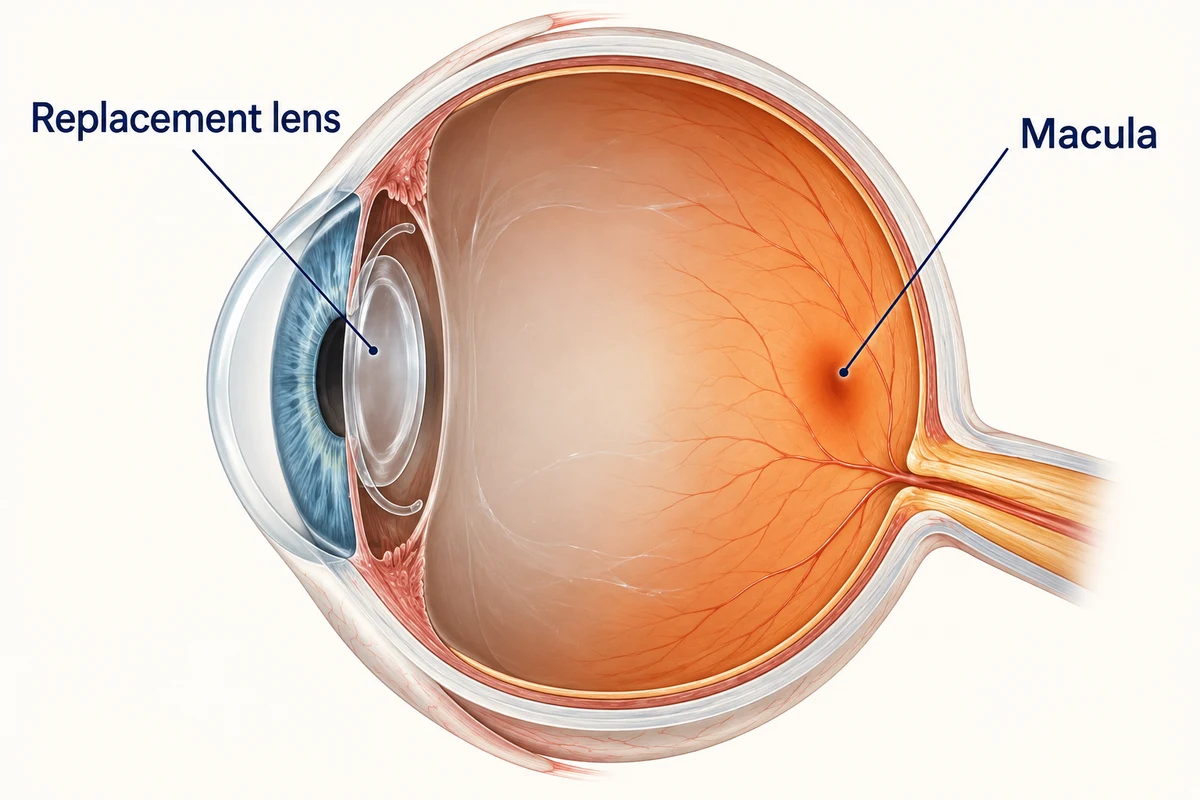
Cataract and AMD affect different parts of the eye. A cataract clouds the natural lens near the front. AMD affects the macula, the small area of retina at the back that provides detailed central vision. Cataract surgery replaces the cloudy lens with an artificial intraocular lens, or IOL. It does not repair damage to the macula. Read more about AMD.
The replacement lens and the macula have different jobs. Both contribute to the vision you experience after cataract surgery. This illustration is simplified.
One important part of that vision is contrast sensitivity: the ability to separate an object from its background. Reading pale print, recognising a face in shadow or seeing detail in dim light asks more of the visual system than reading black letters on a brightly lit chart.
AMD can reduce contrast sensitivity and make low-light tasks more difficult, although the effect varies with the person and the stage of disease. Some people with early AMD retain good contrast on testing. A good result on the ordinary letter chart does not, by itself, describe every aspect of everyday vision.
What do multifocal and EDOF lenses offer?
Their main benefit is a wider useful range of focus, allowing some activities without glasses. A multifocal lens creates more than one focus, including near vision. An EDOF lens extends the range of focus, usually placing more emphasis on distance and intermediate tasks, such as using a computer. Reading glasses may still be needed, especially for small print.
This is different from reducing spherical aberration, an optical imperfection that can affect image sharpness. Aspheric monofocal lenses can also address spherical aberration. A lens does not need to be multifocal or EDOF to have that feature.
The wider focus range can come with trade-offs. Multifocal lenses may reduce contrast and produce haloes or glare. Some EDOF designs also reduce contrast compared with a monofocal lens, particularly in dim conditions. However, EDOF is a broad category: different designs do not have identical effects.
Someone with a healthy retina may tolerate an optical compromise without finding it troublesome. My concern in AMD is that there may be less capacity to tolerate an additional loss of contrast, particularly if the macula deteriorates later. Being less dependent on glasses and having the clearest possible image are related goals, but they are not interchangeable.
Why think beyond the first few months after surgery?
An IOL is intended to remain in the eye for many years. AMD is a potentially progressive condition, but its course is variable: some eyes remain stable for a long time, while others develop more substantial visual loss. Contrast does not necessarily decline steadily in every person with early disease.
My concern is that an optical compromise that seems acceptable now may become more noticeable if retinal function declines. That is why I discuss future visual quality, as well as the immediate convenience of using fewer glasses. This concern is a reason for caution; it is not proof that every person with AMD will do poorly with an EDOF or multifocal lens.
In my clinical experience, I have seen patients who managed without glasses after multifocal or EDOF lens surgery return to needing them five to ten years later as AMD affected their vision. Small print and reading in poorer light are often where the difficulty becomes apparent. This is an observation from practice, not a measured rate or a prediction of what will happen to an individual patient.
There is no fixed five-to-ten-year expiry for these lenses. Nor does needing glasses later establish that the implant has failed. AMD progression, a changed glasses prescription and other eye conditions can all affect vision.
Glasses may improve focus or help with reading, but they cannot reverse macular damage or fully restore contrast lost to AMD. Better lighting, larger text, magnification and low-vision support may also help.
What are the alternatives?
A monofocal lens provides one main focus. The chosen focus can be planned for your needs; when it is set for distance, reading glasses are usually required. My usual preference in AMD is to accept that need for glasses in exchange for avoiding the additional optical compromises of a multifocal design. A monofocal lens cannot prevent AMD progression or guarantee clear vision.
A toric monofocal lens also corrects suitable corneal astigmatism. “Toric” describes astigmatism correction, not multiple focus points. It can therefore be an option for someone with AMD who would otherwise benefit from a monofocal lens.
An enhanced monofocal lens may provide a little more intermediate vision than a conventional monofocal. A study in early and intermediate dry AMD found an intermediate-vision advantage, but it was retrospective and assessed outcomes only one month after surgery. It does not establish what happens as AMD progresses, and these lenses should not be presented as a promise of freedom from glasses.
For the broader choices, see intraocular lenses.
Could an EDOF lens still be reasonable for me?
Possibly, particularly with mild disease and carefully considered expectations. Recent studies of a non-diffractive EDOF design have reported encouraging results in selected patients with AMD. However, the studies are small or observational, and they do not resolve the long-term comparison with monofocal lenses.
For example, a 2025 study followed 22 patients with mild AMD for six months, without a monofocal comparison group or contrast-sensitivity testing. A 2026 pilot followed 20 patients with a mixture of early macular conditions for three months. Its findings cannot be treated as results from 40 AMD eyes: only 14 eyes had AMD. These studies support further consideration, not a guarantee of lasting spectacle independence.
A patient may place a high value on using fewer glasses now and accept the possibility of less satisfactory vision later. Serious other illness or limited life expectancy may also influence how someone weighs those priorities. I would still assess whether the lens is suitable today: a shorter time horizon does not remove immediate contrast, glare or reading difficulties.
For most patients with AMD, these considerations leave me favouring a monofocal approach. For a selected patient, the balance may be different. The decision should be about the exact lens and the individual eye, not simply the label “premium”. More detail is available in the EDOF lens guide and multifocal lens guide.
What should we assess before deciding?
The assessment needs to establish how much of the visual difficulty comes from the cataract and how much comes from the macula. A retinal examination and an OCT scan help assess the macular changes. Lens measurements, astigmatism, the health of the other eye and your everyday activities also matter.
Useful questions to bring to the consultation are:
- What stage of AMD do I have, and what limits my vision now?
- What improvement is realistic from removing the cataract?
- Why does this particular lens suit my macula and my reading needs?
- What glasses am I likely to need, in bright and dim conditions?
- How might the balance change if my AMD progresses?
Cataract surgery may still be worthwhile when AMD is present, but the likely benefit and the usual surgical risks need to be discussed together. When the cataract is not causing enough difficulty to justify surgery, monitoring and updating glasses may be appropriate. See cataract surgery for the procedure, recovery and risks.
What if I already have a multifocal or EDOF lens?
A diagnosis of AMD does not mean your existing lens must be removed. It also does not establish that the lens caused the AMD. If you are comfortable with your vision, continue the monitoring recommended for your retinal condition.
If your vision changes, have the cause assessed rather than assuming you simply need stronger glasses. The macula, glasses prescription, ocular surface and capsule behind the implant may all need checking. Further treatment depends on what is found; exchanging an IOL cannot repair AMD.
New distortion, a new blurred or dark central patch, or a sudden change in vision needs prompt eye assessment. Contact your treating eye-care team; seek urgent eye care if they are unavailable. Do not wait for a routine lens-choice appointment.
References and further reading
- Owsley and colleagues. Contrast sensitivity across AMD stages and visual-function changes over three years . IOVS and TVST, 2026.
- Mehta. Management of cataract in patients with AMD . Journal of Clinical Medicine, 2021.
- Grzybowski and colleagues. Multifocal intraocular lenses and retinal diseases . Graefe’s Archive for Clinical and Experimental Ophthalmology, 2020.
- Thananjeyan and colleagues. EDOF implantation in AMD: pilot study . Clinical Ophthalmology, 2024.
- Elvira and colleagues. Non-diffractive EDOF outcomes in AMD . Frontiers in Medicine, 2025.
- Demircan and colleagues. Non-diffractive EDOF with micro-monovision in early macular pathology . Clinical Ophthalmology, 2026.
- Venter and colleagues. Enhanced and conventional monofocal lenses in dry AMD . Clinical Ophthalmology, 2025.
These are the published sources behind this article. They are written for clinicians and do not replace advice about your own eye.
How do I make an appointment with Dr Chen?
Appointments and enquiries through Vision Eye Institute, Chatswood.
Clinic appointments: (02) 9424 9999